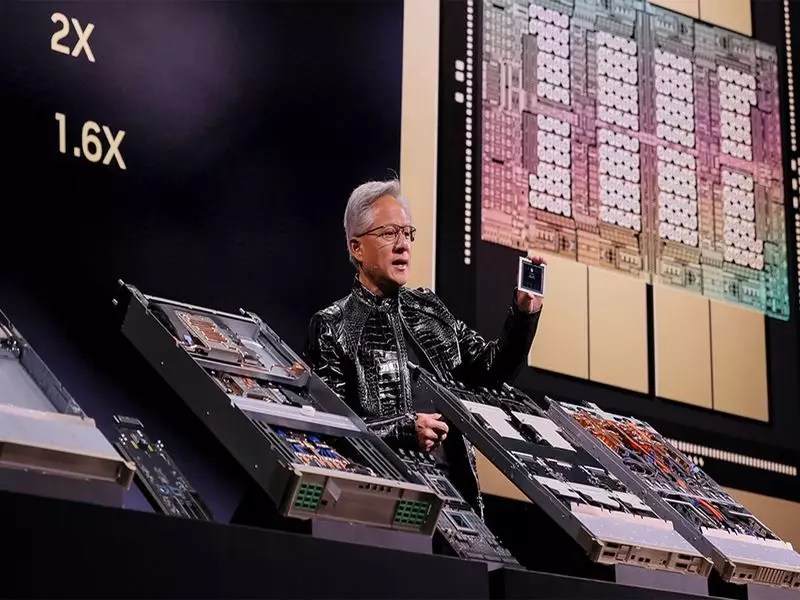
In a significant move set to reshape the landscape of artificial intelligence computing, Nvidia Corporation has officially announced the commencement of full-scale production for its next-generation AI platform, named Vera Rubin. The platform's critical processors will be manufactured by the Taiwan Semiconductor Manufacturing Company (TSMC) using its cutting-edge 4-nanometer (nm) process technology.
Unveiling the Vera Rubin AI Supercomputer
The announcement was made by Nvidia's visionary CEO, Jensen Huang, during a keynote address at the COMPUTEX forum in Taipei. The Vera Rubin platform represents the successor to the company's current flagship Blackwell architecture and is designed to push the boundaries of AI training and inference capabilities. Huang confirmed that the platform is now in full production and is expected to ship to customers within the current calendar year, specifically in 2025.
This new system is not just an incremental update. It is built upon a completely new GPU architecture, referred to as Rubin, and will be powered by an advanced GPU named R100. Furthermore, it will utilize a new central processor called Vera CPU. The integration of these components is aimed at delivering unprecedented performance for the massive data centers that power modern generative AI, large language models, and scientific computing.

TSMC's Foundry Role and the 4nm Advantage
A cornerstone of this announcement is the continued and deepened partnership with TSMC. The Vera Rubin platform's GPUs and CPUs will be fabricated on TSMC's sophisticated 4nm (N4P) manufacturing node. This process technology offers significant improvements in power efficiency and transistor density compared to previous generations, allowing Nvidia to pack more computational power into its chips while managing thermal and energy constraints.
This reliance on TSMC underscores the critical importance of advanced semiconductor foundries in the global AI arms race. Nvidia's decision solidifies TSMC's position as the world's leading contract chipmaker for high-performance computing. The company also confirmed that its future roadmap includes plans for chips built on TSMC's even more advanced 3nm process, codenamed 'Rubin Ultra', signaling a commitment to relentless innovation.
Implications for the Global AI Ecosystem
The launch of the Vera Rubin platform has wide-ranging consequences. For tech giants like Google, Microsoft, Amazon, and Meta—who are Nvidia's primary customers—this means access to more powerful tools to train increasingly complex AI models. This could accelerate breakthroughs in various fields, from drug discovery to autonomous systems.
For the broader industry, it reinforces Nvidia's dominant position in the AI hardware market. By consistently delivering annual architectural updates (from Hopper to Blackwell, and now to Rubin), the company is setting a pace that competitors like AMD and Intel will find challenging to match. The announcement also highlights the strategic geopolitical significance of Taiwan's semiconductor industry, as the world's most advanced AI hardware remains dependent on TSMC's manufacturing prowess.
In conclusion, Nvidia's Vera Rubin is more than a new product; it is a statement of intent. By moving to full production with TSMC's 4nm chips, Nvidia is not only fueling the next wave of AI innovation but also defining the infrastructure upon which the future of technology will be built. The race for AI supremacy is increasingly a race for silicon excellence, and with this move, Nvidia has sprinted ahead once again.