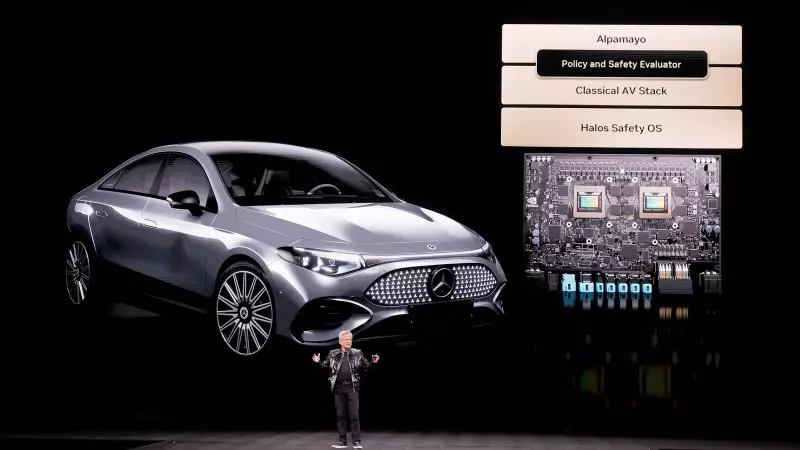
In a major push to dominate the future of transportation, chipmaking giant Nvidia has announced ambitious plans to develop the technology for autonomous vehicles and advanced robots, with its CEO setting a bold vision for a billion self-driving cars on global roads.
The CES 2026 Announcement: Alpamayo and the AI Roadmap
During a keynote address at the Consumer Electronics Show (CES) 2026 in Las Vegas, Nvidia's Chief Executive Officer Jensen Huang laid out the company's strategy. The centrepiece of the announcement was the unveiling of a new vehicle platform named Alpamayo. This platform is designed to allow cars to 'reason' in real-world environments by processing data from cameras and sensors.
Huang revealed that the company is targeting to begin testing its autonomous vehicle technology, specifically for robotaxis, by 2027. He expressed a grand long-term vision, stating, "We imagine that someday a billion cars on the road will all be autonomous."

How Nvidia's Technology Plans to Power Self-Driving Cars
The Alpamayo platform represents a suite of AI models and tools aimed at accelerating the development of self-driving capabilities. The core idea is for an onboard computer to analyze sensory inputs, break down complex driving scenarios into manageable steps, and devise solutions dynamically.
A key feature highlighted is the platform's ability to handle unexpected situations, such as a traffic light outage. Nvidia stated that the Alpamayo model would be offered for free, allowing potential users and developers to retrain it with their own data, fostering wider innovation in the sector.
Nvidia's foray into autonomous driving is not starting from scratch. The company is building upon its existing collaboration with luxury automaker Mercedes-Benz, working on vehicles capable of hands-free highway driving and urban navigation.
Global Rollout and Expansion into Robotics
Jensen Huang provided a concrete timeline for the introduction of the first Nvidia-powered autonomous cars. He said the first vehicle would hit the roads in the United States in the first quarter of the year. This will be followed by a European launch in the second quarter, with an Asian introduction scheduled for the second half of the year.
Beyond self-driving cars, Nvidia is also extending its AI prowess into the broader field of robotics. At the same event, the company introduced new AI models and technology specifically for robots. Huang mentioned a partnership with industrial giant Siemens AG to integrate artificial intelligence more deeply into the physical world, signalling a move towards smart manufacturing and automation.
This dual focus on autonomous vehicles and next-generation robotics underscores Nvidia's strategy to be the foundational AI brain for a new era of intelligent machines, transforming both how we travel and how we work.