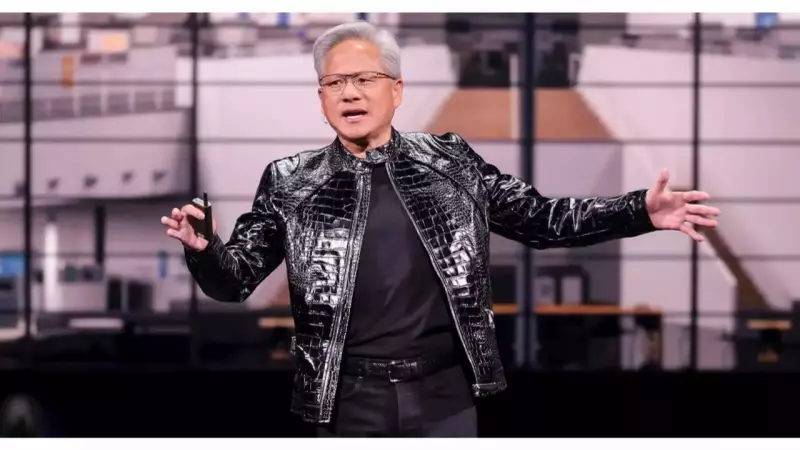
In a significant development at the CES 2026 technology showcase, Nvidia's visionary CEO Jensen Huang reportedly held confidential meetings with the top executives of two automotive giants: Mercedes-Benz and Hyundai. These high-stakes discussions occurred shortly after Nvidia, the world's leading chipmaker, unveiled its groundbreaking 'Alpamayo' platform—its first dedicated self-driving car artificial intelligence system.
Strategic Talks and Hyundai's Catching-Up Game
The timing of Huang's meeting with Hyundai's Executive Chair, Euisun Chung, has sparked intense speculation within the automotive industry. Analysts are questioning whether this signals Hyundai's intent to integrate Nvidia's new Alpamayo AI into its future vehicle lineup. According to a detailed report by the Korea JoongAng Daily, Hyundai has invested billions over the years in autonomous technology but still finds itself lagging behind competitors like Tesla, which already offers more sophisticated features to consumers.
The South Korean automaker has set an ambitious internal target: to equip its mass-market cars with Level 2+ self-driving capabilities by the end of 2027. The report further suggests that Hyundai has already expressed a strong desire to deepen its collaboration with Nvidia. This interest is backed by action; Hyundai previously announced a massive order for 50,000 of Nvidia's powerful Blackwell graphics processing units (GPUs). These chips are destined to accelerate the development of not just self-driving cars but also advanced robotics.

Mercedes-Benz Charges Ahead with Alpamayo
While Hyundai plays catch-up, Mercedes-Benz has surged forward, securing a first-mover advantage. The German luxury carmaker has become the first automotive brand globally to officially adopt Nvidia's Alpamayo AI for its production vehicles. The debut model for this partnership will be the upcoming Mercedes-Benz CLA.
The rollout plan is already in motion: the AI-powered CLA is scheduled to hit roads in the United States in the first quarter of the year. This will be followed by a European launch in Q2 and an Asian market entry in the third quarter, marking a rapid global deployment of the new technology.
What Makes Alpamayo AI a Game-Changer?
Nvidia's Alpamayo isn't just another driver-assistance system. It represents a family of open-source AI models that the company describes as the world's pioneering "thinking and reasoning" AI for autonomous vehicles. Its core innovation is the introduction of Vision-Language-Action (VLA) models. These enable a self-driving system to:
- Comprehend and interpret its visual surroundings.
- Logically reason through complex and challenging driving scenarios.
- Execute precise and safe driving maneuvers.
The comprehensive platform also includes large-scale reasoning models, sophisticated simulation tools for testing rare or dangerous events, and open datasets to train and verify AI systems.
Emphasizing Nvidia's open approach, Jensen Huang stated in a press interaction in Las Vegas, "We open source to everyone, so if a customer would like to use our model that we train, they're welcome to do that. We just want to enable the world's autonomous industry. Everything that moves should be autonomous."
Addressing concerns about potential memory chip shortages, Huang expressed confidence, noting Nvidia's position as the "first and only consumer of HBM4" (High-Bandwidth Memory 4). He explained that this unique status ensures a stable supply, with partners like Samsung Electronics and SK Hynix scaling up production to meet Nvidia's soaring demand.
Digital Twins: A Broader Industrial Vision
The CES conversation also highlighted Nvidia's expanding role beyond cars. During an onstage dialogue with Siemens CEO Roland Busch, Huang cited the example of major Korean shipbuilder HD Hyundai. Its shipyards have been transformed through a fusion of Siemens' digital twin technology and Nvidia's Omniverse platform.

Huang described this as a perfect example of creating a comprehensive digital replica where every engineering aspect—from CAD designs to electronics—is integrated and simulated. "In the future, I hope the digital twin of the ship, we'll actually put it in the ocean, a virtual simulation of the ocean, and see it completely operate," Huang remarked, outlining a future where entire industries are designed and tested in virtual worlds before physical execution.
These behind-the-scenes meetings at CES 2026 underscore a pivotal moment. As Nvidia cements its foundational role in the future of autonomy, traditional automotive leaders are forging critical alliances to navigate the shift towards intelligent, self-driving machines.