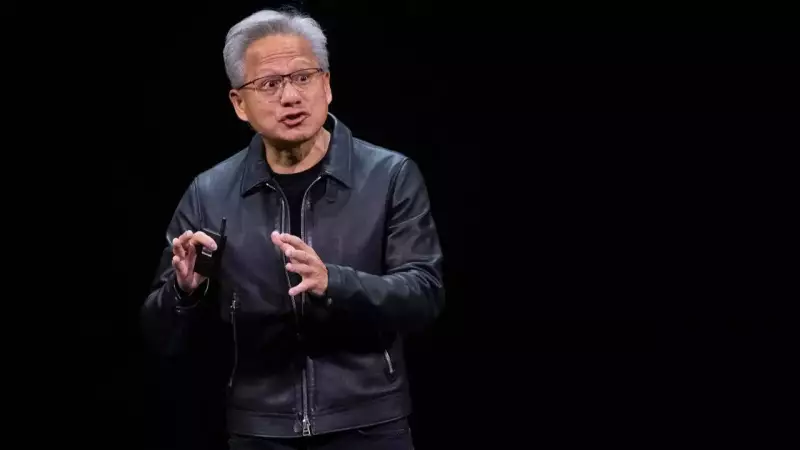
In a clear message to shareholders and the tech industry, Jensen Huang, the visionary founder and CEO of Nvidia, has firmly stated he has no intention of stepping down from his role in the foreseeable future. The 62-year-old executive made these remarks during a question-and-answer session at the recent CES event, directly addressing queries about his future at the semiconductor giant he started in 1993.
The Secret to a Three-Decade Tenure: Don't Get Fired, Don't Get Bored
When asked about his remarkable longevity at the helm, Huang offered a characteristically candid and humorous formula for his success. "The secret for being CEO for this long is 1, don't get fired, and 2, don't get bored. I don't know which one comes first," he quipped. He emphasised his sustained passion for the company's operations and his consistent ability to meet performance expectations. On the question of his timeline, Huang was resolute: "How long [will I remain CEO]? For as long as I deserve it."
Huang's tenure, which began when he co-founded Nvidia at a Denny's restaurant over three decades ago, far surpasses that of many contemporary tech titans. He has been CEO for 31 years, compared to Apple's Tim Cook (14 years), Meta's Mark Zuckerberg (22 years), and Tesla's Elon Musk's time at SpaceX (since 2002). Under his leadership, Nvidia's stock has soared from pennies per share in its early years to over $187, recently making it the world's most valuable company.

A 'Great Responsibility': Leading the AI Revolution
Huang framed his role not just as a corporate position but as a crucial duty within the global technology ecosystem. He described being Nvidia's CEO as carrying a "great responsibility," noting that the company's performance impacts the entire market, not just the tech sector.
"We are the captain of this industry and we have supply chain partners and collaboration partners all over the world who are counting on us to do our part," Huang explained. "It took us 34 years to get here. We're getting good at it. If you do something for 34 years, you can figure it out."
New Chips, New Partnerships: Nvidia's CES Announcements
The CES stage was also used by Huang to unveil Nvidia's next strategic moves. A major highlight was the announcement of the next-generation Vera Rubin superchip platform, named after astronomer Vera Rubin. This new platform promises a staggering leap in efficiency, capable of training AI models 10 times more efficiently than its predecessor, Blackwell. Huang detailed that a massive 10 trillion-parameter AI model can now be trained in just one month using only a quarter of the chips previously required.
Further cementing Nvidia's expansion beyond pure hardware, Huang announced a significant partnership with Mercedes-Benz to develop self-driving technology, positioning it as a direct competitor to Tesla's Autopilot system. This move underscores Nvidia's ambition to be the foundational brain for autonomous vehicles globally.
Huang also addressed the unprecedented market demand, stating, "Demand for Nvidia GPUs is skyrocketing. Models are increasing by a factor of 10, an order of magnitude, every single year." This demand, largely fuelled by the global AI boom post-2020, is responsible for the vast majority of Huang's personal wealth accumulation.
Born in Taipei in 1963, Huang's journey to the pinnacle of tech is a storied one. Sent to the US at age nine, a paperwork error placed him in a challenging school in rural Kentucky, where he undertook menial jobs like cleaning toilets. A brilliant student, he finished high school at 16, studied electrical engineering, and worked night shifts at a diner before founding Nvidia. His story remains integral to the company's driven and resilient culture as it navigates its dominant position in the AI age.