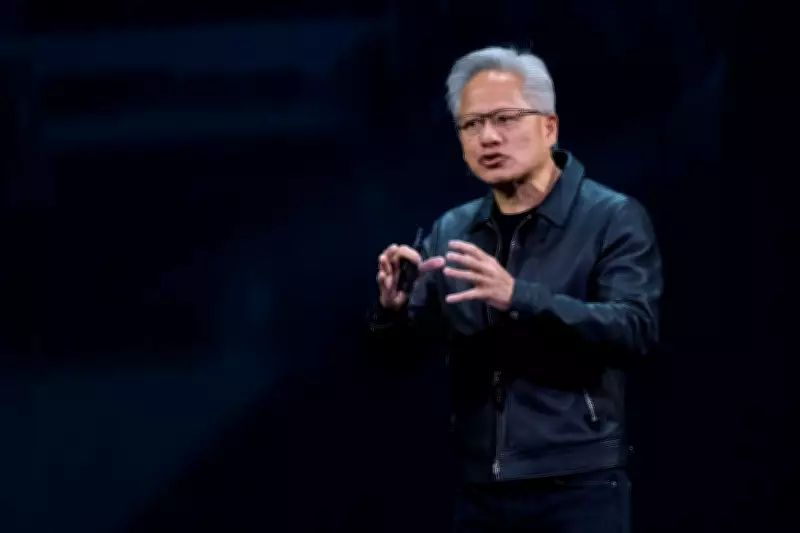
Nvidia CEO Jensen Huang: AI Will Create More Jobs, Not Eliminate Them
In a bold counter to prevailing anxieties, Nvidia CEO Jensen Huang has publicly disputed the widespread belief that artificial intelligence (AI) will lead to massive job losses. Speaking to the media during Nvidia's annual GTC 2026 conference, Huang articulated a contrarian perspective, asserting that the opposite is likely true.
Historical Precedent: Technology Creates More Work
Huang drew upon historical examples to bolster his argument. He pointed out that the advent of personal computers, the internet, and mobile devices did not reduce overall employment but instead made people busier and generated more job opportunities. "The fact of the matter is PCs made us more busy. The internet made us more busy. Mobile devices made us super busy," Huang stated. "Every technology wave in history that was supposed to destroy work instead created more of it. Not different work. More work. The pattern is consistent enough that dismissing it requires a real argument. Not just anxiety."
Addressing Labor Shortages, Not Automation Fears
The Nvidia CEO directly tackled the narrative of job elimination by highlighting current labor shortages across multiple industries. "We are millions of truck drivers short. We are tens of millions of manufacturing workers short. Employment is very high, and yet many companies don’t have enough labor," Huang explained. He posited that the core economic issue is not excessive automation but a critical shortage of workers.

Regarding automation and robotics, Huang offered a nuanced view. He suggested that robots are not introduced into a world of abundance to displace existing workers but are deployed to fill essential roles in sectors experiencing severe labor gaps. "Robots do not arrive into a world of abundance and displace people who have jobs. They arrive into a world of shortage and fill roles that cannot be filled any other way," he said.
The Economic Logic: Growth Leads to Hiring
Huang presented a clear economic rationale to support his stance. "Shortages constrain growth. Growth constrained means wealth not created. Companies not scaled. Jobs not added. Robots remove the constraint. The economy expands. Hiring follows expansion," he elaborated. According to Huang, by addressing labor shortages through automation, the overall economy can grow, which in turn stimulates further job creation across various sectors.
Acknowledging Uncertainty in the AI Era
While confident in his historical argument, Huang acknowledged a unique aspect of the current AI revolution. He noted that unlike previous technological waves that automated physical tasks, AI possesses the capability to perform cognitive work on an unprecedented scale. "That argument is historically airtight. But history has also never seen a technology that could perform cognitive work at this scale. Every previous wave automated physical or mechanical tasks. This one is different in kind. Not just a degree," Huang admitted.
He also expressed some uncertainty about the future trajectory, recognizing that no one can predict with absolute certainty how this wave will unfold. "The honest answer is that nobody knows with certainty whether this wave follows the same arc as every previous one. What is certain is that the people who bet against technology creating more work have been wrong every single time. So far," the Nvidia CEO concluded, leaving room for debate while emphasizing the historical trend of job creation through technological advancement.