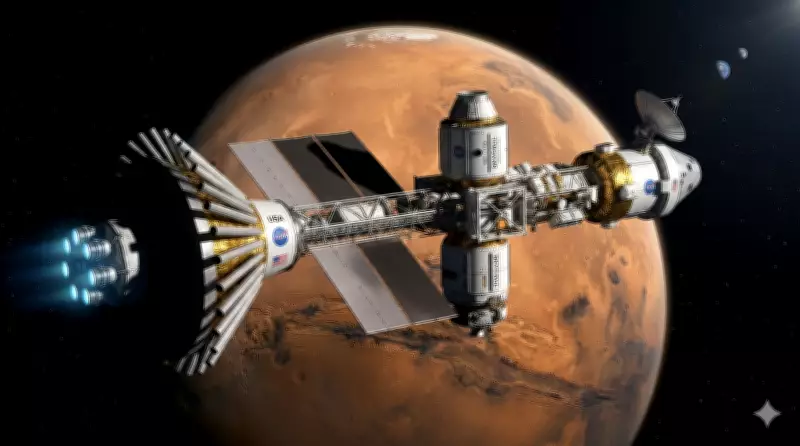
NASA's Nuclear-Powered Mars Mission: A New Era of Space Exploration Begins
The announcement that NASA plans to launch a nuclear-powered mission to Mars by the year 2028 heralds a transformative new chapter in humanity's quest to explore the cosmos. For decades, Mars exploration has predominantly relied on chemical and solar power systems, which, while effective, come with significant limitations in terms of speed, efficiency, and operational range. The introduction of nuclear power into this arena signals a revolutionary shift, empowering scientists to envision a future where space travel is faster, more efficient, and less dependent on external energy sources like the sun.
What Is NASA's Nuclear-Powered Mars Mission?
The upcoming NASA mission centers on a spacecraft equipped with Nuclear Electric Propulsion (NEP). This advanced propulsion system operates by utilizing a compact nuclear reactor to generate substantial electrical power. This electricity then drives highly efficient propulsion mechanisms, enabling the spacecraft to traverse vast interplanetary distances while consuming minimal fuel compared to traditional methods.
This mission, potentially linked to the Space Reactor-1 (SR-1) concept, aims to demonstrate the practical efficacy of nuclear power in the harsh environment of space. Beyond propulsion, the spacecraft may deploy innovative robotic tools, such as helicopter drones, to explore the Martian surface. These drones could access remote or challenging terrains that conventional rovers cannot reach, significantly enhancing our ability to study Mars in unprecedented detail.

NASA emphasizes that these missions are critical not only for Mars exploration but also for laying the groundwork to power future deep-space endeavors, setting the stage for more ambitious human and robotic expeditions.
How Nuclear Propulsion Works in Space
Nuclear propulsion represents a fundamental departure from conventional rocket technology. Unlike traditional rockets that depend on rapid, fuel-intensive chemical bursts, nuclear systems provide a steady, highly efficient power source. Currently, two primary technologies are under active development:
- Nuclear Thermal Propulsion (NTP): This method uses a nuclear reactor to heat a propellant like hydrogen, generating thrust through thermal expansion.
- Nuclear Electric Propulsion (NEP): This approach harnesses electricity produced by nuclear power to operate ion engines, which offer exceptional efficiency for long-duration travel.
According to NASA, nuclear thermal propulsion can be two to five times more efficient than standard chemical propulsion systems. This enhanced efficiency translates to either faster travel times or the ability to carry heavier payloads without requiring enormous fuel reserves. Moreover, nuclear propulsion is not reliant on sunlight, making it ideally suited for deep-space missions where solar energy becomes increasingly scarce and ineffective.
Why This Mars Mission Matters for Human Exploration
One of the most daunting challenges in sending humans to Mars is the protracted travel duration, which currently spans between six and nine months using existing technology. Nuclear propulsion technology holds the potential to drastically reduce this transit time, thereby mitigating associated health risks for astronauts, such as prolonged exposure to cosmic radiation and microgravity effects, while also lowering financial costs.
NASA, in collaboration with DARPA, has already initiated testing of nuclear rocket engines in space, with the goal of validating the technology before its integration into the Mars mission. As Deputy Administrator of NASA, Pam Melroy, stated, "This demonstration will be a crucial step... to send humans to Mars." Beyond speed, nuclear technology can provide continuous power generation throughout the mission, supporting life-support systems, scientific instruments, and communication equipment.

What Makes This Mission a Technological Breakthrough
This mission stands out as a unique convergence of propulsion, power, and exploration capabilities. Unlike prior missions that depended on solar panels and batteries, nuclear power offers the ability to generate electricity consistently, regardless of environmental conditions or distance from the sun. Key advantages include:
- The capacity to produce uninterrupted power, independent of solar proximity.
- Enabling long-duration missions with sustained energy supply.
- Facilitating exploration in extreme and harsh space environments.
NASA highlights that developing "flight-heritage nuclear hardware" is essential not only for Mars but also for future missions to more distant destinations like Jupiter and Saturn, paving the way for broader solar system exploration.
The Future of Space Travel with NASA
NASA's nuclear-powered mission to Mars in 2028 is far more than a singular experiment; it represents the dawn of a new epoch in space exploration. Should this mission prove successful, nuclear power could become the standard for future space ventures, leading to faster, more productive expeditions and ultimately enabling human settlements on other planets. In essence, this endeavor brings humanity closer to a future where Mars is no longer a distant, unreachable world but an accessible destination within our grasp.