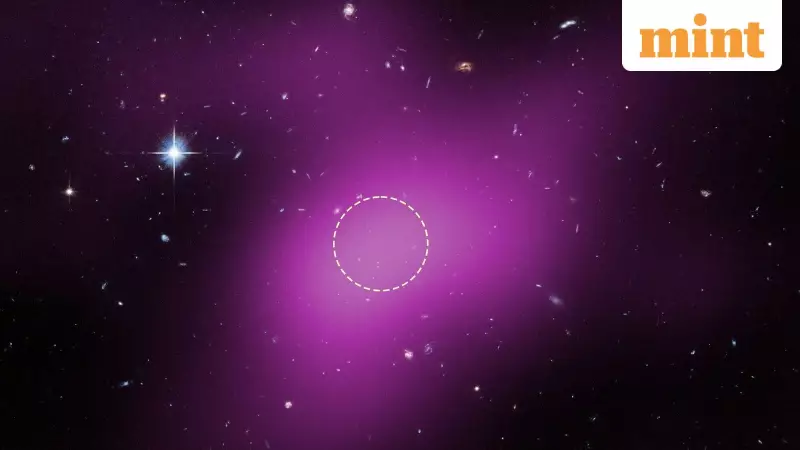
In a groundbreaking discovery that peers into the cosmic shadows, NASA's Hubble Space Telescope has identified a mysterious, starless cloud of gas, rich in dark matter, located a staggering 14 million light-years from Earth. Dubbed 'Cloud-9', this object is being hailed by scientists as a pristine relic from the universe's infancy and a direct window into the enigmatic dark universe.
A 'Failed Galaxy' in Our Cosmic Backyard
The findings, published in The Astrophysical Journal Letters, detail the nature of Cloud-9. Formally known as a "Reionisation-Limited H I Cloud", it is the first object of its kind ever observed. Cloud-9 is a neutral hydrogen cloud from the early universe that simply never gathered enough gas to ignite star formation. This crucial failure makes it an invaluable cosmic fossil.
"This is a tale of a failed galaxy," explained Alejandro Benitez-Llambay of the Milano-Bicocca University in Italy, the program's principal investigator. He emphasized the scientific value, stating, "In science, we usually learn more from the failures than from the successes. In this case, seeing no stars is what proves the theory right. It tells us that we have found in the local universe a primordial building block of a galaxy that hasn't formed."

Hubble's Crucial Role in the Discovery
Prior to Hubble's keen eye, astronomers could only speculate. Ground-based telescopes, like the Very Large Array (VLA) whose radio data first hinted at the cloud's presence, lacked the sensitivity to rule out the presence of faint stars. They could only see the diffuse magenta glow of neutral hydrogen.
However, Hubble's Advanced Camera for Surveys provided the definitive proof. Its deep, high-resolution look into the heart of Cloud-9, marked by the peak of the VLA's radio emission, found it to be completely devoid of stars. The few points of light within its boundary were confirmed to be distant background galaxies, not residents of the cloud itself.
A Rare Portal to the Dark Universe
This absence of stars is precisely what makes Cloud-9 so special. It is dominated by the gravitational influence of dark matter, the invisible substance that makes up most of the universe's mass but does not emit, absorb, or reflect light.
Team member Andrew Fox of AURA/STScI for the European Space Agency (ESA) described the find as transformative. "This cloud is a window into the dark universe," Fox said. "We know from theory that most of the mass in the universe is expected to be dark matter, but it's difficult to detect this dark material because it doesn't emit light. Cloud-9 gives us a rare look at a dark-matter-dominated cloud."
The discovery suggests that our universe could be teeming with similar small, dark matter-dominated structures—other 'failed galaxies' that have remained hidden because they never lit up with stars. By studying Cloud-9, researchers hope to unlock secrets about galaxy formation, the conditions of the early universe, and the fundamental nature of dark matter itself, pushing the boundaries of our understanding of the cosmos.