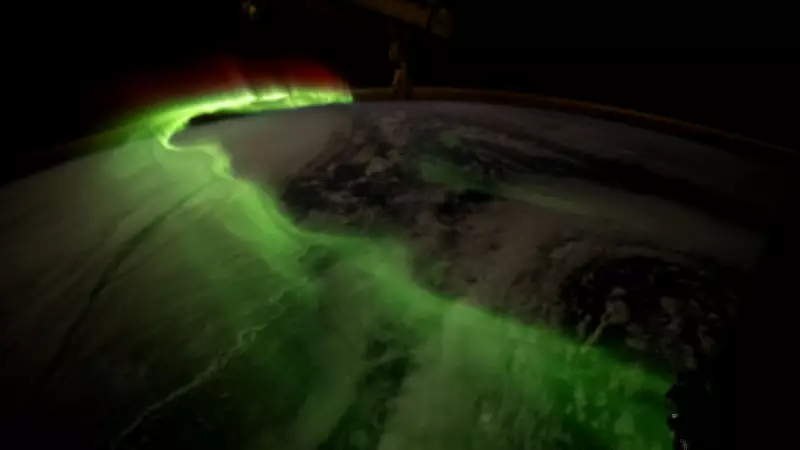
For most people, the Southern Lights are a rare spectacle glimpsed from remote corners of the Southern Hemisphere. For astronauts orbiting hundreds of kilometres above Earth, however, the phenomenon appears from an entirely different perspective. A recent image and time-lapse captured by NASA astronaut Jessica Meir have offered the world a remarkable view of the Aurora Australis as luminous green ribbons flowed across Earth's atmosphere below a SpaceX Dragon spacecraft. The footage reveals the scale, movement and beauty of one of nature's most powerful light displays, transforming a familiar astronomical event into something almost otherworldly. Beyond its visual appeal, the scene provides a vivid reminder of the dynamic relationship between the Sun and Earth, where streams of charged particles interact with our planet's magnetic shield to create spectacular displays visible from both the ground and orbit.
What Causes the Southern Lights?
The Southern Lights, known scientifically as the Aurora Australis, occur when charged particles released by the Sun collide with gases in Earth's upper atmosphere. According to NASA Earth Observatory: "When energetic particles from space collide with atoms and molecules in the atmosphere, they can cause the colorful glow that we call auroras." These particles follow Earth's magnetic field towards the polar regions, where they interact with oxygen and nitrogen atoms, producing vivid colours that can include green, red, purple and pink. NASA notes that green auroras are typically associated with collisions involving oxygen atoms. The phenomenon is the southern counterpart to the Aurora Borealis observed in northern latitudes.
A Unique Orbital Perspective
From orbit, astronauts witness the aurora from above rather than below, allowing them to see immense curtains of light stretching across the curvature of Earth. This unique vantage point reveals the true scale of geomagnetic activity unfolding along the planet's magnetic field lines. NASA astronaut Jessica Meir recently took to X and shared a time-lapse sequence filmed from a SpaceX Dragon spacecraft, showing the Southern Lights rippling beneath the capsule as it travelled over high southern latitudes. Describing the experience on social media, she wrote: "As opposed to the previous aurora I’ve seen, this one danced and snaked its way directly below us, putting on quite a show. I am in awe of this evocative phenomenon." The footage captures luminous green waves undulating across the atmosphere, creating the impression of a living river of light flowing around the planet. Unlike ground-based observations, the orbital perspective reveals how auroral activity forms a vast ring around Earth's magnetic poles.

Scientific Significance of Auroras
NASA has long documented similar views from the International Space Station. In one official image description, the agency noted that astronauts photographed the Aurora Australis while orbiting approximately 265 miles above the southern Indian Ocean. These observations provide scientists with valuable information about space weather and the interaction between solar activity and Earth's atmosphere. Scientists are currently observing heightened solar activity as the Sun progresses through the peak phase of its approximately 11-year solar cycle. Increased solar storms and coronal mass ejections send larger quantities of energetic particles towards Earth, often resulting in stronger and more widespread auroral displays.
Connection Between Sun and Earth
NASA explains that auroras offer more than visual beauty. They are visible evidence of the connection between Earth and the Sun. The agency states: "Auroras show our atmosphere's connection to the heliosphere, the solar system-wide atmosphere of the Sun." As solar activity remains elevated, researchers expect further opportunities to observe dramatic auroral events from both Earth and space. Images captured by astronauts continue to provide a rare perspective, allowing people to appreciate the scale of these interactions beyond the limitations of ground-based observation.

A Living Planet Wrapped in Cosmic Light
For a few moments, Jessica Meir's camera transformed a scientific phenomenon into a work of natural art, revealing Earth not as a static world beneath our feet, but as a living planet wrapped in streams of cosmic light. The TOI Science Desk stands as an inquisitive team of journalists, ceaselessly delving into the realms of discovery to curate a captivating collection of news, features, and articles from the vast and ever-evolving world of science for the readers of The Times of India. Consider us your scientific companion, delivering a daily dose of wonder and enlightenment. Whether it's the intricacies of genetic engineering, the marvels of space exploration, or the latest in artificial intelligence, the TOI Science Desk ensures you stay connected to the pulse of the scientific world. At the TOI Science Desk, we are not just reporters; we are storytellers of scientific narratives. We are committed to demystifying the intricacies of science, making it accessible and engaging for readers of all backgrounds. Join us as we craft knowledge with precision and passion, bringing you on a journey where the mysteries of the universe unfold with every word.