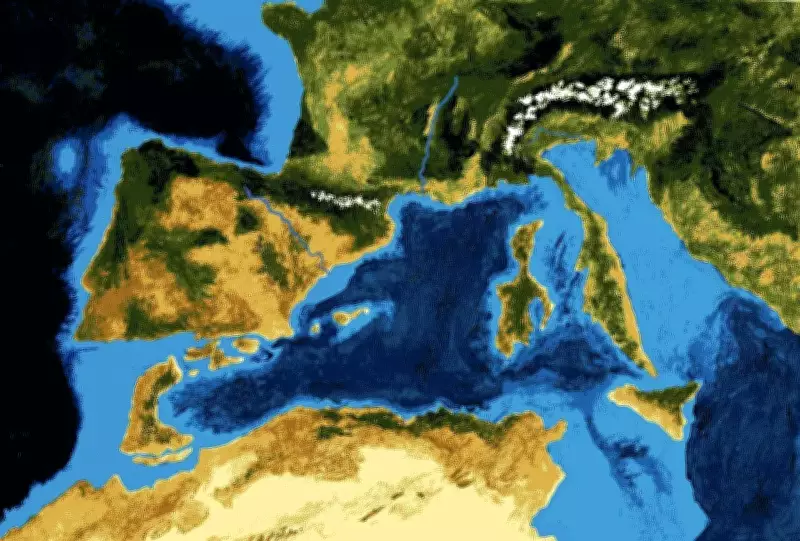
It is hard to imagine that the sun-drenched beaches of the Mediterranean were once part of one of the most inhospitable places on Earth. Yet, six million years ago, travelers would have seen no horizon line. Instead, they would have encountered a flat desert of sharp salt crystals, with hallucinations brought on by extreme temperatures. This immense structure, known as a salt giant, now lies beneath the seabed, covered by sedimentary layers and water.
A Geological Makeover on an Epic Scale
This period was not merely a drought but a geological transformation between two continents. The sea was cut off from its primary water source, the Atlantic Ocean, turning the entire basin into a giant baking tray. Over hundreds of thousands of years, water levels rose and fell, leaving behind a graveyard of minerals that defined the basin's chemical composition.
Sea Held in Tectonic Lockdown
The scale of change is hard to grasp. An area larger than many countries was reduced to a vast depression as natural channels for seawater were blocked. Without a constant influx of water to balance evaporation, salt concentrations soared to levels lethal to almost all marine life.

A key study, Causes and Consequences of the Messinian Salinity Crisis, reveals that this episode created remarkable geological formations. As waters receded, vast layers of gypsum and halite (common salt) formed. The Mediterranean became a giant natural salt trap, accumulating about five percent of all salt in the world's oceans. Repeated episodes built successive salt layers on the seafloor.
This event, known as the Messinian Salinity Crisis, caused sea levels to drop by two kilometers, carving deep valleys for rivers like the Nile and Rhone. The immense salt deposits beneath the seabed continue to influence regional geology today.
The Mystery of the Two-Kilometer Drop
For decades, experts debated how much water vanished. Some argued the sea remained relatively full but became extremely salty; others suspected a total collapse. Recent chemical analyses of ancient salt crystals have settled the debate. A pivotal 2024 study, Chlorine isotopes constrain a major drawdown of the Mediterranean Sea, confirmed that the sea level dropped by an astonishing two kilometers. This turned the Mediterranean into a series of isolated, hypersaline lakes far below the Atlantic Ocean.
Such a drastic reduction forced major rivers to respond. The Nile and Rhone cut deep valleys, now buried under sediments. The crisis occurred in two phases: one of high salinity, followed by rapid water level decline. This serves as a powerful example of how drastically Earth can change.
The giant salt deposit is not merely an ore; it symbolizes a period when the planet reshaped itself entirely.