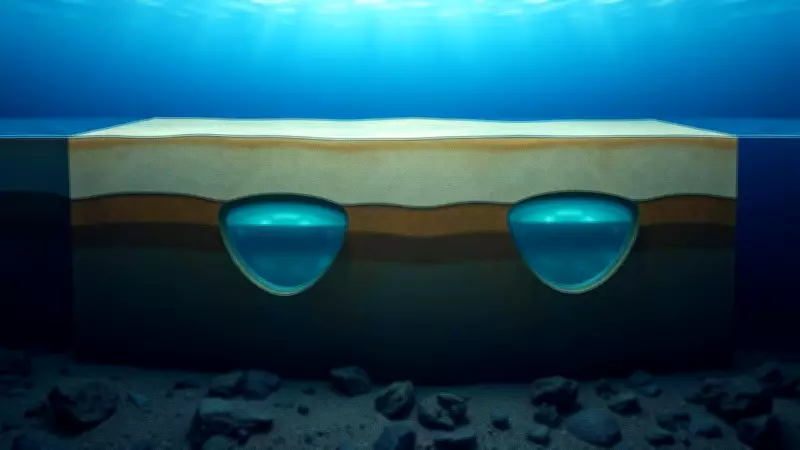
When we gaze upon the vast Atlantic Ocean, it is easy to assume that all water beneath the surface is salty. However, nature often conceals its secrets. Deep within the ocean floor along the U.S. Atlantic seaboard, scientists have uncovered an extensive network of fresh water that surpasses all previous expectations. This hidden realm of low-salinity water, locked beneath the ocean floor, offers a testament to Earth's geologic past.
Discovery of a Hidden Water Giant
This discovery was not a matter of chance. Researchers employed advanced marine technology to "see" through the ocean floor, revealing a continuous aquifer stretching from the New Jersey shoreline far into the deep sea. This enormous body of water spans hundreds of kilometers, fundamentally altering how coastal residents view their most precious resource: water.
The finding represents a paradigm shift in Earth science. It indicates that the interface between ocean and groundwater is far more complex than previously thought. Beyond its scientific significance, this resource has major implications for managing coastal resources as global warming progresses and sea levels rise.

How Scientists Located the Aquifer
To detect the water, the research team used electromagnetic waves that distinguish between saltwater and freshened groundwater in sediment layers beneath the ocean surface. They discovered continuous underground water bodies extending up to 90 kilometers from the coastline in some areas.
A key study published in the journal Scientific Reports provides the technical basis for this discovery. The researchers estimate the system contains approximately 2,800 cubic kilometers of low-salinity groundwater, making it one of the largest offshore freshwater bodies ever physically mapped. The study highlights that this water is likely a mix of ancient water trapped during the last Ice Age and modern runoff still pushing outward from the mainland.
The Scale and Significance
It is difficult to conceptualize the scale of this formation. This is not a collection of small puddles but an extensive system structured along the continental shelf. Understanding how such formations store water helps predict how coastal aquifers on land will behave under pressures such as pumping.
The immense discovery, stretching hundreds of kilometers, holds an estimated 2,800 cubic kilometers of low-salinity water—a blend of ancient glacial melt and modern runoff.
How Does Freshwater Survive on the Seafloor?
One might wonder how freshwater persists on the seafloor surrounded by salt. The answer lies in geological history. During the last Ice Age, these lands were not covered by ocean. Lower sea levels allowed rainwater and melting snow to penetrate deeply into the soil, forming extensive freshwater deposits. Later, as glaciers melted and sea levels rose, thick sediment layers isolated this water from the surrounding saltwater.
This phenomenon is not unique to the United States. According to research published in the journal Nature, hidden aquifers are a recurring feature along continental margins worldwide. As more of the ocean floor is mapped, such submarine freshwater sources may prove far more common than previously suspected.
Implications and Future Prospects
Although this water is an intriguing find, it is not a quick fix for water supply challenges. Extracting water lying beneath many miles of seawater and soil requires significant engineering efforts. Nevertheless, the discovery is valuable for understanding coastal systems. The water may supply nutrients and minerals to the oceans, impacting coastal marine ecosystems.
The discovery illustrates that the Atlantic Coast of America is not merely a boundary between land and sea but a meeting point between two worlds.
A Testament to Unexplored Mysteries
Finally, the discovery of the Atlantic margin aquifer is a testament to how much more there is to learn about our planet. What we know about resource limits may only be a matter of perception, as Earth continues to conceal its mysteries beneath waves and sands until we uncover them.
This article is brought to you by the TOI Science Desk, a team of journalists dedicated to curating captivating science news for readers of The Times of India.