In a stark warning about the perils of technological dependence, Maharashtra Chief Secretary Rajesh Aggarwal on Tuesday forcefully advocated for India to develop its own "sovereign AI" capabilities. He pointed to the alleged quiet external takeover of Venezuela's critical infrastructure as a sobering cautionary tale for the nation.
The Venezuela Warning and a Call for Sovereignty
Aggarwal referenced recent geopolitical events, suggesting a silent takeover of a nation's systems can precede overt action. "We saw Americans just going to another country and picking up their President, very silently, very recently," he said, alluding to Venezuela. While noting people have different conjectures, he stated, "probably they got full grip over their power grid many months back and sold into many of their systems."
He issued a direct warning for India's future, stating that without indigenous AI strength, the country risked becoming "a slave again — of a different kind." Aggarwal emphasized that technological sovereignty is now a strategic imperative, not an optional pursuit. This is especially crucial given that nearly 60% of India's data centres are located in Maharashtra.

AI's Transformative Potential and Strategic Imperative
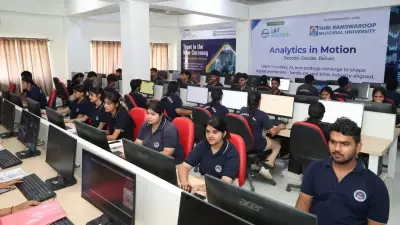
The Chief Secretary, an IIT Delhi alumnus with AI work dating to the late 1980s, spoke at a day-long conclave on 'AI for Science' at IIT Bombay. This meeting acts as a precursor to the broader AI Impact summit scheduled for February. He argued that mastery over AI and its entire manufacturing supply chain is vital to safeguarding national sovereignty.
"So unless we are good at AI and we are good at manufacturing and the whole supply chain of the entire thing, our sovereignty will also be at stake in future," Aggarwal asserted. He described AI as "a very different beast from other inventions till now," urging collective effort to ensure India remains sovereign in this new age.
Government and Academic Leaders Echo Strategic Vision
Other leaders at the conclave elaborated on AI's transformative power. Richa Bagla, Maharashtra Principal Secretary for Finance, Accounts and Treasuries, stated that digital platforms have evolved from mere systems of record to powerful systems of intelligence.
She outlined key applications where AI could serve as a backbone for governance:
- Predictive analytics for cash flow, revenue trends, and expenditure patterns.
- Early warning systems for abnormal transactions, fraud detection, and risk profiling.
- Automating compliance, audit readiness, and decision support for budget formulation.
- Improving grievance handling for faster public service delivery.
IIT Bombay Director, Shireesh Kedare, offered a succinct perspective on AI's impact, noting, "The short-term impact of AI is over-estimated and the long-term impact of AI is mostly under-estimated."
Abhay Karandikar, Secretary of the Department of Science and Technology, suggested AI's potential runs even deeper. He posited that if AI begins to disrupt the process of scientific discovery itself, its effect would be far greater than currently imagined, as it could challenge fundamental scientific principles.
The conclave collectively underscored a clear message: for India, developing sovereign AI is not just about economic advantage but is fundamentally linked to future national security and strategic autonomy.