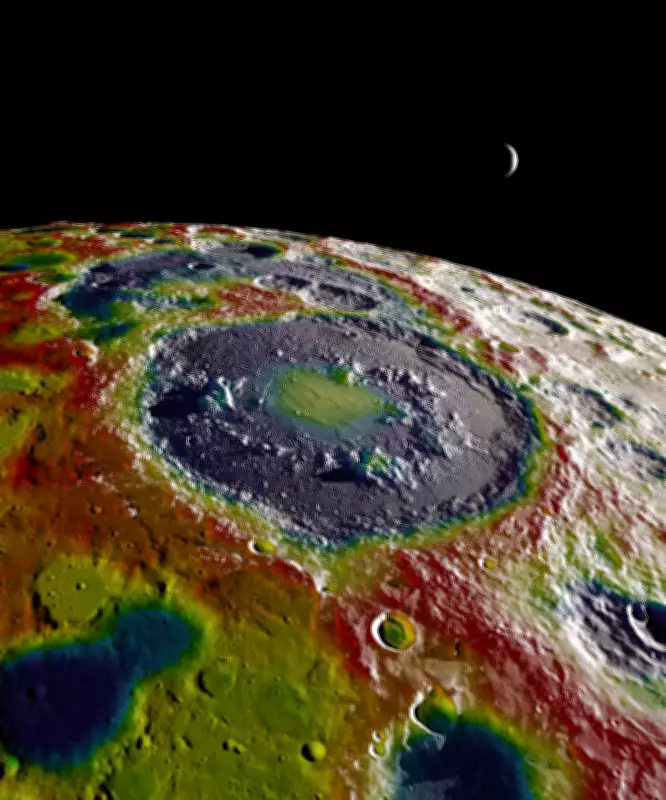
When envisioning the early days of our solar system, one often pictures an incredibly violent period marked by massive celestial collisions. Huge objects from space slammed into young planets, dramatically altering their terrain. For many years, scientists have sought to uncover the precise sequence and rate of these collisions to better understand the environment in which Earth's first life forms evolved.
Challenges in Reconstructing Early Impacts
Reconstructing the sequence of events from that era is extremely difficult because Earth's surface has continually changed through geological processes such as weathering, volcanism, and subduction. Due to these ongoing changes, scientists believe evidence of early impacts has been erased.
A Lunar Rock Provides an Unfiltered View
However, an extraordinary discovery involving an uncommon lunar rock recovered in Northwest Africa has offered an unfiltered view into this chaotic past. A study published in the journal Geology, titled "Three-body evidence of ca. 3.7 Ga to 3.2 Ga bombardment across the inner solar system," confirms that our neighboring moon safely recorded the history of our early planet. By examining a piece of the moon that eventually traveled to Earth, scientists mapped a colossal ancient collision that entirely liquefied a section of the lunar surface roughly 3.5 billion years ago.

According to Carolyn Crow, a planetary scientist at the University of Colorado Boulder, uncovering the timeline of these space collisions provides indispensable context regarding the history of our world. "On Earth, the first fossil evidence of life shows up around 3.5 billion years ago, meaning that life is emerging and evolving before then. The question that we often have, even going back further, is what was the impact record when life was emerging?" Crow explained in a statement. She added, "It is important for understanding how life is taking hold, how life is emerging. The cadence of these catastrophic events is an important part of the equation."
Decoding the Scorching History of Lunar Crystals
The key to solving this planetary mystery was found inside a specific lunar meteorite labeled NWA 12593. When researchers scrutinized the structural composition of this African specimen, they discovered that it had preserved records of three entirely independent impact events over its lifespan. While the subsequent collisions modified the rock's structure, it was the earliest impact that stunned the scientific team.
Using advanced radiometric dating to follow the decay process of radioactive materials contained within the object, scientists established that the first hit occurred approximately 3.5 billion years ago. The uniqueness of this meteorite came from the sheer amount of thermal energy released during that impact. It was powerful enough to melt the lunar soil and make it behave like lava.
Physical evidence of this extreme heat was preserved as an unusual mineral structure known as a cubic zirconia phase. Although cubic zirconia is best known on Earth as a diamond substitute in jewelry, it can also serve as a geological thermometer for planetary scientists. This specific structural phase can only form when rock encounters extreme temperatures exceeding 2,370 degrees Celsius, proving that the space collision was energetic enough to completely liquefy the local lunar crust.
Identifying a Simultaneous Solar System Bombardment
In addition to shedding light on the moon's volatile past, the findings from the Geology paper provide a vital link that unifies the history of the inner solar system. When the research team cross-referenced the 3.5-billion-year-old lunar strike with data from independent studies, they uncovered a compelling correlation. Impact indicators and craters of the same age had previously been identified on Earth and on 4 Vesta, a massive asteroid positioned in the primary asteroid belt between Mars and Jupiter.
The confirmation of a similar impact age on three different bodies is very rare in astronomy. The similarity in timing suggests that there was a wave of bombardment by asteroids within the inner solar system during that period. This indicates a transition as the solar system moved from a chaotic era of frequent impacts to a later period in which impacts became less common.

Carolyn Crow emphasized that identifying this interconnected planetary record represents a breakthrough for geologists. "It's not very common, which is why we're very excited about it," Crow shared during the discussion. "It's pretty rare to have all three records line up like this."
The Meteorite's Physical Structure
The meteorite's physical structure also shows how these pulverized planetary materials fused over time. The specimen is classified as a breccia—a specific variety of sedimentary rock made up of sharp, broken mineral shards bound together by a fine-grained matrix. Crow used a familiar architectural comparison to illustrate this texture. "Breccias are similar to what you would see if you went and chipped out a chunk of concrete. You would see all these little rocks, and then it's fused by the cement," Crow explained. "But the meteorite is fused by the impact process. You get all these chunks of different kinds of rocks that the impact hit into. These all get mixed up, and then it gets fused like your concrete sidewalk."
Ultimately, the third and most recent impact event blasted the rock off the lunar surface, launching the fragment of cosmic concrete into space until it eventually intersected with Earth and landed in Northwest Africa. By decoding the radioactive clocks preserved inside this meteorite, researchers are gaining a clearer understanding of the high-energy planetary setting in which Earth's earliest life emerged.