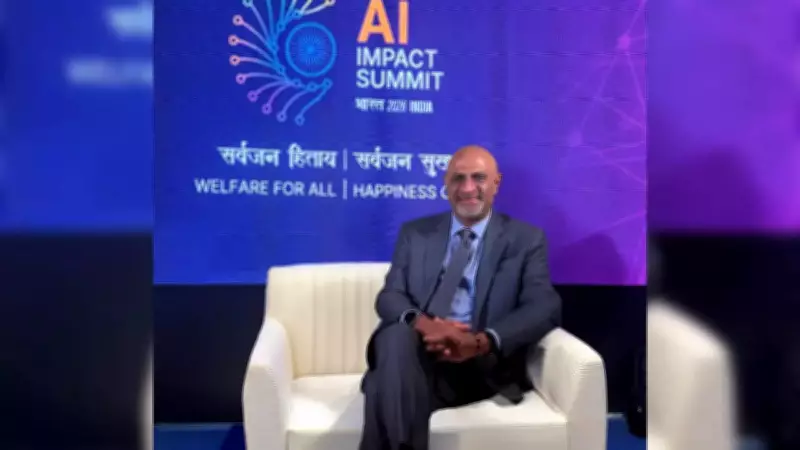
Kore.ai CEO Emphasizes Human Accountability in AI Agent Development
As global tensions rise regarding the autonomous behavior and nature of artificial intelligence agents, Kore.ai CEO and co-founder Raj Koneru has delivered a clear message: human developers bear ultimate accountability for the decisions made by these sophisticated programs. Speaking exclusively to The Times of India during the recent India AI Impact Summit 2016, Koneru addressed widespread industry fears that minor errors could trigger catastrophic "cascading failures" across digital ecosystems.
The Fundamental Question of Control
"The 'who's in charge' question is precisely the right one to be asking, and I am pleased that the conversation has matured to this crucial point," Koneru stated. "Humans are always in charge and accountable, and they absolutely must be. We are the ones creating these agents, defining their roles and responsibilities, establishing guardrails, and determining exactly how much autonomy they should be granted. Therefore, we humans are ultimately responsible for every decision these AI agents make."
He further clarified that "accountability does not transfer to the technology itself. If you built it, if you defined its parameters, you own the outcome. It really is that straightforward."

AI Agents: Current Capabilities and Limitations
When discussing the autonomous capabilities of AI agents, Koneru provided a realistic assessment of current technological maturity. "Let us be completely honest about where we stand today. AI agents have not yet matured to the point where they can independently make critical financial or legal decisions. That is simply the current reality, and everyone building in this space understands this limitation. We are progressing along that path, but we have not arrived at that destination yet."
Koneru explained that Kore.ai designs its AI agents with a specific confidence threshold mechanism. "When our agent acts, it does so with measurable confidence. When confidence levels drop below our established threshold, the AI agent will automatically stop operation and require human intervention. This intervention layer is absolutely non-negotiable in our design philosophy. Since risk appetites vary dramatically across different industries, this confidence threshold must be carefully calibrated according to specific sector requirements."
The Evolution of Jobs in an AI-Driven World
Addressing widespread concerns about potential job displacement due to AI chatbots and agents, Koneru dismissed what he called "the job fear" as a "moot point."
"Jobs will not simply disappear, but their fundamental nature will undoubtedly transform," he explained. "Humanity has always evolved alongside technological advancement. Before email, we communicated through physical mail, then we adapted to email, and now we've embraced platforms like WhatsApp. The same evolutionary pattern will occur with artificial intelligence."
Looking toward the future, Koneru predicted: "The nature of employment will essentially split into two primary categories. First, those who build AI agents for others to utilize. Second, those who use AI agents to accomplish their work more efficiently. Regardless of which path individuals follow, everyone will eventually work alongside AI agents in some capacity."
India's Strategic Advantage in the AI Landscape
Koneru also shared his perspective on India's unique position in the global artificial intelligence ecosystem. He argued that while building massive data center infrastructure or creating foundational models like GPT has become somewhat standardized, India's true strength lies in scaling technology to unprecedented levels.
"Infrastructure and base models have become table stakes, and the global community is already constructing these at enormous scale," Koneru observed. "This is not where India's greatest opportunity resides. India's most significant strength has consistently been taking existing technology and building extraordinary additional value on top of it. We thrived within the service economy using exactly this approach. Artificial intelligence presents no different scenario."

He emphasized that India should focus on education and talent development specifically geared toward building AI applications for global markets, mirroring the country's established success in the information technology industry.
"Two critical factors will determine success, including for rural India," Koneru outlined. "First, we must educate and equip our workforce to build with AI technology. Second, we must direct that talent toward developing sophisticated AI applications not merely for domestic use but for international markets."
"Just as India successfully exported IT services worldwide, the country can now assume leadership by building AI applications for both India and the global community," he concluded. "Kore.ai itself developed enterprise AI technology from India for international clients. The necessary infrastructure exists here, the talent pool is present. The decisive question is whether we will build upon this foundation with equivalent ambition. This is precisely where India will thrive, and where genuine transformation will ultimately occur."
Kore.ai maintains its headquarters in Orlando, Florida, with major operational offices and significant presence in Hyderabad, London, Seoul, Tokyo, Frankfurt, and Dubai. The company develops its comprehensive platform and applications primarily from India, delivering these solutions to large enterprise clients across the United States and worldwide markets.