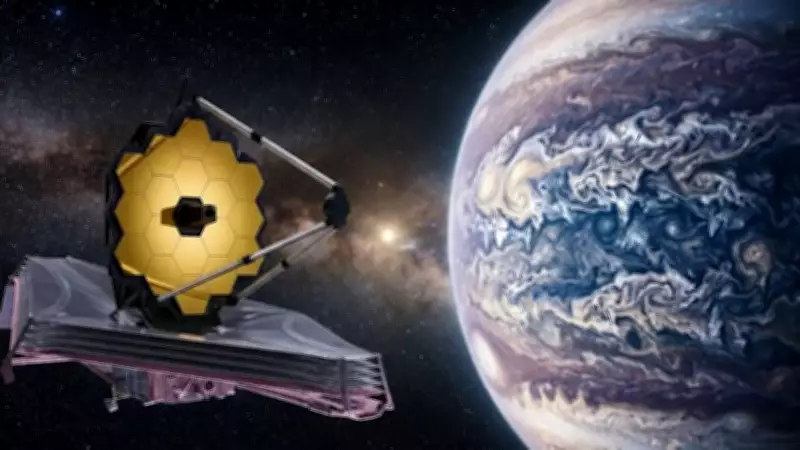
The James Webb Space Telescope (JWST) has achieved a groundbreaking milestone by capturing a direct image of Epsilon Indi Ab, a 'Super-Jupiter' located just a dozen light-years from Earth. This discovery significantly advances our understanding of planets beyond our solar system.
Key Discovery: Water-Ice Clouds on a Cold Gas Giant
Using its Mid-Infrared Instrument (MIRI), an international team of researchers detected signs in the planet's atmosphere that strongly suggest the presence of patchy clouds composed of water ice. This finding challenges existing models of cold gas giants, as Epsilon Indi Ab's atmosphere appears to be driven by water-ice meteorological cycles, similar to Earth's upper atmosphere, rather than the ammonia-rich composition of Jupiter. The unexpectedly weak ammonia signals have provided scientists with crucial insights into the evolution of giant planet atmospheres, offering a foundation for future characterization of smaller, temperate, and potentially habitable rocky planets across the galaxy.
How JWST Captured the Hidden Giant
According to NASA Science, the JWST employed a specialized coronagraph built into its MIRI instrument to block the bright light from the host star, Epsilon Indi A, enabling direct capture of the planet's heat radiation. Epsilon Indi Ab is a massive world with a precisely measured mass 7.6 times that of Jupiter, making it one of the most massive cold exoplanets ever observed. The data revealed significant absorption at shorter wavelengths than theoretical models predicted, a phenomenon attributed to high-altitude, patchy clouds scattering light.

Record-Breaking Cold World
With an estimated effective temperature ranging from 200 to 300 Kelvin, near the freezing point of water, Epsilon Indi Ab is almost 100 degrees Celsius colder than any other directly imaged gas giant. At such low temperatures, the atmosphere undergoes changes, allowing for the formation of water-ice crystals instead of being dominated by methane and ammonia. This makes the planet a 'Jupiter-analogue' that bridges the gap between scorching hot gas giants in distant star systems and the frigid giants within our own solar system, providing a unique glimpse into water cycles on worlds with immense gravity.
Direct Imaging Unlocks Cold Exoplanets
Most exoplanets are studied through transits, but Epsilon Indi Ab was discovered using direct imaging, a challenging technique as planets appear millions of times dimmer than their stars. As noted by ESA/Webb, this discovery is significant because the planet is a mature, 'middle-aged' world approximately 3.5 billion years old, indicating substantial cooling over time. Studying such a cold and mature planet allows astronomers to refine evolutionary models that predict planetary changes across billions of years.
Current Atmospheric Models Challenged
Research published in The Astrophysical Journal Letters highlights that the apparent lack of methane and ammonia suggests high atmospheric metallicity—a large presence of elements heavier than hydrogen and helium. Heavy elements may cause dense clouds to form or increase light absorption. This observation strongly contradicts current one-dimensional atmospheric simulations and implies that 'Super-Jupiters' could possess more complex chemical compositions than previously thought.