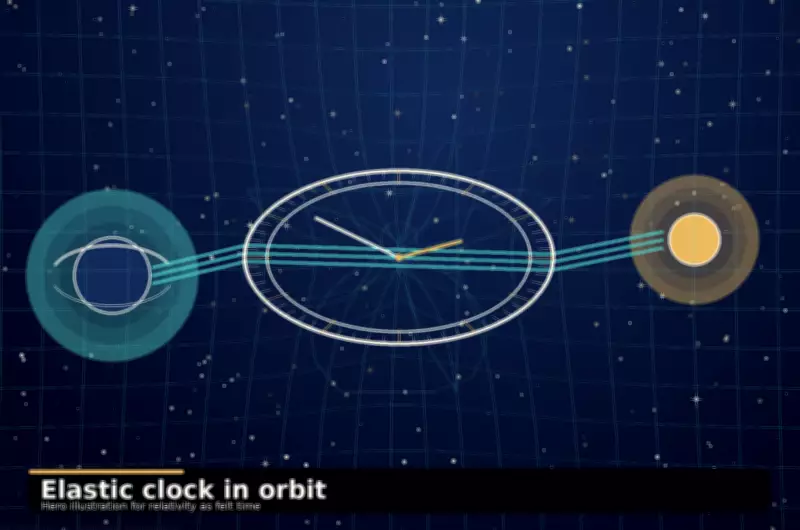
Interstellar, Einstein, and the Strange Elasticity of Time
The blockbuster film Interstellar captivated audiences with its mind-bending portrayal of time, where hours on a distant planet equate to years on Earth. This cinematic depiction is not mere science fiction but is deeply rooted in the groundbreaking theories of Albert Einstein, specifically his theory of relativity, which introduces the concept of time's elasticity.
The Science Behind Time Dilation
Einstein's theory of relativity revolutionized our understanding of time and space. It posits that time is not a constant, universal flow but is relative and can stretch or compress depending on factors like gravity and velocity. This phenomenon, known as time dilation, means that time passes at different rates for observers in different gravitational fields or moving at different speeds.
In Interstellar, this is vividly illustrated when the crew visits a planet orbiting a massive black hole. The intense gravity of the black hole causes time to slow dramatically on the planet's surface compared to a spaceship farther away. As a result, what feels like a few hours for the astronauts translates to decades passing for those on Earth, highlighting time's malleable nature.

Real-World Implications and Evidence
While Interstellar takes artistic liberties, the science of time dilation is well-established and has real-world applications. For instance:
- Global Positioning System (GPS): Satellites in orbit experience time slightly faster than on Earth due to weaker gravity and their high speeds. Engineers must account for this time difference to ensure GPS accuracy, adjusting clocks by microseconds daily.
- Experimental Proof: Experiments with atomic clocks have confirmed time dilation. Clocks on fast-moving airplanes or at high altitudes tick at different rates compared to stationary ones, validating Einstein's predictions.
- Cosmic Scales: In astrophysics, time dilation affects observations of distant celestial events, such as supernovae, where time appears stretched due to the universe's expansion.
Philosophical and Cultural Impact
The elasticity of time challenges our everyday perception of a linear, unchanging timeline. It invites philosophical questions about reality, existence, and human experience. In popular culture, films like Interstellar bring these abstract concepts to life, making complex physics accessible and sparking curiosity about the universe's mysteries.
Einstein's insights remind us that time is not just a measure on a clock but a dynamic dimension intertwined with space. As we explore deeper into space or develop advanced technologies, understanding time's flexibility becomes crucial for future scientific endeavors.
In summary, Interstellar serves as a powerful narrative tool to explore Einstein's theories, demonstrating how time can bend and warp under extreme conditions. This blend of science and storytelling enriches our appreciation of the cosmos and the fundamental laws that govern it.