Long ago, Indian kitchens ran on firewood, charcoal, and cow dung cakes. Today, almost every home next door runs on that one familiar blue flame: LPG. That familiar red gas cylinder is what keeps it all going. The steady blue flame is powered by LPG or Liquefied Petroleum Gas, which has travelled a complex journey: crossing oceans, borders, and global markets before reaching your stove.
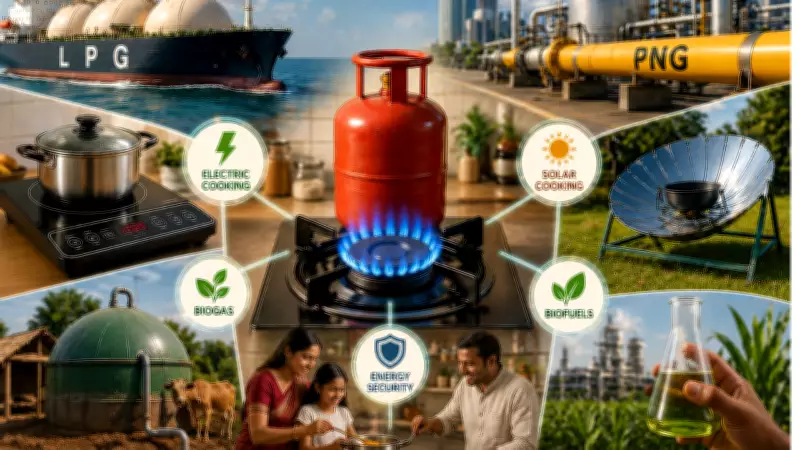
Apart from LPG, people are also becoming increasingly interested in alternatives like PNG, solar cookers, electronic options, and biofuels. However, even with these pipelines, LPG still dominates.
But what if that everyday flame slips out of reach someday? Two months back, when tensions flared in the Middle East and Iran tightened its grip over the crucial Strait of Hormuz, the ripple effects spilled across the globe and particularly into the energy sector. This narrow stretch of water carries nearly 20% of the world's oil, and even a small disruption can send global energy markets into a spin.

India's LPG Equation
For India, the concern was hard to miss. Nearly 90% of its LPG imports pass through this very route, so even a distant geopolitical issue can quietly walk into Indian kitchens. For many households, it wasn't just a headline. Queues formed for cylinder refills, and there were even reports of black marketeering, despite repeated government assurances that adequate supplies were available nationwide. The crisis has left an uncomfortable question: how secure is that everyday blue flame we take for granted?
The vulnerability is exactly what has brought the conversation back into focus. India's clean cooking journey, powered over the past decade by aggressive LPG expansion, now stands at an inflection point. What began as a mission of access, getting cleaner fuel to every household, is gradually evolving into a tougher balancing act of sustainability, affordability, and energy security.
And the numbers make it hard to look away. Between FY21 and FY25, import dependence has remained persistently high, ranging between 55% and 59% of total consumption. In FY25, India's LPG consumption stood at 31.3 million tonnes, while domestic production remained stagnant at 12.8 million tonnes. This left a significant gap of over 18 million tonnes, met through imports. The trend shows a widening supply-demand imbalance. While consumption has steadily risen from 29.7 million tonnes in FY24 to 31.3 million tonnes in FY25, domestic output has shown little movement. As a result, imports have increased to 20.8 million tonnes in FY25, highlighting the country's growing dependence on external supply sources to meet household energy demand.
Which means every global energy shock, every price spike, every geopolitical flashpoint has a direct line into Indian kitchens, right into that moment when you turn the knob on the stove. So the question isn't really whether India needs alternatives to LPG anymore. It's this: What these alternatives could be?
A Shift Already Underway
Here's the interesting part: India isn't starting from scratch. Look closely, and the country is already running on a multi-fuel cooking system. Piped natural gas (PNG) is beginning to penetrate deeper into cities. Biomass and biogas still support rural households. Electricity is quietly entering the mix. LPG solved one major problem, access, but created new ones: import dependence, subsidy burdens, and affordability gaps. So instead of replacing LPG entirely, the push is more towards: What if the future kitchen runs on multiple fuels, not just one?
PNG: Convenient, but Still Fossil-Based
Piped Natural Gas (PNG) is quietly reshaping urban kitchens in India but how different is it really from the LPG cylinders most households still use? Instead of booking and replacing cylinders, PNG flows directly into homes through underground pipelines, offering a continuous, on-demand supply of clean-burning natural gas. It removes the hassle of deliveries and the risk of running out of fuel mid-cooking. The biggest advantage lies in safety and convenience. Unlike LPG cylinders, which store highly pressurised gas and require manual handling, PNG works at lower pressure and includes automatic shut-off systems that immediately stop supply in case of a leak. This also lowers the risk of gas accumulation, explosions, and suffocation, while ensuring uninterrupted cooking.

Since the Middle East conflict began and the energy crunch was feared to enter everyday lives, the government has been encouraging households to switch from LPG to PNG. The shift is already visible. India has over 1.6 crore domestic PNG connections, with expansion across 307 geographical areas covering households, commercial, and industrial users. Recently, more than 42,800 LPG consumers have surrendered their cylinders in favour of PNG, while lakhs of new connections are being added as infrastructure expands. However, adoption still depends on large-scale pipeline networks, household installations, and upfront conversion costs, which slow down rollout in some regions. Even so, with government push and rising urban demand, PNG is steadily positioning itself as a safer, more seamless alternative in India's evolving cooking fuel landscape.
Electric Cooking: The Quiet Disruptor in Urban Homes
Inside India's urban kitchens, one of the most visible alternatives to LPG is already present, not futuristic, but familiar: electric cooking. Induction cooktops, electric pressure cookers, and infrared stoves are widely available today, and with near-universal household electrification, the basic infrastructure is already in place. What is now accelerating interest is simple economics. Induction cooking is highly efficient at the point of use, around 80–90% compared to 45–55% for LPG, and is already being adopted as a supplementary option in urban homes. Furthermore, a study by IEEFA shows that electric cooking can be about 37% cheaper than non-subsidised LPG and nearly 14% cheaper than PNG. Along with zero direct household emissions, better indoor air quality, and reduced dependence on imported fuels, the case for electric cooking is getting stronger. Yet, a large-scale shift is not without challenges.
Replacing LPG entirely faces structural limits. Cooking creates sharp morning and evening peak demand, which would put significant pressure on electricity distribution systems if adoption rises quickly. It would require major upgrades in grid capacity and infrastructure. Puneet Kumar, Partner, EY Parthenon-India, told TOI: "Electric based cooking requires stable electricity, new utensils and higher sanctioned load. For lower-income households, LPG despite price volatility remains cheaper, faster, and culturally familiar...In the current scenario, though switching does appear necessary to certain extent (% require deliberation), but we need a well-defined rollout plan to build commensurate electric infra and adoption." There are also practical barriers: the need for stable power supply, higher sanctioned loads, and compatible cookware. For many lower-income households, LPG still feels more reliable, quicker, and culturally familiar. At a broader level, since nearly 70% of India's electricity still comes from coal, shifting cooking demand to electricity without cleaning up the grid risks moving emissions upstream rather than eliminating them. Because of these factors, the transition needs to be gradual and carefully planned rather than abrupt.
Biogas: The 'Desi' Solution
Imagine if you could use kitchen waste to fuel your kitchen! From cattle dung and crop residue to kitchen waste and municipal garbage, almost every form of organic waste carries energy. In theory, it is a ready-made fuel system sitting in plain sight. Through a process called anaerobic digestion, this waste is broken down in oxygen-free conditions to release gas that can directly power cooking stoves. Refined further, it becomes Compressed Biogas (CBG), a purified, pressurised form that can be transported through cylinders and pipelines much like natural gas. On paper, the scale looks impressive. "India has significant potential to produce biogas and compressed biogas (CBG) given the immense availability of agricultural residue, organic waste, and municipal biomass," Sushil Mishra, Director at Crisil Intelligence told TOI.
India already has around 132 operational CBG plants with a combined production capacity of roughly 920 tonnes per day. Policy support has also expanded over time. The National Policy on Biofuels (2018) pushed advanced biofuels like CBG, while the GOBAR-DHAN initiative aims to convert farm and animal waste into clean fuel and organic manure, targeting rural-scale deployment. But the gap between promise and performance is still wide. India's estimated biogas potential stands at around 87 billion cubic metres annually, yet less than 1% of it is currently being tapped.
Challenges for India's Biogas Ambitions
The advantages are clear: local fuel production, reduced waste dumping, lower emissions, and an additional income stream from organic manure. But the constraints: high setup costs, inconsistent feedstock supply, weak financing structures, and operational complexity, continue to slow momentum. EY's Kumar said, "Though India's SATAT (Sustainable Alternative Towards Affordable Transportation) scheme aims for setting up 5,000 CBG plants, but actual commissioning has been slower than planned due to high capital costs, inconsistent feedstock supply, and financing." Kumar pointed out that the challenge begins with the very nature of the fuel itself. "Biogas being produced from biomass is abundantly available but has a structural disadvantage over LPG."
Biogas faces major logistical and structural hurdles despite its potential. Biomass is difficult to collect, store, and transport because it is high-volume, low-density, geographically dispersed, and seasonal, with transportation becoming especially unviable beyond 20–30 km. Unlike LPG, which moves efficiently through refineries, pipelines, extraction units, and bottling plants, biogas lacks such a streamlined distribution system. Storage adds another layer of complexity, requiring high capital investment and dealing with safety risks and corrosion caused by hydrogen sulfide and moisture. It also needs purification, costly compression, and compliance with strict regulations. Its decentralised nature further limits scale. In other words, the fuel exists, but moving it, storing it, and scaling it remains the bottleneck. At the same time, Mishra noted that scaling biogas will require time, investment, and stronger systems for feedstock supply, processing, and distribution. Translating this potential into large-scale adoption requires time, investment, and resolution of structural challenges. These include consistent feedstock aggregation, efficient processing systems, and last-mile logistics. In comparison, LPG benefits from a well-established nationwide distribution network and has played a pivotal role in expanding clean cooking access. In the current context, biogas and CBG are best positioned as complementary solutions rather than immediate substitutes for LPG.
Solar Cooking: The Cleaner Alternative
What if the cleanest kitchen fuel wasn't something you bought but something that literally came with the morning sun? Solar cooking is being seen as one of the most sustainable alternatives in India's clean cooking mix. It's simple in idea, but powerful in impact, retaining nutrition, keeping costs low, and cutting emissions almost entirely out of the equation. Where it really stands out is scale. Think large kitchens that feed hundreds or even thousands of people every day: residential schools, industrial canteens, hospitals, religious ashrams, police and defence messes, even hotel kitchens. In such settings, solar cookers can replace nearly 35–40 LPG cylinders a year when used at full capacity.
And it's not just one kind of "solar cooker" anymore. The technology has quietly diversified. At the basic end are solar box cookers, which work at around 100°C, simple, steady, and sun-dependent. Then come concentrating solar cookers, like parabolic dishes, which can go beyond 100°C and actually handle more intensive cooking tasks. A step ahead are advanced round-the-clock systems that store heat, allowing cooking even when the sun isn't shining. And then there are community solar cookers, which use superheated steam and are already running in places of mass feeding, including temples like the Shirdi Sai Temple in Maharashtra. The innovation pipeline is also heating up, with newer systems like Surya Nutan and PV-based induction cooking trying to make solar cooking more flexible and less weather-bound. So while it still sounds like a "sunny-day solution," solar cooking is quietly moving from experimental setups to serious community kitchens and eventually into homes.
Ethanol for Cooking: The Next Big Thing?
India has already crossed a key milestone in transport fuels, achieving its 20% ethanol blending target ahead of schedule. The next question now being explored is more unusual: can ethanol move from vehicles into kitchens? The petroleum sector is actively pushing the idea of ethanol as a cleaner household cooking fuel, as part of efforts to cut dependence on imported LPG and expand the biofuel ecosystem. R S Ravi, Director (Downstream) at the Federation of Indian Petroleum Industry (FIPI), speaking at the All India Distillers' Association conference, said that "a lot of work is happening" on ethanol-based cooking technologies. He pointed to ongoing research at institutions such as the LPG Equipment Research Centre and several IITs, where prototypes of ethanol-compatible stoves are being developed. According to Ravi, the idea is still in early stages but gaining momentum, with research bodies already testing ethanol stoves as a potential cleaner alternative or supplement to LPG, especially for rural and semi-urban households. However, he also noted that moving ethanol from bulk industrial supply to homes would require entirely new logistics systems, including packaging formats and last-mile delivery networks. For now, ethanol cooking remains in the pilot and policy exploration stage, but it is increasingly part of India's broader clean cooking conversation.
Bio-LPG: Same Cylinder, Cleaner Fuel
What if India's clean cooking transition didn't require changing stoves, cylinders, or habits, but only changing what flows through them? That's the promise of next-generation fuels like Dimethyl Ether (DME), which aim to fit directly into India's existing cooking system rather than replace it. Commenting on the fuel's requirement, Kumar added: "DME needs large-scale production capacity, regulatory push and consumer awareness. Their usage could be enhanced with policy approaches similar to ethanol blending in petrol and CBG blending in natural gas networks. Its enhanced use will help to lower import exposure, improve energy security and can buy time for infrastructure development for alternative fuels." Compatibility is its biggest strength: no new stoves, no behavioural shift, and no overhaul of infrastructure. Just a cleaner version of what households already use. However, it is still in early stages. DME requires significant investment, policy support, and scaling up of manufacturing capacity. For now, these fuels represent a transitional idea: cleaner energy designed to slip quietly into the systems India already relies on.
So, What's the Way Forward?
Experts say India's shift away from LPG won't be a straight replacement, but a gradual, multi-layered transition spread over the next 10–15 years. Puneet Kumar pointed out that LPG's dominance is deeply structural, backed by a nationwide delivery network, long-standing consumer habits, and strong subsidy support like PM-Ujjwala. Moving beyond it, he said, would essentially mean rebuilding a similar ecosystem for new fuels. While options like biogas and electricity are promising, their scale-up will depend on infrastructure upgrades, grid readiness, and policy support, making the transition a long-term process. Sushil Mishra of Crisil also highlighted that there is unlikely to be a single replacement for LPG. Instead, households will choose based on practicality, availability, cost, convenience, and lifestyle. PNG may work best where pipeline networks exist, biogas where organic waste is consistently available, and electric cooking for homes with stable power or rooftop solar. Transitional fuels will continue to play a role, with adoption shaped by local conditions rather than a uniform national shift. In other words, India's cooking energy future is likely to be a mix of solutions rather than a single fuel story.