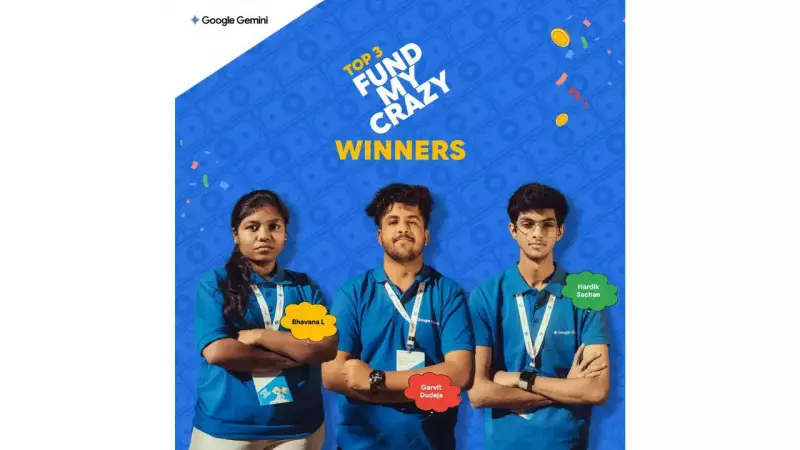
Google has revealed the top three student innovators from its nationwide Fund My Crazy campus innovation campaign, a contest that challenged participants to tackle everyday campus problems using Gemini AI as a thinking partner. The initiative saw an overwhelming response, attracting more than 29,000 entries in just nine days from students across India.
Meet The Top Three Winning Innovations
Securing the first prize, Hardik Sachan from Shaheed Bhagat Singh Evening College in Delhi developed Feko Pay. This is a chat-first application designed to end the common headache of splitting cafe bills among friends. The app employs artificial intelligence to itemize bills simply by scanning a photo, effectively solving the issue of chasing friends for payments. Sachan credited Gemini AI for assisting him during the ideation phase and in creating his presentation materials.
"Gemini helped me a lot while making my presentation and ideation stage, especially Canvas and Nano Banana. The mock-ups and everything else were perfect," Sachan stated.

In second place was Garvit Dudeja from Malaviya National Institute of Technology in Jaipur with his project, Swappr. This platform introduces a gamified barter system that helps students unlock value from unused dormitory items. Through a swipe-based interface limited to their campus, students can trade expensive gear like guitars and textbooks. Dudeja highlighted how the AI tool streamlined his creative process.
"Google Gemini helped me organize my thoughts, structure my thought process, and get me on a structured path," Dudeja noted.
Bhavana L from Sona College of Technology in Salem, Tamil Nadu, took the third spot with Rest In Pieces. This unique marketplace identifies reusable hardware components from abandoned senior-year projects. By converting discarded robots and sensors into affordable resources for junior students, the platform tackles the growing problem of electronic waste on campuses. Bhavana confirmed that Gemini played a crucial role in her research and presentation development.
Showcasing Widespread AI Adoption in Student Projects
The campaign also recognized seven additional finalists who demonstrated the versatile application of AI-assisted problem-solving. Their projects addressed a wide array of campus challenges:
- P S Sai Vikas from Bengaluru used Gemini as a companion while designing concepts for 24/7 printout machines.
- Devika Mukundan from Thrissur analyzed six months of data with Gemini's help to predict canteen food waste and reduce leftovers.
- Shivam Saini from Panipat utilized the tool to visualize and scale his proposed student travel network.
- Harshal Ashok Suryavanshi from Kolhapur developed a digital out-pass system, with Gemini simplifying complex concepts.
- Aditya Rao from Chennai employed Gemini to visualize his idea for robotic "monkey honeypots."
- Dani Mathew from Vaikom and Eshwar Anand Badugu from Rajkot both leveraged Gemini to synthesize research and generate mockups for their respective projects.
AI as a Catalyst for Student Confidence and Innovation
This campaign underscores the rapidly growing integration of artificial intelligence tools in the academic and innovative pursuits of Indian students. The trend is supported by a Google-Kantar report released earlier this year, which found that a staggering 95% of Gemini student users in India reported feeling more confident. They are using the AI tool extensively for academic support and early career preparation.
Participants in the Fund My Crazy contest leveraged Gemini for a diverse range of tasks, from building technical stacks and visualizing complex solutions to testing their initial assumptions. The contest serves as a powerful demonstration of how AI tools are becoming deeply integrated into student innovation processes. They act as catalysts that help translate raw, creative ideas into structured, presentable solutions across countless real-world use cases, shaping the problem-solvers of tomorrow.