Indian Developers Embrace Personal Accountability for AI Outcomes
According to the latest Dev Barometer survey from BairesDev, a significant majority of Indian software developers are stepping up to take personal responsibility for the outcomes generated by artificial intelligence tools. The quarterly study, conducted in January 2026, polled 1,329 developers across 61 countries, including 200 from India, revealing a strong sense of ownership and trust in AI technologies.
Key Findings on AI Accountability and Trust
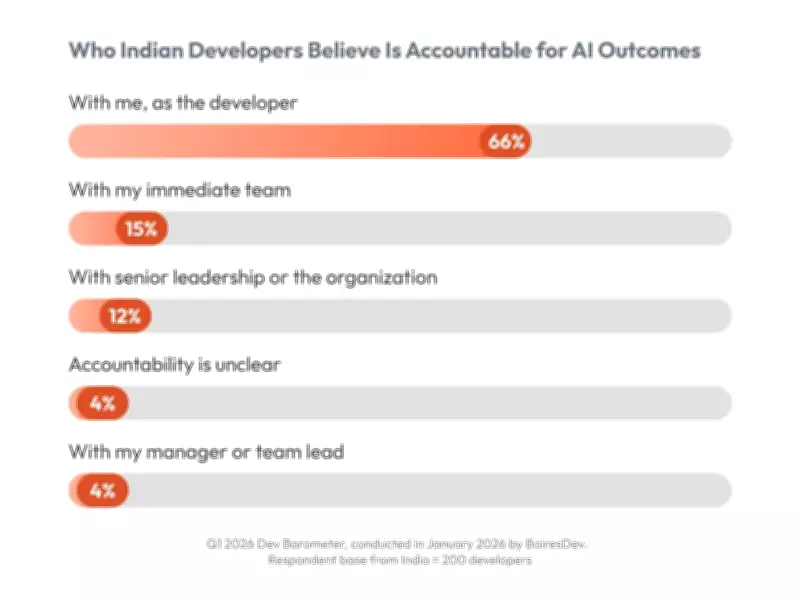
The survey highlights that 66% of Indian developers believe accountability for AI-generated results rests with them personally. In contrast, only 4% reported uncertainty about where accountability lies. This indicates a clear shift toward individual responsibility as AI becomes more integrated into production workflows.
When it comes to fairness, 70% of Indian developers trust AI tools to be equitable across genders. Breaking this down further, 72% of male developers expressed trust, compared to 65% of female developers. Additionally, 36% of respondents noted that AI has increased visibility or opportunities for women in software teams, while 31% observed no significant change, and 12% felt it reduced opportunities.

Career Momentum and Validation Challenges
A striking 90% of Indian developers feel that using AI and developing related skills is boosting their career momentum. This sentiment underscores AI's role in accelerating productivity and mobility within the tech industry. However, validation remains a critical focus area, with 60% identifying critical evaluation of AI output as a baseline skill for 2026.
Despite high comfort levels—92% feel at ease using AI tools, and 58% believe benefits outweigh overhead—challenges persist. 68% of developers cited a lack of knowledge about validating AI outputs as a common gap in teams adopting these tools. Furthermore, 34% pointed to deadline pressure as a primary barrier to verifying AI-generated work.
Factors Influencing AI Benefits and Enterprise Insights
Indian developers identified key factors determining who benefits most from AI adoption:
- 68% highlighted access to tools, training, and infrastructure, tied with willingness to experiment.
- 58% emphasized seniority and experience as driving factors.
- 51% cited organizational culture and team norms.
Among women developers, team culture and norms (60%) ranked higher than seniority and experience (56%) in shaping advancement through AI skills, suggesting that enablement environments are increasingly crucial.
Nacho De Marco, CEO and Co-Founder of BairesDev, commented, "AI isn't a side tool anymore. It's embedded in production workflows, and once it touches production, accountability changes. The teams that scale AI successfully treat validation as engineering, not as an afterthought." He added that building accountability involves rigorous testing and human oversight, with developers owning final decisions on AI-generated code.
Survey Methodology and Background
The Dev Barometer survey by BairesDev, a nearshore software development company serving clients like Abbott, Adobe, and Google, included 200 Indian developers in its Q1 2026 edition. Among Indian respondents, 36% had eight or more years of professional experience, and 29% were women. This data reflects how AI is reshaping delivery workflows and career trajectories in India's engineering teams, marking an inflection point in enterprise AI adoption where responsibility consolidates at the individual level.