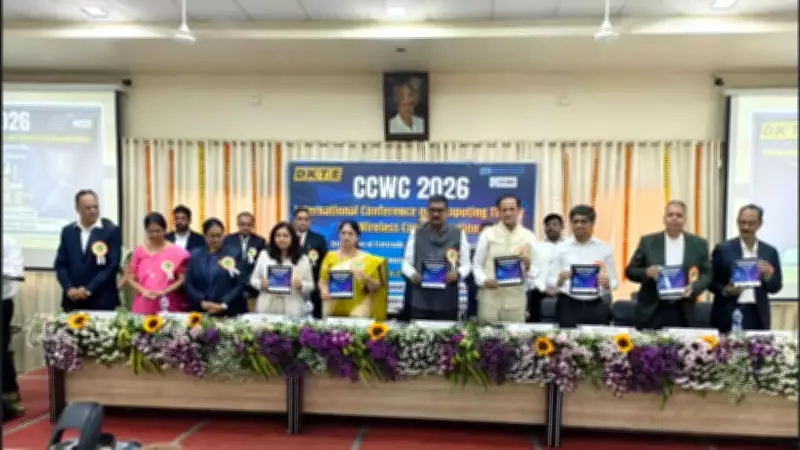
IEEE International Conference CCWC 2026 Announces Prestigious Best Paper Awards
The IEEE International Conference on Computing, Communication and Web Technologies (CCWC 2026) has officially announced its Best Paper Awards, honoring two exceptional research contributions that tackle critical challenges at the convergence of artificial intelligence, governance frameworks, and next-generation computing infrastructure. The conference organizers issued a detailed statement highlighting the significance of these awards within the global research community.
Rigorous Selection Process from Thousands of Submissions
CCWC 2026 received an impressive 3,434 research submissions from scholars and scientists across the globe, representing a diverse range of technological disciplines and geographical regions. Following an exhaustive multi-stage review process conducted by expert committees, only 266 papers were ultimately accepted for presentation at the conference. This represents an acceptance rate of approximately 7.7 percent, underscoring the exceptional selectivity and technical depth that characterizes this premier international event.
First Award: Governance-as-Architecture Framework for AI Compliance
The first Best Paper Award was presented to "Governance-as-Architecture: A Framework for Compliance-Native AI in Regulated Large-Scale Data Ecosystems" authored by Sudhir Vishnubhatla. Reviewers praised this paper for fundamentally advancing the discourse on artificial intelligence governance beyond conventional policy checklists and compliance documentation.

The research introduces a comprehensive, engineering-driven framework where policy requirements, control mechanisms, and evidentiary standards become integral architectural components rather than supplementary afterthoughts. The paper presents a sophisticated multi-plane reference architecture consisting of control, data, model, and decision planes that demonstrate with remarkable clarity how policy-as-code implementations, default lineage tracking, model-risk assessment gates, and human-in-the-loop safeguards can be systematically integrated into large-scale, distributed AI ecosystems.
The technical committee noted that the paper "reads like an operating manual for regulators and chief data officers" and successfully combines conceptual rigor with practical implementation roadmaps that have immediate relevance across multiple sectors including financial services, healthcare delivery systems, critical infrastructure management, and public-sector AI deployments.
Second Award: Quantum Computing as a Service Architecture
The second Best Paper Award was conferred upon "Quantum Computing as a Service (QCaaS): Architecture, Orchestration, and Performance Trade-offs" authored by Rajesh Kumar, Hemang Upadhyay, Chandra Prakash Pandey, and Priya Ranjan Kumar. In a field often characterized by theoretical promises and abstract discussions, this research distinguished itself through its systematic, engineering-focused examination of hybrid quantum-classical cloud platforms.
The paper meticulously details a comprehensive QCaaS stack architecture, ranging from user application programming interfaces and orchestration services down to quantum processing units and underlying cloud infrastructure. The authors provide thorough analysis of how scheduling algorithms, communication latency factors, error mitigation techniques, and cost-aware resource management strategies collectively influence real-world performance outcomes.
By conducting comparative evaluations of classical, hybrid, and pure-quantum execution models, and grounding their discussion in practical application domains such as optimization problems, financial governance systems, ethical AI implementations, and supply-chain management, the researchers have created what reviewers described as "one of the most practically useful blueprints for enterprises planning serious quantum experiments over the next decade."

Technical Excellence and Practical Relevance Recognized
According to the CCWC 2026 technical program committee, both award-winning papers demonstrated exceptional merit not only in their technical sophistication but also in their maturity of insight and clarity of presentation. These contributions successfully transform complex, specialized topics—specifically regulatory-grade AI governance frameworks and quantum cloud computing architectures—into actionable guidance for technology practitioners, policy makers, and industry leaders worldwide.
The conference also featured distinguished keynote speakers including Rishiraj Kohli, an independent researcher based in the United States, and Sumeer Basha Peta, an independent researcher from Massachusetts, United States, who shared their insights on emerging technological trends and research directions.