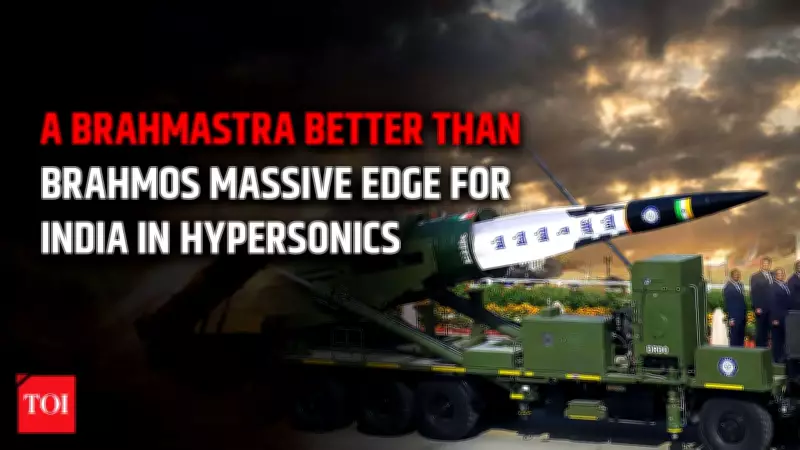
Hypersonic warfare is emerging as the most disruptive military technology of the twenty-first century. These weapons, traveling at speeds above Mach 5, include glide vehicles boosted by rockets that maneuver unpredictably and cruise missiles powered by scramjets capable of sustained hypersonic flight. Unlike ballistic missiles, hypersonic weapons can change course mid-flight, fly at lower altitudes, and exploit radar blind zones. Their speed and maneuverability make interception nearly impossible, compressing decision timelines to seconds and ensuring penetration of even advanced defenses.
India's Hypersonic Journey
India has advanced from supersonic to hypersonic systems. Operation Sindoor in 2025 demonstrated the lethality of BrahMos supersonic missiles. Building on this, the Defence Research and Development Organisation tested an actively cooled scramjet combustor for 1,200 seconds, a world-class achievement. India's projects include the Hypersonic Technology Demonstrator Vehicle, the planned BrahMos-II, and concepts such as the Dhvani glide vehicle, LR-AShM, and ET-LDHCM, signaling determination to achieve indigenous hypersonic capability.
Strategic Implications
Hypersonic weapons could fundamentally alter the rules of war. Their ability to bypass traditional missile defenses and strike with little warning forces nations to rethink deterrence strategies. For India, indigenous hypersonic technology reduces reliance on foreign suppliers and enhances strategic autonomy. The development of such systems also boosts the domestic defense industrial base, fostering innovation in materials, propulsion, and guidance systems.

Global Context
Several nations are racing to develop hypersonic weapons, including the United States, Russia, China, and now India. The technology is seen as a potential game-changer in regional conflicts, offering a first-strike advantage or a credible deterrent. However, the high cost and technical challenges mean that only a few countries will likely field operational systems in the near term. India's progress, exemplified by the scramjet test, positions it as a key player in this high-stakes arena.
In conclusion, hypersonic missiles represent a modern-day Brahmastra—a weapon of immense power and strategic significance. As India continues to push the boundaries of defense technology, the world watches to see how these new capabilities will shape the future of conflict.