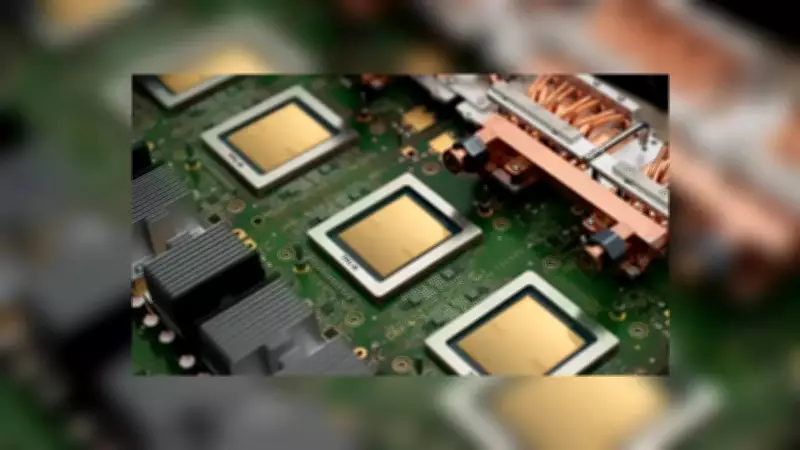
Google Launches Specialized TPU Chips for the Agentic AI Era
At the Google Cloud Next 2026 conference, Google has officially unveiled its latest generation of Tensor Processing Units – the TPU 8i and TPU 8t. These chips are specifically engineered for what the company terms the "Agentic Era," marking a direct challenge to Nvidia's dominance in the AI silicon market. The strategic move involves optimizing hardware for autonomous AI agents that can perform complex, multi-step tasks on behalf of users.
Dual-Chip Strategy: Training vs. Inference
Google is decisively moving away from a one-size-fits-all hardware approach. Instead, it has developed two distinct chips to handle the core facets of AI work. The TPU 8t is a training chip optimized for building the world's most complex AI models. According to Google, it can scale to connect up to 9,600 chips as a single super-machine, delivering three times the processing power of previous generations while being twice as energy-efficient. This design aims to construct the "brains" of AI systems faster than ever before.
Complementing this is the TPU 8i, which is designed for inference – the process where an AI model runs and responds to user queries in real-time. Google claims this chip offers an 80% improvement in performance per dollar, enabling companies to deploy millions of AI agents simultaneously without prohibitive costs. It is built for speed, ensuring that AI agents can reason, plan, and execute workflows quickly enough to provide a seamless, responsive user experience.

Google's Full-Stack Advantage Over Nvidia
While Nvidia's GPUs remain the industry benchmark, Google believes its integrated approach provides a critical edge. Unlike Nvidia, which primarily focuses on chip manufacturing, Google controls the entire AI stack. This includes designing the chips, developing AI models like Gemini 3, and operating the massive, energy-efficient data centers where they run. This vertical integration allows Google's hardware and software teams to collaborate closely, fine-tuning the chips to run Google's specific AI code with optimal efficiency.
"It now becomes sensible to specialize chips more for training or more for inference," explained Google Chief Scientist Jeff Dean in a recent interview. By splitting the workload between dedicated chips, Google aims to drastically reduce the response times that often make current AI chatbots feel sluggish, thereby enhancing the practicality of agentic AI.
Major Industry Adoption and Market Shifts
The market is already responding to Google's new offerings. In a significant development, Meta (parent company of Facebook and Instagram) has signed a multi-billion dollar, multi-year contract to utilize Google's TPUs. Santosh Janardhan, Meta's head of infrastructure, acknowledged the potential inference advantages, while also noting that adopting any new platform involves a learning curve.
Furthermore, leading AI developer Anthropic has secured access to up to one million TPUs to power its next-generation models. These high-profile partnerships signal a shifting landscape in AI infrastructure procurement.
Notably, Google is not completely severing ties with Nvidia. Recognizing customer demand for choice, Google Cloud will continue to offer a portfolio of options, including its own Axion CPUs, the new TPU series, and the latest Nvidia GPUs. However, with the launch of the TPU 8-series, Google has unequivocally declared its ambition: to become the foundational provider for the future of autonomous AI agents, directly contesting Nvidia's silicon supremacy in this critical new domain.