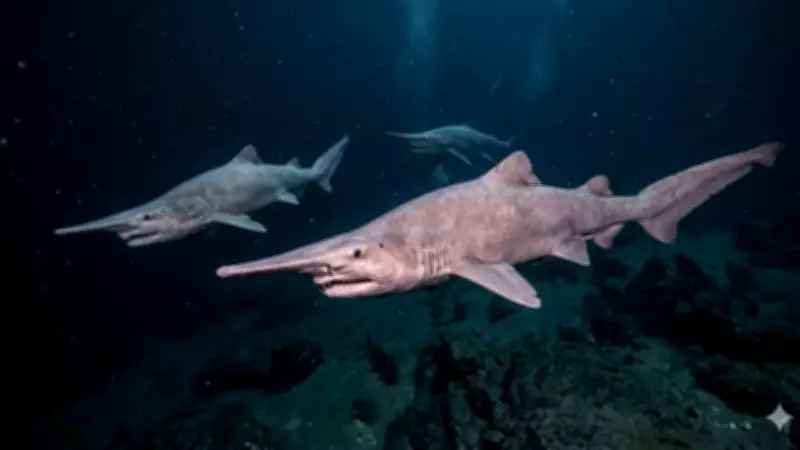
Goblin Shark: A Rare Deep-Sea Predator
Far below the ocean's surface, where sunlight fades into a cold blue darkness, the goblin shark moves slowly through the deep with a face that seems almost unfinished. Its flattened snout, loose skin, and needle-like teeth have helped make it one of the strangest sharks ever photographed, though sightings remain rare. Most people only encounter it through grainy deep-sea footage or preserved museum specimens.
The species has existed for millions of years and is often described as a "living fossil" because its lineage stretches far back through shark evolution. Yet much about its behaviour remains uncertain. Scientists still rely on scattered captures, accidental fishing records, and a limited number of detailed observations to understand how it survives hundreds of metres below the sea surface, where pressure rises sharply, and food can be difficult to find.
Goblin Shark's Oily Liver May Be the Secret to Surviving Deep Oceans
Goblin sharks are usually found along continental slopes and submarine canyons, often between 270 and 1,300 metres deep. Their bodies look noticeably softer than those of many fast-moving sharks closer to the surface. The skin lacks the rigid muscular appearance associated with species such as great whites or makos, which reflects the slower pace of life in deep water.

According to reports by the US Fish and Wildlife Service, the species relies on a large, oily liver to maintain buoyancy in deep ocean conditions. Sharks do not possess swim bladders like many fish, so the liver acts as a natural flotation system. In the goblin shark, this organ can make up a considerable portion of the animal's body weight.
Its pinkish colour is another unusual feature. The skin itself is partly translucent, allowing blood vessels underneath to show through faintly. Dead specimens often lose this colouring quickly after capture, becoming pale grey or brown.
The Strange Jaw Movement Helps Goblin Sharks Hunt in the Darkness
Most sharks bite forward in a relatively direct motion. Goblin sharks do something different. Their jaws can shoot outward from the skull with surprising speed, extending well beyond the head before snapping shut around prey.
This feeding behaviour became the subject of closer scientific attention after researchers analysed high-speed footage of a live specimen in Japan. As reported in research published in Academia, titled "Notes on the record of goblin shark", the jaw projection appears highly specialised for catching fish and squid in low-light environments where sudden movement may matter more than pursuit speed.
The teeth themselves are narrow and sharply pointed rather than serrated. That shape suits slippery prey found in deeper waters. Crustaceans, cephalopods and smaller fish have all been identified in stomach examinations from captured specimens.
Why Goblin Shark Sightings Remain Extremely Rare
Even now, much of the scientific record depends on isolated captures rather than long-term observation. As per the study, a goblin shark was recorded in Indonesian waters, adding to the relatively small number of confirmed sightings from the region.
The report described how specimens are often discovered accidentally through deep-sea fishing operations rather than targeted research missions. In some cases, the sharks arrive damaged because of rapid pressure changes during ascent from deep water. Japan remains one of the main locations where goblin sharks have been documented consistently. Several specimens have also appeared near Taiwan, South Africa, Australia and parts of the Gulf of Mexico. Still, verified records remain scattered enough that many aspects of their migration patterns and population numbers are unclear.
Why the Goblin Shark Is Called a Living Fossil
The goblin shark belongs to the family Mitsukurinidae, a lineage that dates back tens of millions of years. Fossil relatives suggest similar sharks were already present long before modern oceans developed their current ecosystems.

As per the study, evolutionary history partly explains why marine biologists continue studying the species despite the difficulty of observing it alive. Deep-sea animals often preserve traits that disappeared elsewhere over time, especially in stable environments where evolutionary pressures changed more slowly. Its appearance may seem strange beside modern predatory sharks, though much of that impression comes from human familiarity with coastal species. In its own environment, the goblin shark appears highly adapted rather than primitive — a slow-moving hunter designed for darkness, pressure and scarce food far below the surface world.