Harvard Engineer's Flight Map Discovery Reveals Eye's Color Perception Quirks
Hinnerk Schulz-Hildebrandt, a biomedical optics engineer at Harvard Medical School, recently made an unexpected observation while casually checking a flight map on his smartphone. As he traced the flight path with his eyes, he noticed something peculiar: a line that appeared purple when viewed straight ahead seemed to shift to a bluer hue when caught in his peripheral vision. This intriguing flicker between purple and blue, depending on where he focused his gaze, sparked his curiosity and led to the creation of a compelling visual illusion.
The Illusion: Purple Dots on a Blue Background
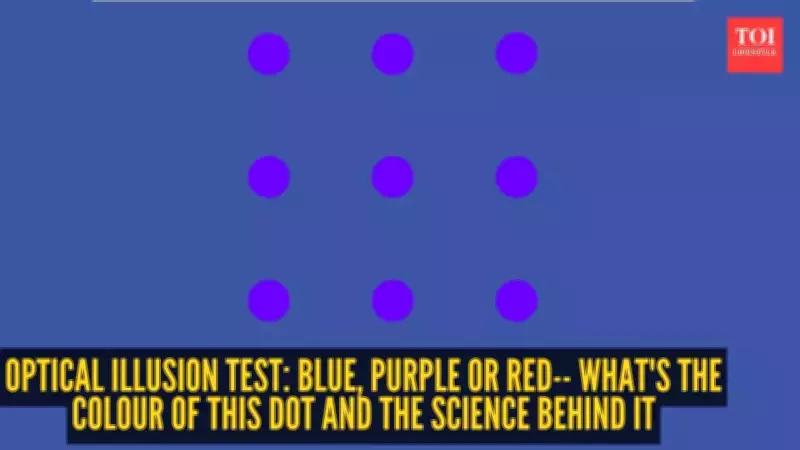
Published in the journal Perception, this illusion features nine small purple dots set against a soft blue background. For individuals with normal color vision, when they fixate their gaze directly on one of these dots, a fascinating effect occurs. The dot at the center of their vision appears distinctly purple, while the surrounding dots gradually take on a bluer tint. At first glance, this might seem like a simple optical trick, but it actually uncovers profound insights into the complex workings of human color perception.
How Our Retinas Influence Color Vision
The effectiveness of this illusion is rooted in the anatomy of our retinas. Specialized cells known as cones are responsible for detecting different wavelengths of light, with specific types for red, green, and blue. In the central region of the retina, called the fovea centralis—which we use for direct staring—there is a relatively low density of blue-sensitive cones. Consequently, our central vision is less attuned to blue compared to the peripheral areas. When we look straight at a dot, our brain receives reduced "blue" input from the center of our visual field, causing the color to perceptually shift toward purple, even though the actual hue on the screen remains unchanged.

The Role of the Yellow Pigment Layer
Adding to this effect is a thin layer of yellow pigment situated in front of the fovea. This layer acts like built-in sunglasses, absorbing some blue and near-ultraviolet light before it reaches the retina. As visual neuroscientist Jenny Bosten from the University of Sussex explains, this yellow filter subtly blocks blue light in the very center of our vision, making the dot under direct gaze appear less blue and more purple. In contrast, the periphery, where this yellow layer is thinner or absent, allows more blue light to pass through, so the same color looks bluer when viewed indirectly. Our brains typically calibrate out this imbalance, but illusions like this one bring it into sharp focus.
Background Color and Simultaneous Contrast
The blue background in Schulz-Hildebrandt's illusion plays a crucial role as well. Our brain does not perceive color in isolation; it constantly compares hues to their surroundings through a process called simultaneous contrast. For instance, a gray circle on a reddish background may appear slightly greenish because the brain interprets it as "less red." Similarly, a dot that is a mix of blue and purple looks more purple against a blue background, as the brain suppresses the similar blue tones. When combined with the central vision's reduced sensitivity to blue, this results in a striking visual shift: one dot seems richer in purple, while others fade toward blue, despite all dots being identical.
Connections to Maxwell's Spot and Broader Implications
This illusion also relates to an older phenomenon known as Maxwell's spot, where people perceive a faint red or yellowish dot near the center of their vision under specific lighting conditions. Last year, experimental psychologist Akiyoshi Kitaoka of Ritsumeikan University in Japan independently developed a version of Maxwell's spot illusion using blue, green, or red dots on solid backgrounds to emphasize the weakness of blue perception in central vision. Bosten notes that Schulz-Hildebrandt's blue-on-blue background likely amplifies the effect by layering multiple known visual tricks: the yellow pigment layer, the uneven distribution of blue cones, and the influence of neighboring colors.

In summary, while this illusion does not reveal entirely new biological processes, it skillfully integrates several well-understood mechanisms to create a fresh and surprising experience. It serves as a gentle reminder that our perception of reality is not a direct reflection but a carefully edited translation shaped by the intricate structures of our eyes and the adaptive habits of our brain.