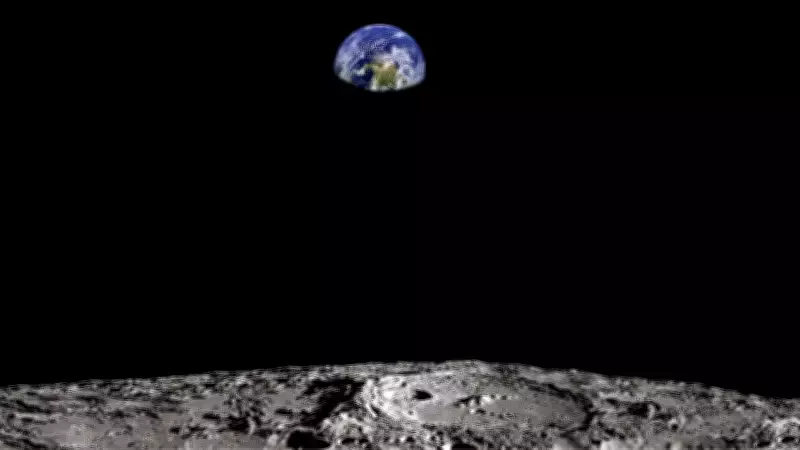
On a clear night, the Moon dominates the sky, bright enough to cast shadows and large enough for dark patches and surface features to be seen without any equipment. It appears close, almost familiar. For most people, the Moon feels like Earth's immediate neighbor while the planets belong to a much larger and more remote part of the Solar System.
That impression is misleading. Despite looking nearby, the gap separating Earth and the Moon is so vast that all eight planets of the Solar System could be lined up within it. Even Jupiter and Saturn, the two giants that dwarf every other planet, would fit into the available space. It sounds like a trick of mathematics at first, but the numbers behind it reveal just how difficult it can be for the human mind to judge distances in space.
The Earth-Moon Gap Is So Huge That Every Planet Could Fit Inside It
According to NASA, the Moon sits at an average distance of about 384,400 kilometers from Earth. The figure changes slightly because the Moon follows an elliptical path rather than a perfectly circular one, moving closer and farther away during different parts of its orbit.

That average distance is already enormous by everyday standards. As per NASA, roughly 30 Earth-sized worlds could fit between our planet and the Moon. Seen another way, the space separating the two bodies is far larger than many people imagine when they glance upward at the night sky.
The scale becomes easier to appreciate when compared with planetary sizes. Earth itself measures around 12,756 kilometers across. The Moon may seem almost within reach on a clear evening, yet there is enough room in the gap for dozens of worlds the size of our own planet.
Calculation Behind Every Planet Fitting Between Earth and the Moon
The claim that every planet could fit between Earth and the Moon comes from a straightforward exercise. According to the BBC, the diameters of Mercury, Venus, Earth, Mars, Jupiter, Saturn, Uranus and Neptune, then place them side by side. When their widths are combined, the total comes to just under 400,000 kilometers.
That figure is remarkably close to the average Earth–Moon distance. At first glance, it appears slightly too large, but the Moon does not remain at the same distance from Earth throughout its orbit. When it reaches the farthest part of that journey, the available gap grows enough for the entire planetary lineup to fit.
What makes the comparison striking is the inclusion of the gas giants. Jupiter alone spans nearly 140,000 kilometers in diameter, while Saturn stretches more than 120,000 kilometers across. Together, they account for most of the total distance. Yet there is still room for the remaining planets to join the line. It is one of those rare astronomical facts that sounds invented until the arithmetic is checked.
The Moon Illusion and the True Distance Between Earth and the Moon
Part of the confusion comes from the way the Moon presents itself in the sky. It is both bright and visually detailed. Unlike planets, which generally appear as points of light to the unaided eye, the Moon shows visible surface markings. People can identify dark lava plains and broad contrasts in terrain without a telescope. The result is an object that feels physically close.
As per the BBC report, there is also the well-known Moon illusion. When the Moon sits low on the horizon, it often appears much larger than it does when overhead. Although its actual size in the sky remains nearly unchanged, surrounding landscape features can trick the brain into interpreting it differently.
Because of these visual cues, many people instinctively underestimate the distance involved. The Moon seems close enough that fitting even Jupiter between it and Earth feels implausible. Fitting every planet sounds impossible. Space, however, rarely matches human intuition. Vast emptiness is often the dominant feature of the Solar System, and the Earth–Moon system is no exception.

What the Earth–Moon Distance Reveals About the Solar System
The comparison highlights something astronomers encounter constantly: celestial objects are usually separated by far more space than popular illustrations suggest. Textbook diagrams often compress distances to fit onto a page. Planetary orbits are reduced to neat layouts, and neighboring worlds appear relatively close together. In reality, the Solar System is dominated by gaps.
The Earth–Moon distance offers a useful example because it involves two objects people already know well. The Moon is Earth's only natural satellite and has accompanied our planet throughout human history. Yet even this familiar relationship contains a stretch of space large enough to accommodate every recognized planet in the Solar System.
NASA's figures on the Moon's average distance make the calculation possible, while planetary measurements show the comparison is more than a curiosity. It serves as a reminder that the scales involved in astronomy are often far beyond what everyday experience prepares us to imagine.
The next time the Moon rises above the horizon and appears almost within touching distance, it is worth remembering what lies hidden in that gap. There is enough room there for Mercury, Venus, Earth, Mars, Jupiter, Saturn, Uranus and Neptune, all lined up between our world and its nearest celestial companion.