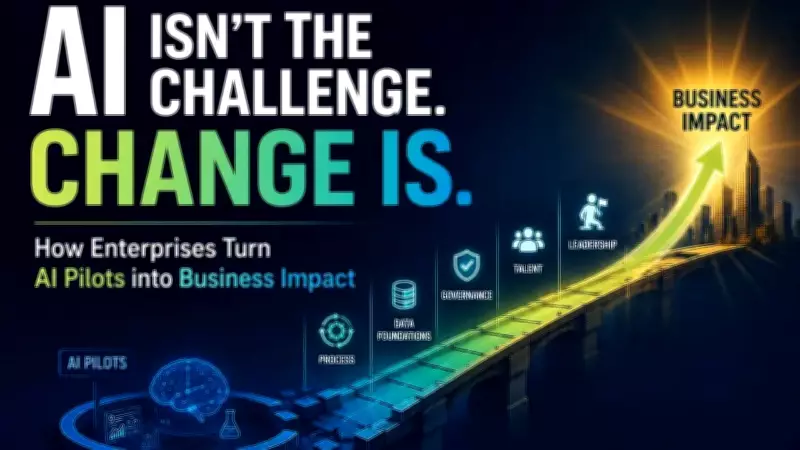
Enterprises are not short of AI ambition. They are short of the hard plumbing needed to turn ambition into business change. That was the consensus in a discussion held in association with Publicis Sapient, as part of a series titled 'AI that's built to deliver'. The problem, they said, is rarely the lack of AI experiments. It is the inability to change workflows, data foundations, operating models, governance, talent and business ownership to make AI solutions scale.
The Pilot Problem
Thousands of pilots are ongoing, but the challenge lies in creating value and outcomes from them, said Harish Gudi, SVP at Optum Insight, the data, analytics, and technology services division of Optum, a subsidiary of UnitedHealth Group. He emphasized that reimagining processes is crucial. In healthcare, this means rethinking the journey from insurance claim filing to cost determination, payer processing, member communication and payment. Currently, this can take days or months. AI offers a chance to make the process real-time, frictionless and end-to-end.
Sanjay Menon, EVP and MD for India at Publicis Sapient, noted that many pilots stall because they are managed in a sandbox. Scaling requires changing the operating model. He cited a retailer that used AI in a pilot to cut demand-signalling-to-inventory-procurement time from seven days to six hours. However, the company stopped at five days because going further would require changing processes and roles. Where they get stalled is usually just on the intent of how much you are ready to bite the bullet and let the change scale, Menon said, adding that ultimately, leadership is key.

Process Change and Leadership
Sanjiv Kumar, digital engineering lead for corporate banking at Kotak Mahindra Bank, provided an example from supply-chain finance to underline the importance of process change and leadership responsibility. He said if a previously onboarded customer requests financing for 100 invoices, should he be asked to produce all 100 invoices, or are a few enough? Can AI read the invoices and reconcile them? Someone has to decide what's best for the bank. AI cannot do that. If you need a P&L impact from AI, leadership has to get involved to change the way processes are.
Getting Governance Right
AI governance is another essential element in scaling. Mohua Sengupta, SVP and country head for India at US insurance company The Standard, said the critical factor in insurance is trust. Insurers engage with customers during difficult moments, making full automation neither desirable nor acceptable. In insurance, the gating principle to move from experimentation to scaling is trust, Sengupta said. Auditability is key, and there is no question of automating empathy. At The Standard, AI is used to identify missing data faster, reducing claims timelines by six days in some cases. A decision engine has cut another two days. However, while claim acceptance can be AI-led, denials always have a human review.
Kumar said banking faces similar constraints because it deals with public money. There are some use cases where you can be predictive, but ultimately, certainty of the software is essential.
Rewards and Competencies
Shaji Philipose, MD at the India GCC of global tyre maker Bridgestone, underlined how employee performance metrics need to change to ensure AI's business impact. He noted how organizations traditionally looked at how many people have been put into a job and how many hours they worked. I think the future is all about who is agile enough to adopt all the latest AI tools, who is taking risks, who has the guts to take a decision that can impact several jobs, he said.
Sandhya Varanasi, India hub CTO for energy management at Schneider Electric, emphasized the criticality of upskilling talent and leadership's central role in this upskilling, and in continuously evaluating how competencies are evolving. With AI, what are the shifts in roles happening, should a particular role be completely transformed? That is a key role we play as leaders to constantly evaluate that, she said.