The year 2025 has been a dramatic rollercoaster for tech titan Elon Musk, marked by staggering financial highs and significant personal and professional challenges. The 54-year-old billionaire saw his net worth soar past the $700 billion milestone and even took on a symbolic leadership role in the Dogecoin community. However, this period also witnessed his much-publicised fallout with US President Donald Trump and sustained criticism over the controversial outputs of his AI venture, Grok.
Beyond Tesla and X: Musk's "Biggest Product" Vision
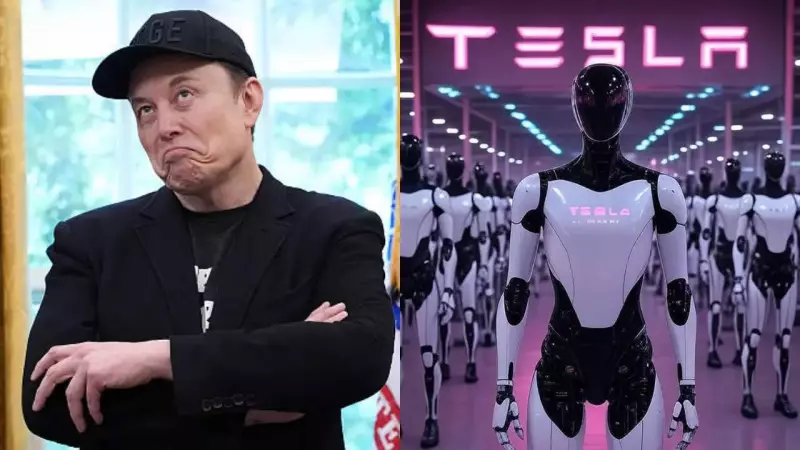
While the world views Tesla and the social media platform X as his crowning achievements, Musk himself points to a future product he believes will dwarf them all. He has told investors that his "biggest product of all time" is not a car or an app, but an army of humanoid robots. Musk passionately argues that these robots, named Optimus, have the potential to eliminate poverty and the very concept of mandatory work, while generating what he describes as "infinite" revenue streams for Tesla.
Musk has essentially bet both Tesla's future and a large portion of his personal fortune on this vision. He foresees a world where Optimus units work in factories, handle domestic chores, perform complex surgeries, and even assist in colonising Mars. Currently assembled by hand, Musk's audacious plan involves scaling production to millions of units per year.

The Long Road from Concept to Reality
The journey began in 2021 when Musk first unveiled the bot concept using a dancer in a costume. He described it as friendly and designed to navigate human environments, taking over dangerous, repetitive, and boring tasks. However, turning this dream into a market-ready product has proven immensely challenging.
Public demonstrations often reveal the robot being remotely operated by engineers. A significant technical hurdle is creating a robotic hand with the sensitivity and dexterity of a human hand. Despite these obstacles, Musk's confidence is backed by a new compensation package tied to ambitious goals: transforming Tesla into an $8.5 trillion company and selling at least one million Optimus bots within a decade, a feat that could earn him a staggering $1 trillion pay package.
"The car is to Tesla what the book was to Amazon," Morgan Stanley analyst Adam Jonas noted, suggesting Tesla uses automotive manufacturing as a foundational lab for broader robotics ambitions.
Optimus in Development: Sorting Legos and Walking Red Carpets
Within Tesla's Palo Alto engineering headquarters, Optimus prototypes are a common sight, navigating offices to learn human interaction. The 6-foot tall machines are being trained on tasks like sorting Legos by colour, folding laundry, and using power tools, according to former employees.
In a striking display of pop culture crossover, an Optimus unit made its red carpet debut at the "Tron: Ares" premiere in Hollywood in October 2025, performing a choreographed fight sequence with actor Jared Leto. Musk, referencing Star Wars, has claimed, "This is why I say humanoid robots will be the biggest product ever. Because everyone is gonna want one, or more than one."
Expert Skepticism and Multi-Trillion Dollar Predictions
The field of robotics remains cautiously optimistic but realistic. While robots are staples in factories for heavy, programmed tasks, the flexibility, precision, and adaptability required for humanoid functions are frontier challenges. Ken Goldberg, a roboticist at UC Berkeley, agrees that hands are difficult but notes the larger issue is integrated perception and control in uncertain environments.
"Getting these robots to do something useful is the problem," Goldberg stated, highlighting the gap between demonstration and practical, reliable application. Yet, the financial projections are colossal. Analyst Adam Jonas predicts the global humanoid robot industry could generate $7.5 trillion in annual revenue by 2050. If Tesla can solve the engineering puzzles, it stands to capture a dominant share of this future market. The company is currently developing its third-generation Optimus, having missed an earlier target to deploy a commercial version in its own factories by the end of 2025.