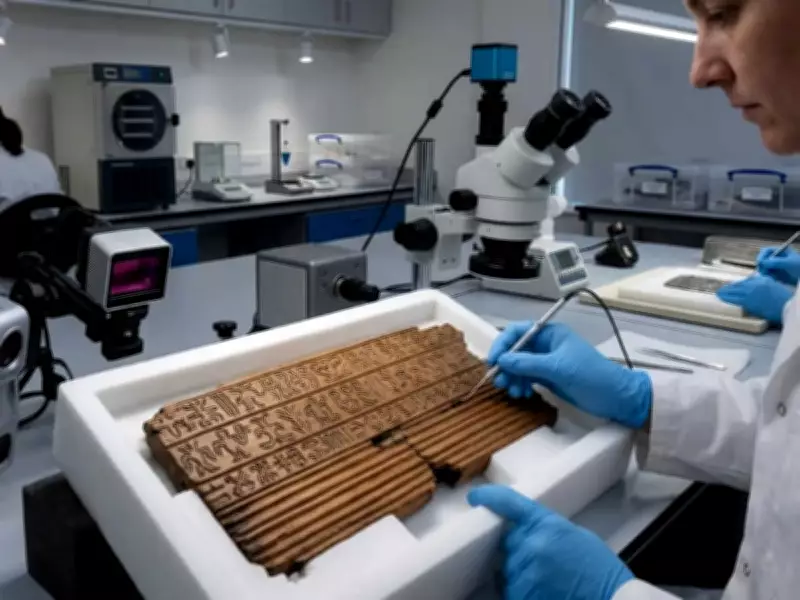
A new scientific study has reignited debates about the origins of writing on Easter Island, suggesting that the remote island may have independently invented a script known as Rongorongo. This discovery could potentially rewrite human history by adding a new location to the short list of places where writing emerged without external influence.
Easter Island and Its Mysterious Script
Easter Island, a Chilean volcanic island in the South Pacific, is famous for its nearly 900 monumental statues called moai, created by the Rapa Nui people between the 13th and 16th centuries. The island is a UNESCO World Heritage site, renowned for its extreme isolation and unique archaeological landscape. Among its treasures are wooden tablets covered with a script known as Rongorongo, which consists of carved symbols called glyphs. Unlike many ancient scripts, Rongorongo has not yet been deciphered, adding to its mystery.
New Evidence from Radiocarbon Dating
The study, published in Scientific Reports and led by Silvia Ferrara, an archaeologist and linguist at the University of Bologna, Italy, examined four wooden items with Rongorongo engravings. Using radiocarbon dating, researchers estimated when the wood for the tablets was harvested. One tablet was dated to 1493-1509, approximately 200 years before Europeans arrived on the island in 1722. This suggests that at least some Rongorongo tablets existed before any known external contact, supporting the idea that the script was developed independently by the Rapa Nui.

If confirmed, Rongorongo would join the few known independent writing systems from Mesopotamia, Egypt, China, and Mesoamerica. The authors noted that the issue is critical, as it would represent another instance of writing emerging in human civilization.
Challenges and Uncertainties
Despite the promising results, scientists caution that the findings are not conclusive. Radiocarbon dating determines the age of the wood when it was cut, not when it was engraved. There is a possibility that older wood was reused at a later time. However, Ferrara argues that it would be unusual to carve into an ancient piece of wood. Another limitation is the small sample size: only one of the four tablets tested appeared to predate European contact, while the others were much younger. To verify the hypothesis, researchers need to analyze more tablets, but only about 27 Rongorongo artefacts have survived, scattered in museums worldwide.
Implications for Human History
Understanding whether Rongorongo was independently invented would have profound implications. Writing systems often mark the emergence of complex societies. An independent script would highlight the intellectual and cultural achievements of the Rapa Nui and challenge earlier theories that external factors were necessary for the development of writing in isolated societies. Easter Island, one of the remotest inhabited islands, was settled by Polynesians between 1150 and 1280 AD, located about 2,360 miles from the coast of Chile.
Next Steps in Research
More studies are needed to create a precise timeline. This requires access to additional Rongorongo tablets and improved dating techniques. Meanwhile, scholars continue efforts to decipher the script, which remains untranslated. The lack of translation makes it impossible to determine how the writing system was used. However, these findings provide a solid foundation for future research, suggesting that the history of writing in the region may be more complex than previously thought.
While the idea of an isolated civilization developing its own writing system is intriguing, the puzzle remains unsolved. For now, Rongorongo is considered one of the world's most enigmatic linguistic phenomena. Further investigation may reveal fascinating insights into the lives of the islanders and the origins of human writing.