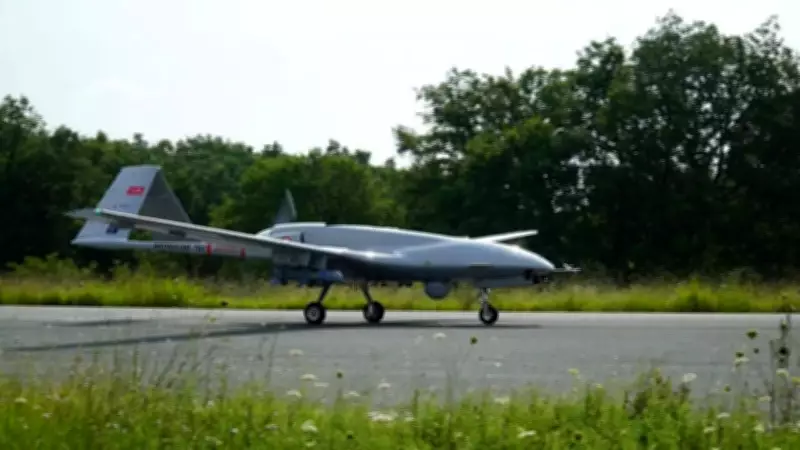
In 2020, a series of videos appeared on social media timelines as Azerbaijan’s Ministry of Defence began publishing footage of drone strikes during the 2020 Nagorno-Karabakh War. The Turkish-made Bayraktar TB2s seemed to roam freely, striking targets deep in the Armenian rear, including air defence systems and frontline fortifications.
These strikes were hailed as true game changers, representing a war-winning capability. As if foreshadowing this, the concept of drone swarm threats was depicted in a 2017 YouTube video titled ‘Slaughterbots’, and its 2021 sequel, showcasing the lethality and unpredictability of AI-enabled drones and drone swarms, especially in the hands of hostile actors.
The world continues to describe the exploits of drones in the Russia-Ukraine War, the Israel-Hamas/Hezbollah standoff, and most recently, in the extensive bilateral use of unmanned aerial systems during Operation Sindoor—India’s name for the four-day India-Pakistan conflict that unfolded in May this year as a fallout of the heinous Pahalgam massacre. While such fascination with drones in modern warfare is understandable, it is worth noting that drones have been participants in combat since the beginning of the 20th century.

Scope of Drones in Modern Combat
While drones now operate across all three domains—land, sea, and air—this article focuses on the attributes and trends of aerial drones, comparing them with another revered and indispensable facet of warfighting: artillery firepower. The comparison is based on the overwhelming usage of both assets in modern combat.
Historical Context and Evolution
Drones are not new to warfare. Their use dates back to early 20th-century experiments. However, recent technological advancements have exponentially increased their effectiveness. The Bayraktar TB2, for instance, demonstrated how relatively inexpensive drones can neutralize high-value targets, including advanced air defence systems.
Artillery, on the other hand, has been a cornerstone of military strategy for centuries. Its ability to deliver sustained, area-denying firepower remains unmatched. However, the precision and flexibility of drones are challenging this dominance.
Comparative Analysis: Drones vs Artillery
- Cost-Effectiveness: Drones are generally cheaper than artillery systems and ammunition, allowing for more frequent and widespread use.
- Precision: Modern drones can strike with pinpoint accuracy, reducing collateral damage compared to traditional artillery.
- Surveillance and Reconnaissance: Drones provide real-time intelligence, enabling better target acquisition and battle damage assessment.
- Vulnerability: Drones are susceptible to electronic warfare and air defence systems, whereas artillery is harder to neutralize once emplaced.
- Logistics: Drones require less logistical support than artillery batteries, which need extensive ammunition and maintenance chains.
Future Implications
The increasing reliance on drones does not necessarily spell the end for conventional artillery. Instead, it suggests a shift towards integrated warfare, where both systems complement each other. Artillery can provide suppressive fire and area denial, while drones conduct precision strikes and reconnaissance.
The conflict in Ukraine has shown that drones and artillery can be used in tandem to devastating effect. Similarly, the India-Pakistan confrontation demonstrated the utility of drones in a high-intensity, short-duration conflict.
As technology advances, the line between drones and artillery may blur further. Directed energy weapons, loitering munitions, and AI-driven targeting systems are likely to redefine the battlefield. However, the relevance of conventional artillery will persist, albeit in an evolved form.
This article was originally published on Chanakya Diaries.

About the Author: TOI World Desk — At TOI World Desk, our dedicated team of seasoned journalists and passionate writers tirelessly sifts through the vast tapestry of global events to bring you the latest news and diverse perspectives round the clock. With an unwavering commitment to accuracy, depth, and timeliness, we strive to keep you informed about the ever-evolving world, delivering a nuanced understanding of international affairs to our readers. Join us on a journey across continents as we unravel the stories that shape our interconnected world.