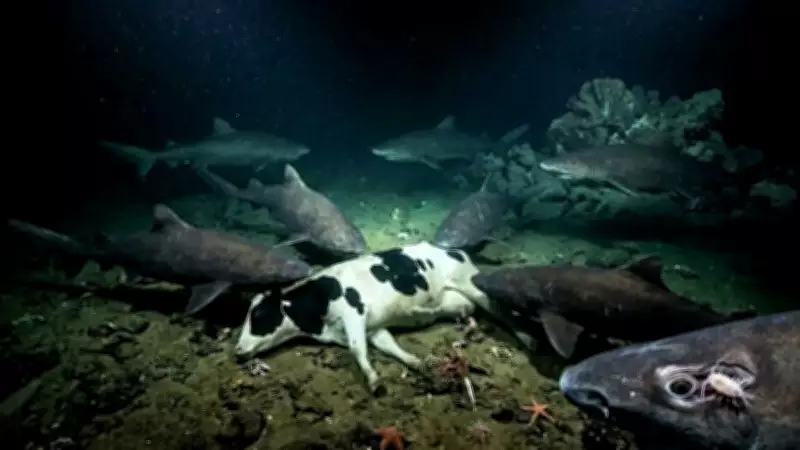
In a groundbreaking deep-sea experiment, scientists from Sun Yat-sen University dropped a cow carcass to a depth of 1,629 meters in the South China Sea. The project aimed to mimic a 'whale fall,' where whale remains nourish the usually barren ocean floor. The mission's footage left the marine biology world in awe. To everyone's surprise, eight giant Pacific sleeper sharks emerged from the darkness, marking the first time this elusive species was observed in this region. Consequently, this discovery not only broadens our understanding of their habitat by thousands of kilometers but also uncovers a surprisingly intricate and respectful social order among these deep-sea creatures that had never been documented before.
South China Sea Deep-Sea Mission Reveals Hidden World of Pacific Sleeper Sharks
The mission primarily aimed to study how deep-sea ecosystems process nutrient cycling of organic matter in high-pressure benthic environments. Scientists decided to drop a cow carcass near Hainan Island's continental slope, creating what they called an artificial 'food fall.' A study in the journal Ocean-Land-Atmosphere Research reported this experiment. As a result, high-definition cameras captured footage of eight Pacific sleeper sharks, with lengths ranging from 1.9 to 5.1 meters. This observation was significant because these sharks are usually linked with the colder waters of the North Pacific.
Pacific Sleeper Sharks Exhibited a Sequential Feeding Hierarchy
The most 'unexpected' aspect of the footage was not just the presence of the sharks, but their behavior. Unlike the chaotic feeding frenzies often seen in surface-dwelling sharks, these deep-sea predators displayed a 'queue-feeding' strategy, as noted in research published in the National Library of Medicine. Observations showed that as one shark finished eating and moved on, another would step up to take its place. This suggested an organized approach to survival, not a solitary one.

Unique Defensive Anatomy of the Pacific Sleeper Shark
The video captured unprecedented morphological data, showing the Pacific sleeper shark up close and personal. Scientists observed that these sharks have a specialized adaptation for protecting their eyes when they eat. Unlike other sharks with a nictitating membrane, these retract their eyeballs into their sockets to shield them from harm while they feast. Furthermore, a few sharks had parasitic copepods infesting the ocular tissue. This is a characteristic they share with their relative, the Greenland shark, as noted in a journal published at MDPI.
Climate Shift or Hidden History? Why Sharks Are Migrating Toward Tropical Waters
The discovery points to the possibility that the South China Sea could be an important pathway or even a nursery for large deep-sea predators. Lead researcher Han Tian remarked that the appearance of these sharks in tropical deep waters necessitates further biogeographic investigation. Have they always been there without anyone noticing, or is climate change pushing them into new areas? This finding opens new questions about the distribution and behavior of these enigmatic creatures.