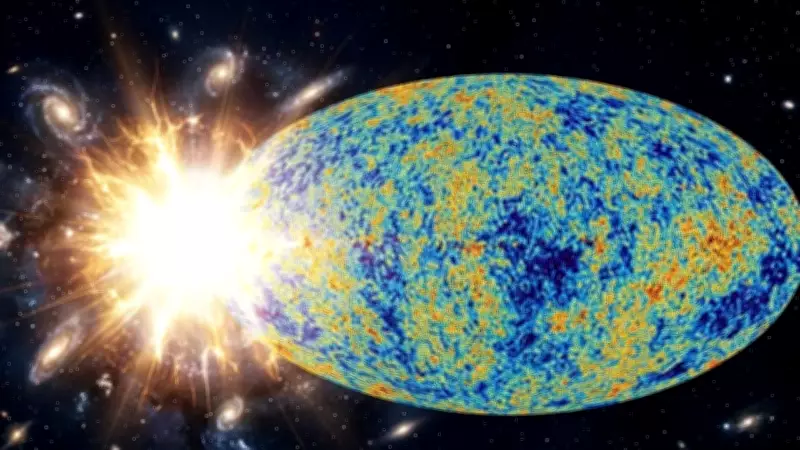
In 1964, two scientists at Bell Labs, Arno Penzias and Robert Wilson, were tasked with eliminating noise from a sensitive horn antenna. Their goal was to reduce interference, but they encountered a persistent low-frequency hum that remained regardless of where the antenna was pointed. Initially suspecting equipment interference or even bird droppings, they meticulously cleaned and checked the system. However, this mysterious static turned out to be the Cosmic Microwave Background (CMB), the thermal glow left over from the Big Bang. Their accidental discovery marked a turning point in cosmology, shifting it from a purely theoretical field to an observational science by providing solid evidence that the universe began with an enormous, hot expansion billions of years ago.
The Mysterious Background Noise and Proof of the Big Bang
The noise recorded by Penzias and Wilson was a uniform signal coming from every direction in the sky. Scientists eventually identified it as the CMB, a type of electromagnetic radiation spread across the universe. Scientific records show this radiation originates from the first light that moved freely through space about 380,000 years after the Big Bang. This breakthrough disproved the Steady State theory, confirming that the universe had a specific explosive beginning.
How Penzias and Wilson Isolated the Cosmic Signal
Working in Holmdel, New Jersey, the two scientists used a 20-foot horn-reflector antenna originally designed for Project Echo. Their research, published in a journal at Cambridge University, detailed how they accounted for all possible sources of terrestrial noise—including urban interference and cleaning the antenna—before concluding the signal was extraterrestrial. They found the noise had an excess antenna temperature of approximately 3.5 Kelvin, closely matching theoretical predictions for the leftover heat of a newborn universe.

The Theory Behind the Hum
While Penzias and Wilson detected the signal, Robert Dicke's team at Princeton University developed the theoretical explanation. The discovery is considered the most significant breakthrough in modern astronomy, allowing scientists to observe the universe shortly after its birth. The Smithsonian Astrophysical Observatory describes this radiation as relic radiation from the early universe, showing that the universe continues to expand and cool over time.
One Discovery Launched Several Missions
Penzias and Wilson received the Nobel Prize in Physics in 1978 for their discovery. According to records from the National Science Foundation and NASA, this unexpected finding opened doors for modern missions such as COBE, WMAP, and the Planck satellite. These missions have since provided detailed maps of the early universe and refined the age of the universe to 13.8 billion years.