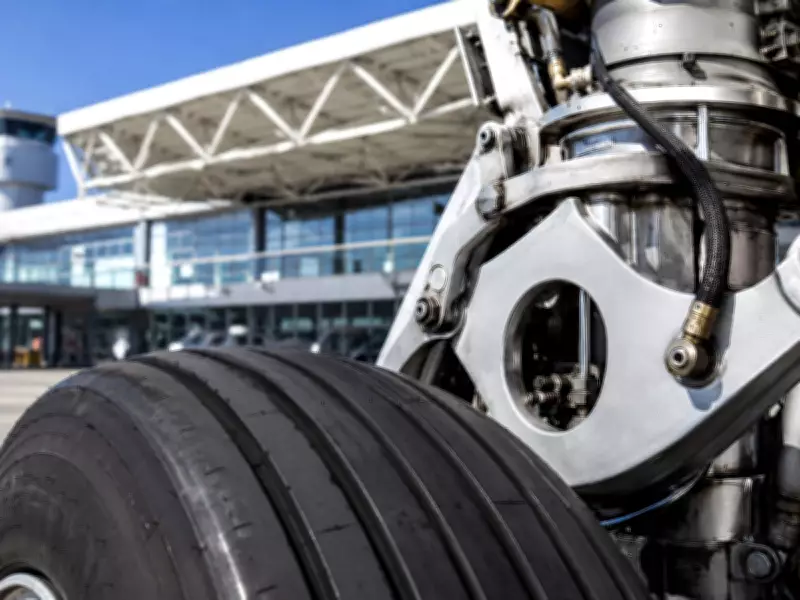
Every time a giant commercial jet lands on a tarmac or a family sedan bumps into a pothole at highway speeds, a marvel of materials science goes unnoticed. The tyres on these multi-ton machines are designed to withstand thousands of violent impacts, blistering friction, and extreme shifts in weight without shredding. For nearly a century, the secret to producing rubber tough enough to survive this punishing lifestyle was a surprisingly low-tech ingredient. Manufacturers combined pure rubber with carbon black, a microscopic black soot produced by burning fossil fuels in low-oxygen environments, then ground it to a fine powder. This simple additive is why virtually every tyre in the world is pitch black.
By the 1920s, engineers had already discovered that adding this powder made rubber incredibly resilient, but the reasons why remained a stubborn mystery. For generations, tyre companies purchased dozens of different grades of soot and empirically tested them on real asphalt. It was trial and error. What was happening inside the tyre at the level of atomic physics was a black box through and through.
Now, a team of University of South Florida researchers has opened that box and solved a century-old problem in soft materials science by showing precisely how these microscopic particles change the fundamental behaviour of rubber. The atomic playground presented a challenge: interactions between tiny carbon particles and the sprawling tangle of long polymer chain molecules occur at a scale too microscopic to see with standard imaging and happen far too fast to capture on film.

To overcome this, a team including Professor David Simmons, Dr Pierre Kawak, and doctoral student Harshad Bhapkar addressed the problem digitally. Using sophisticated computer modelling, they reconstructed the interior of a high-performance tyre by carrying out 1,500 distinct molecular dynamics simulations. This huge computational effort enabled them to track the exact movements of hundreds of thousands of individual atoms as they responded to physical stress.
The breakthrough, detailed in a study in the journal PNAS, found that the actual power of reinforced rubber is rooted in a basic mathematical property called Poisson's ratio. It measures how much a material changes its physical shape in one direction when pulled or compressed in another. If you take a normal rubber band without reinforcement and stretch it, it gets thinner and narrower in the middle. The material is easily deformed, but its total volume remains approximately constant. However, when a tiny amount of carbon black particles is added, the physics changes. These hard, inflexible particles of soot resist being squeezed sideways under stress. The carbon obstacles stop the surrounding rubber from thinning in the usual way, so the material has only one physical choice: the entire composite structure must increase its total volume as it stretches.
Rubber does not want to expand in volume very much, and it takes a lot of force to make it do so, so the material is essentially fighting itself. This inner battle causes a huge surge of structural resistance, which gives the tyre its legendary durability and prevents heavy loads from ripping the polymers apart. Using advanced computer modelling, they demonstrated that these particles alter rubber's behaviour by increasing its total volume when stretched, creating significant structural resistance.
Before this digital breakthrough, the scientific community had three competing ideas to explain why soot makes tyres stronger. One theory was that carbon particles clump together in rigid, load-bearing chains. Another said the sticky polymer layers are tightly bound to each particle, like a very strong glue, creating a glassy shell. A third approach, purely geometrical, posited that the actual space taken up by the particles forces the surrounding rubber to bend and deform much more sharply than pure rubber ever could. The great thing about the new research is that it does not negate these classic ideas. Instead, the simulation reveals that all three historical mechanisms work together, feeding into the same physical result. It is the spatial crowding, the interlinked networks, and the sticky, immobilised polymer layers combined that push the rubber into this state of intense volumetric resistance.

This unified picture was first suggested in a previous study by the same group of researchers. That study, published in ACS Macro Letters, first pointed to the thermal and elastic properties behind these nanocomposites, clearing the way for this year's definitive atomic evidence. The discovery gives automotive engineers a tool to solve a permanent headache known in the industry as the Magic Triangle. In tyre design, three key performance factors are always in conflict: fuel efficiency, wet-road grip, and general durability. Previously, changing a tyre recipe to enhance one characteristic often meant sacrificing another. A stickier tyre for better braking on wet pavement generally hurts a vehicle's mileage, while a compound that lasts longer often reduces its grip on the road.
Now, with a clear, mathematical blueprint of how carbon black works at the atomic level, manufacturers can finally move away from a century of guesswork. This allows designers to start picking particle sizes and tailoring rubber chemistry with a purpose, potentially leading to tyres with superb longevity without impacting safety or fuel economy. The implications of this physics breakthrough extend far beyond the automotive world. High-performance rubber composites are essential elements of heavy industry, such as power plant seals, hydraulic systems in aircraft, and sophisticated medical devices. In the past, catastrophes have struck when unexpected failures have occurred in these materials, such as the 1986 Space Shuttle Challenger disaster, which was caused by the failure of a rubber O-ring seal that had stiffened in cold temperatures.
According to the research, although the data is based on highly accurate computer models that still need to be validated by physical experiments, the results provide a new platform for the rational design of tougher materials. Engineers are getting closer to building a safer and more efficient world, from the pavement up, by turning a century-old mystery into a predictable science.