Scientific Community Divided Over Mysterious Space Visitor
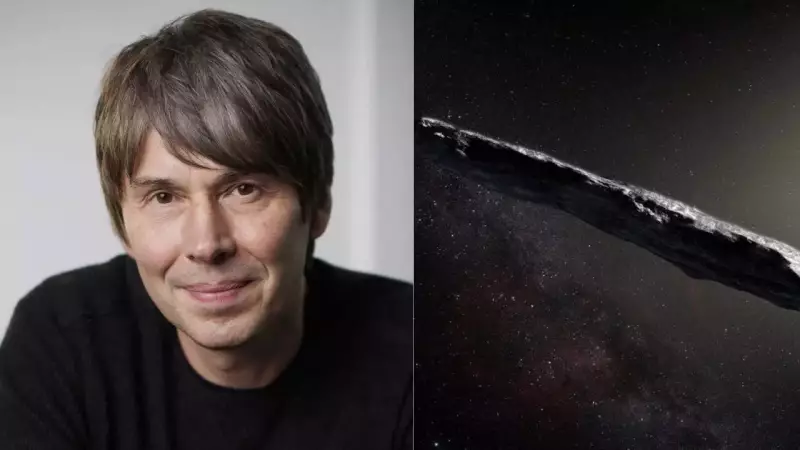
Renowned astrophysicist Professor Brian Cox has stepped forward to counter growing online speculation that an interstellar object detected entering our solar system might be an alien spacecraft. The scientist, famous for making complex cosmic concepts accessible to the public, urged people to trust verified scientific research rather than what he termed as "drivel" circulating on social media.
Cox's intervention comes amid increasing excitement about the object known as 3I/ATLAS, with theories about its possible artificial origins being promoted by Harvard astrophysicist Professor Avi Loeb. The scientific community finds itself divided over interpretations of this rare visitor from beyond our solar system.
The Discovery of 3I/ATLAS: A Rare Interstellar Visitor
NASA's Asteroid Terrestrial-impact Last Alert System (ATLAS) first detected the mysterious object on 1 July. This global early-warning network, operated by the University of Hawaii with NASA funding, uses telescopes strategically located in the United States, Chile, and South Africa to identify potential threats to Earth.

The discovery marked a significant astronomical event, as 3I/ATLAS represents only the third known interstellar object ever observed entering our solar system. Measuring approximately the size of New York City, the comet immediately captured scientific attention due to its unusual path and behavior.
NASA confirmed the object's interstellar status based on the distinctive shape of its orbital path, clearly establishing that it originated outside our solar system. The space agency provided reassuring news, stating unequivocally that the object "poses no threat to Earth and will remain far away", passing no closer than 170 million miles from our planet.
Astronomers have noted several unusual characteristics that distinguish 3I/ATLAS from typical comets, including color changes and the emission of strange jets. The object follows a hyperbolic orbit, meaning it will pass through our solar system only once before heading permanently back into deep space. While its trajectory aligns closely with the orbital planes of Venus, Mars, and Jupiter, it will not approach Earth closely.
Most experts believe the unusual activity might simply represent natural cometary outgassing, where volatile materials evaporate under sunlight, creating bursts of gas and dust.
The Alien Craft Theory and Scientific Controversy
Despite conventional scientific explanations, Harvard theoretical physicist Professor Avi Loeb has proposed that 3I/ATLAS could be a "technological artifact" created by an intelligent civilization. In a paper co-authored with Adam Hibberd and Adam Crowl, Loeb suggested that the object might possess "active intelligence."
Loeb outlined two possibilities following from this hypothesis: "First, that its intentions are entirely benign and second, they are malign." The physicist has previously described the comet as "potentially hostile" and suggested it might be executing "braking thrust" as it approaches Earth, implying possible controlled movement.
In interviews, Loeb estimated a 30 to 40 percent chance that 3I/ATLAS is not naturally formed. Using his self-created "Loeb scale" - where zero represents a normal space rock and ten denotes confirmed artificial origin - he placed the object at a four. "So that means it's most likely natural," he told LADbible, "but nevertheless it's a very high probability for it being something else, and that's why we should continue to consider it seriously."
Loeb further characterized the object as a potential "black swan event" - a rare, high-impact occurrence that defies normal expectations. His claims have created divisions within the scientific community, with most astronomers rejecting the notion of alien involvement.
Among the prominent skeptics is astrophysicist Neil deGrasse Tyson, who dismissed the theory outright, stating: "We have good data on our own comets and asteroids and moons and planets.... You want to say aliens are coming? OK, it's clickbait. Nobody else is saying that about this object but Avi Loeb and his group."

Brian Cox's Firm Rebuttal and Scientific Perspective
Professor Brian Cox, known for his no-nonsense approach to scientific communication, addressed the controversy directly this week. Writing on X (formerly Twitter), he began: "Just to be clear – given recent drivel online – Comet 3I/ATLAS is a comet, made of carbon dioxide and water ices and bits of other stuff."
He emphasized that the object is "entirely natural in origin, its orbit is as expected, and it will whizz around the sun and then disappear off into the galaxy again."
Cox offered a poetic yet scientifically grounded perspective on the comet's journey through space: "If it ever encounters another inhabited solar system in the far future I hope the living things there are more sensible than us and enjoy it for what it is – a visitor from elsewhere in the galaxy – a pristine lump of rock and ices which formed around a distant, maybe long-dead star billions of years ago and many light years away, just passing through. Isn't that wonderful enough?"
The astrophysicist directed his followers toward verified data, sharing links to credible sources and adding practical guidance for evaluating scientific claims: "A good rule of thumb is to look at the ones that have been submitted to journals (usually noted in the comments)."
Cox's comments reinforce his longstanding stance against misinformation, particularly when speculation outpaces evidence. His message remains consistent with scientific principles: extraordinary claims require extraordinary proof, and according to all available data, 3I/ATLAS represents nothing more – or less – than a fascinating natural wanderer from another star system.
The episode highlights the ongoing challenge scientists face in communicating complex discoveries in an era of rapid information spread and sensational speculation, while maintaining public trust in verified scientific research.