The Consumer Electronics Show (CES) 2026 in Las Vegas witnessed a landmark moment in robotics, as Hyundai Motor Group's subsidiary Boston Dynamics unveiled a revolutionary new version of its famed Atlas humanoid robot. The demonstration left the global audience in awe, showcasing unprecedented levels of agility, balance, and potential for real-world application.
A New Era of Biomechanical Movement
The centerpiece of the reveal was the robot's dramatically enhanced physical capabilities. Gone are the hydraulic movements of older models. The new Atlas is fully electric, boasting a design that prioritizes a wider range of motion and a startlingly graceful, almost human-like, fluidity. Boston Dynamics demonstrated this with a series of complex maneuvers.
The robot confidently navigated a staged environment featuring scattered tools and construction materials. Its party trick, however, was a breathtaking sequence where it used its advanced grippers to pick up a heavy automotive strut, walk across the stage, and precisely place it onto a storage shelf. This was not a slow, cautious movement but a dynamic, purposeful action that highlighted its new strength and spatial intelligence.

Beyond the Demo: The Hyundai-Boston Dynamics Vision
The unveiling was more than just a technical showcase; it was a statement of intent from the Hyundai-Boston Dynamics partnership. Following Hyundai's acquisition of a controlling stake in Boston Dynamics in 2021, the focus has sharpened on practical, industrial applications. Executives from both companies emphasized a future where humanoid robots like Atlas work alongside humans in challenging or repetitive environments.
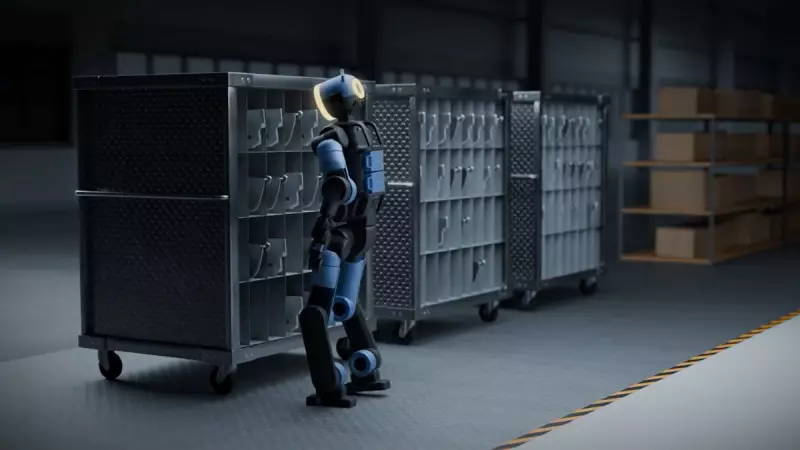
Potential use cases highlighted include automotive manufacturing, logistics in warehouses, and even disaster response scenarios. The electric platform is seen as cleaner, quieter, and more suitable for integration into modern workplaces compared to previous hydraulic systems. The demonstration at CES 2026 served as a powerful proof-of-concept for this collaborative vision, moving Atlas from a research marvel to a prototype for the future of work.
What This Means for the Future of Robotics
The new Atlas represents a significant leap in the intensely competitive humanoid robotics race. Its performance at CES 2026 sets a new benchmark for mobility and dexterity. While the company did not announce a specific commercial release date or price, the demonstration made it clear that Boston Dynamics is transitioning its technology from the lab toward tangible solutions.
The implications are vast. In industries facing labor shortages or hazardous working conditions, robots like Atlas could become invaluable partners. However, the presentation also inevitably sparks discussions about the long-term impact on the workforce and the ethical integration of such advanced machines into society. For now, the takeaway from CES 2026 is clear: Boston Dynamics, backed by Hyundai's industrial might, has shown a compelling and highly advanced glimpse into a future where humanoid robots are capable, agile, and ready to step out of the video reel and into the real world.