Bonobo Research Challenges Human Imagination Uniqueness
Imagination may not be an exclusive human privilege, according to groundbreaking research involving a language-experienced bonobo in controlled cognitive testing. Scientists have investigated whether an ape can comprehend a pretend scenario while simultaneously recognizing its non-reality. This study focuses on the capacity to maintain two distinct ideas in mind, a cognitive ability traditionally associated with symbolic thought and early childhood development in humans.
Testing Pretend Play in Primates
For decades, humans have been considered the only species capable of engaging in pretend play, a behavior linked to cultural development and language acquisition. Rather than relying on anecdotal evidence, this research systematically tested this assumption through a series of carefully designed experiments. The findings indicate that at least one great ape demonstrates significant mental flexibility, reopening questions about the evolutionary origins of human imagination and how far back such cognitive capacities might extend in our primate relatives.
Kanzi's Remarkable Performance
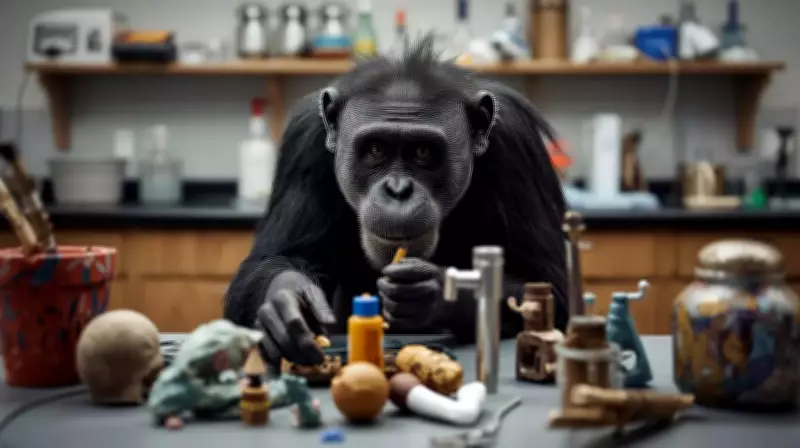
According to the study titled "Evidence for representation of pretend objects by Kanzi, a language-trained bonobo," researchers worked with Kanzi, a bonobo raised in a language-rich environment who was trained to understand spoken English and lexigrams. In the initial experiment, scientists pretended to pour juice into two transparent empty cups, then acted as if they poured the imaginary juice from one cup back into its container.

When asked where the juice remained, Kanzi consistently selected the cup that still contained the imagined liquid. Crucially, the cups were transparent, allowing Kanzi to see they were physically empty, and no food rewards followed these pretend trials, eliminating potential reinforcement biases.
Distinguishing Imagination from Reality
A second critical test examined whether the ape confused pretend objects with real ones. Researchers presented Kanzi with a choice between actual juice and the imagined juice. The bonobo consistently chose the real drink, demonstrating a clear distinction between pretend and real objects. This distinction suggested Kanzi did not treat the pretend object as physically present, indicating sophisticated cognitive processing.
In a further trial involving imaginary grapes, Kanzi again successfully tracked the pretend item as it was moved between different containers. His performance remained consistently above chance levels, showing steady rather than dramatic responses throughout the testing period.
Implications for Cognitive Evolution
The study does not claim that bonobos engage in human-style storytelling or participate in complex symbolic culture. Rather, it indicates a more fundamental capacity to represent something absent while simultaneously understanding its absence. Humans and bonobos share a common ancestor dating back several million years, suggesting that if such representational thinking appears in both lineages, its evolutionary roots may be considerably older than previously assumed.
Researchers acknowledge the study's limitations, noting the small sample size and that findings apply to one exceptionally well-trained individual. Nevertheless, this work adds substantial weight to ongoing scientific discussions about animal cognition, symbolic thought, and the early development of imagination. The traditional line separating human and non-human minds appears increasingly flexible and less fixed than once believed.
Broader Scientific Context
This research contributes to a growing body of evidence challenging anthropocentric views of cognition. As scientists continue to explore the mental capacities of our closest primate relatives, each discovery helps refine our understanding of what makes human cognition unique versus what capabilities we share with other species. The bonobo findings particularly illuminate the cognitive foundations that may have preceded the development of more complex imaginative abilities in human evolution.