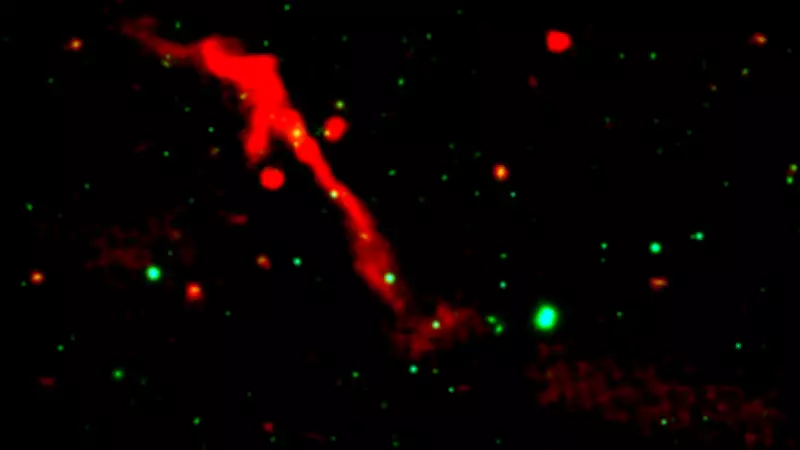
Astronomers Witness Black Hole 'Waking Up' After 100 Million Years in Giant Radio Galaxy
In a groundbreaking astronomical discovery, researchers have observed a rare phenomenon where a supermassive black hole has reactivated after approximately 100 million years of dormancy within a giant radio galaxy. This remarkable finding was made possible through the use of some of the world's most powerful telescopes, including the upgraded Giant Metrewave Radio Telescope (uGMRT) located 80 kilometers from Pune, India.
International Collaboration Uncovers Cosmic Phenomenon
The research represents a significant global effort involving experts from both India and Poland. The team was led by Dr. Sabyasachi Pal, Associate Professor and Head of the Department of Pure and Applied Sciences at Midnapore City College in West Bengal, who served as Principal Investigator. Shobha Kumari, a PhD student, acted as the lead author of the study. Important contributions also came from Dr. Surajit Paul from the Manipal Centre for Natural Sciences in India and Dr. Marek Jamrozy from Jagiellonian University in Poland.
Their findings have been published in the prestigious Monthly Notices of the Royal Astronomical Society, one of the leading journals in the field of astronomy. This publication marks a significant milestone in our understanding of black hole behavior and galactic evolution.

The Giant Radio Galaxy J1007+3540
The focus of this research is the giant radio galaxy designated as J1007+3540. This celestial object is truly enormous, spanning over 3 million light-years across. To put this into perspective, it is approximately 50 times wider than our own Milky Way galaxy. However, this galaxy exists in an extremely hostile environment, situated at the center of a densely packed galaxy cluster filled with searing-hot gas that creates immense cosmic pressure.
Dr. Pal explained the significance of this environment: "Our research shows how extreme cosmic pressure in a galaxy cluster is physically sculpting these fresh energy jets. This galaxy isn't just growing; it's fighting for survival."
Unique Observations Through uGMRT
Using the unique low-frequency capabilities of the upgraded GMRT, operated by the National Centre for Radio Astrophysics - Tata Institute of Fundamental Research in Pune, astronomers were able to capture detailed images of this cosmic event. The telescope's Band 3 (250–500 MHz) imaging revealed what scientists describe as a "double-double" structure—a pair of bright, fresh energy jets nested inside much older, fainter ones.
This distinctive pattern provides clear evidence that the central black hole has recently re-ignited after its long period of silence. As these new jets blast outward, they engage in what astronomers describe as "a violent, beautiful 'tug-of-war' between the power of a black hole and the crushing weight of deep space."
Cosmic Pressure and Galactic Distortion
The intense pressure from the hot gas in the galaxy cluster is having a profound effect on the newly reactivated jets. This pressure is actually pushing the jet's plasma sideways, creating striking curved shapes that are visible in the radio images. Furthermore, this hostile environment has distorted ancient plasma and is stripping material away from the galaxy as it moves through the cluster.
Dr. Pal elaborated on this phenomenon: "This hostile environment has not only distorted the ancient plasma but is also stripping material away from the galaxy as it moves, leaving behind a wispy, millions-of-years-old trail known as a 'galactic wake.'"
Scientific Significance and Future Implications
This discovery serves as a natural laboratory for scientists to study how black holes turn on and off, and how they shape the universe around them. By examining this unique system, researchers can finally observe the full life cycle of supermassive black holes—from how they power up to how they fall silent and eventually "wake up" again.
The uGMRT images were further utilized to study the spectral properties of the source, particularly the spatial distribution of the spectral index for different parts of the structure. This analysis helped scientists understand the aging nature of the radio emission in specific regions of the galaxy.

This research not only advances our understanding of black hole dynamics but also demonstrates the capabilities of Indian astronomical infrastructure and international scientific collaboration in pushing the boundaries of cosmic discovery.