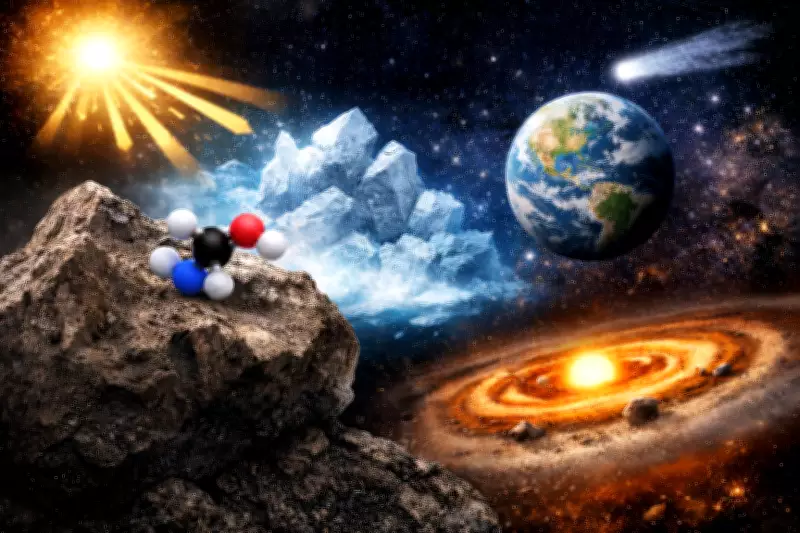
Asteroid Bennu Samples Unlock Secrets of Life's Ancient Origins
In a groundbreaking discovery, samples retrieved from the asteroid Bennu by NASA's OSIRIS-REx mission have provided compelling evidence that some of life's fundamental ingredients were forming in the depths of space long before Earth even existed. The pristine dust and rock, untouched by Earth's atmosphere or water, offer an unprecedented glimpse into the solar system's primordial chemistry.
Organic Molecules Born in Frozen Cosmic Ice
Analysis of the Bennu samples revealed tiny amounts of organic molecules, including nineteen distinct amino acids such as glycine—the simplest building block of proteins. Crucially, the chemical fingerprints of these molecules show they are unequivocally not from Earth. By examining subtle variations in carbon and nitrogen isotopes, researchers have traced their origins to frozen ice in the cold, distant regions of the early solar system, billions of years ago.
This finding challenges previous assumptions that such prebiotic chemistry primarily occurred on warm asteroids or the young Earth. Instead, it suggests that the basic components for life were already being synthesized in the frigid outskirts of our solar system, potentially travelling across space for eons before arriving on our planet.

Isotopic Clues Point to Multiple Formation Pathways
The study, titled 'Multiple formation pathways for amino acids in the early Solar System based on carbon and nitrogen isotopes in asteroid Bennu samples', highlights how isotopes act as a chemical memory, recording the conditions under which these molecules formed. Glycine from Bennu, for instance, carries isotopic signatures indicative of formation in cold ice exposed to radiation, far from the Sun's heat.
In contrast, the well-studied Murchison meteorite tells a different story. Its glycine likely formed later, within a small asteroid containing liquid water. This divergence reveals that the early solar system hosted multiple environments where amino acids could arise, each with unique chemical histories despite some overall similarities in composition.
Nitrogen Isotopes Confirm Deep-Space Origins
Further evidence comes from nitrogen isotopes in Bennu's amino acids, which are elevated to levels typical of formation at great distances from planetary heat. Notably, glutamic acid—which exists in mirror-image forms—shows different isotope patterns between these enantiomers. This data contradicts the notion that space chemistry is uniformly homogeneous, indicating that the two forms experienced slightly different environmental conditions during their formation.
Implications for the Origins of Life on Earth
These discoveries bolster the theory that asteroids like Bennu could have delivered prebiotic molecules to the ancient Earth, seeding it with the raw materials necessary for life. The presence of amino acids in space ice predating Earth's formation implies that such components were available for transport across the solar system long before our planet's birth.
Bennu serves as a unique window into these primal substances, reinforcing the idea that Earth was not the sole cradle for life's building blocks. Instead, the cosmos itself may have been a vast, cold laboratory where the chemistry of life began, with asteroids acting as cosmic couriers that brought these ingredients to our world.
This research not only deepens our understanding of astrobiology but also highlights the importance of sample-return missions in uncovering the mysteries of our cosmic heritage. As scientists continue to analyze the Bennu samples, further insights into the diverse pathways of prebiotic chemistry in the solar system are expected to emerge.