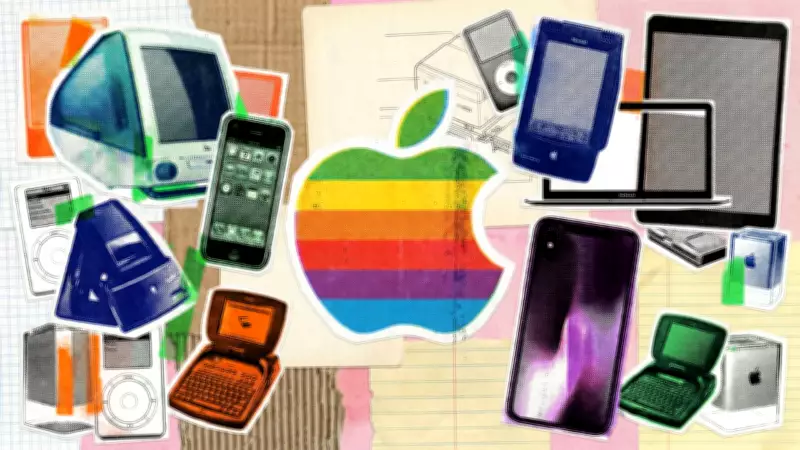
Apple at 50: A Legacy of Destruction and Innovation
This year marks Apple's 50th anniversary, a half-century since Steve Jobs and Steve Wozniak sold a Volkswagen bus and a programmable calculator to fund their startup in a Los Altos, California garage. Fifty years since the hand-soldered Apple I circuit board debuted for $666.66 at the Byte Shop in Mountain View. From those humble beginnings, Apple has evolved from two visionaries in a garage to the world's most valuable company, surviving near-bankruptcy in 1997 and navigating the loss and return of its iconic founder.
Throughout its history, Apple has produced both spectacular failures, like the Newton and butterfly keyboard, and products that fundamentally reshaped civilization. However, Apple's true legacy lies not merely in what it built, but in what it destroyed. Each defining Apple product didn't just create new markets; it rendered existing conventions, categories, and entire industries obsolete, often simultaneously. This list highlights the ten most consequential Apple products—those that changed how the tech industry perceived possibilities, necessities, and acceptability, drawing a clear line between before and after.
Apple II: Democratizing Computing for the Masses
Before the Apple II, computers were confined to offices and universities, inaccessible to regular people. The idea of a home computer seemed as absurd as every household owning a printing press. Steve Wozniak envisioned a personal computer that was "small, reliable, convenient to use, and inexpensive," and the Apple II, launched in June 1977 for $1,298, delivered exactly that. With its plastic case, built-in keyboard, and color graphics, it required no soldering or engineering expertise. Its eight expansion slots allowed for accessories like printers and modems, transforming it into a platform. The exclusive launch of VisiCalc in 1979 drove sales to small businesses, skyrocketing revenue from $775,000 in 1977 to $118 million by 1980. The Apple II buried the notion of computers as specialist tools, ushering in the era of consumer appliances.

Macintosh: Pioneering the Graphical User Interface
Prior to January 24, 1984, computing relied on text-based commands. The Macintosh, introduced with a groundbreaking Super Bowl ad, changed everything with its 9-inch screen, mouse, and graphical user interface (GUI). While not the first GUI—Apple's Lisa preceded it—the Mac's $2,495 price and included software like MacWrite and MacPaint made it accessible. It introduced WYSIWYG (what you see is what you get), shifting computing toward visual interaction. Although initial sales stalled and Jobs was pushed out, the Mac's design paradigm influenced every subsequent operating system, from Windows to Android, making the command line secondary and computing visually intuitive.
PowerBook: Redefining Laptop Design
Before October 1991, portable computers were awkward, with keyboards at the front edge and cumbersome pointing devices. The PowerBook revolutionized this by pushing the keyboard to the rear and placing a trackball in front, creating the modern laptop layout. Apple collaborated with Sony to miniaturize and manufacture the PowerBook 100 in under 13 months. Generating over $1 billion in its first year, Apple became the portable computing market leader. Competitors universally adopted this template, cementing a design that remains unchanged for 35 years.
iMac: Ending the Beige Box Era
In 1997, Apple was near collapse, losing $878 million. Steve Jobs' return brought the iMac, unveiled on May 6, 1998, with its translucent Bondi Blue shell. Designed by Jony Ive's team, it eliminated floppy drives and SCSI ports in favor of USB, a then-languishing standard. The iMac sold 278,000 units in six weeks, attracting many first-time computer owners and turning Apple's loss into a $414 million profit by 1998. It popularized USB, accelerated the floppy disk's demise, and spawned the iconic "i" branding for future products like the iPod and iPhone.

iPod: Revolutionizing Digital Music
Launched on October 23, 2001, the iPod held 1,000 songs and featured a mechanical scroll wheel, marketed as "1,000 songs in your pocket." While not the first MP3 player, its intuitive interface and integration with iTunes—a legal digital music store—made it revolutionary. iTunes became the world's largest music retailer, undermining CDs and piracy. The white earbuds became a status symbol, and the iPod demonstrated Apple's ability to dominate new markets, setting the stage for future ecosystem strategies.
iPhone: Transforming Mobile Communication
On January 9, 2007, Steve Jobs introduced the iPhone as a widescreen iPod, phone, and internet communicator in one device. With its capacitive touchscreen and lack of physical keyboard or stylus, it redefined smartphones. The 2008 launch of the App Store turned the iPhone into a versatile platform, obsoleting devices like point-and-shoot cameras, GPS units, and PDAs. Competitors scrambled to emulate it, leading to the decline of BlackBerry and Nokia, and making the iPhone a pocket computer that absorbed multiple product categories.
MacBook Air: Redefining Laptop Thinness
At Macworld 2008, Steve Jobs pulled the MacBook Air from a manila envelope, showcasing its ultra-thin 0.4 cm profile and 1.36 kg weight. Despite lukewarm reviews for performance, it shifted industry focus from specs to thinness and weight. Intel responded with the Ultrabook category, and the Air's omission of an optical drive accelerated the decline of CDs and DVDs. Its aluminum unibody design became the template for laptop aesthetics across brands.
iPad: Creating the Tablet Category
Launched on January 27, 2010, the iPad filled the gap between phones and computers with its 9.7-inch touchscreen and scaled-up iPhone OS. Critics dismissed it as a giant iPod Touch, but it succeeded by targeting casual use like reading and browsing. The iPad decimated the netbook market and impacted e-readers, establishing a new product category that competitors rushed to emulate.
AirPods: Making Wireless Audio Inevitable
Following the controversial removal of the headphone jack from the iPhone 7 in 2016, Apple released AirPods, wireless earbuds with seamless pairing via the W1 chip. They quickly became the world's best-selling headphones, making wired earbuds seem outdated. AirPods spawned a product line including AirPods Pro and AirPods Max, cementing Apple's dominance in wearable audio.
Apple Silicon: Ending Dependence on Intel
After 15 years of using Intel processors, Apple unveiled the M1 chip on November 10, 2020. Built on TSMC's 5nm process, it unified CPU, GPU, and memory, delivering unprecedented performance and battery life in devices like the fanless MacBook Air. By June 2023, Apple completed the transition to its own silicon, proving that a product company could design superior chips and challenging industry assumptions about processor design.
Over five decades, these ten products exemplify Apple's pattern of not just building the future but making the present feel abruptly obsolete. Each innovation destroyed old paradigms while paving the way for new technological eras, solidifying Apple's role as a transformative force in global technology.