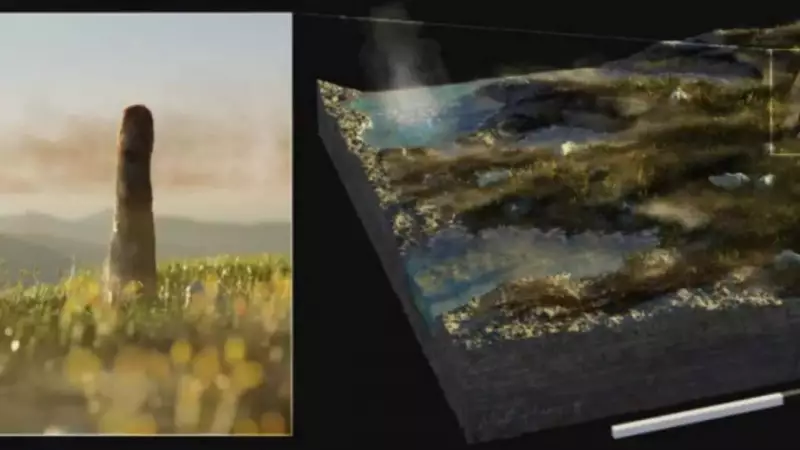
For more than a hundred years, biological science operated under a fundamental assumption: that all life on Earth could be neatly categorized into four primary groups—plants, animals, fungi, and microorganisms. This framework served as the cornerstone of biological classification, providing a seemingly comprehensive understanding of life's diversity. However, a remarkable discovery has completely overturned this long-held belief, forcing scientists to reconsider the very foundations of how we classify living organisms.
The Towering Mystery of Prototaxites
Enter Prototaxites, an ancient organism that lived approximately 400 million years ago and reached astonishing heights of up to 26 feet. This colossal life form represents an entirely distinct branch in the evolutionary tree—one that has no modern descendants and disappeared completely from the planet. Its existence challenges the assumption that science had fully mapped the major categories of life, revealing instead that Earth's biological history contains lost chapters we're only beginning to uncover.
A World Without Trees or Dinosaurs
To understand Prototaxites' significance, we must travel back about 410 million years to an Earth radically different from today. This was a world without trees, mammals, or dinosaurs—a terrestrial landscape sparsely populated by simple plants, moss-like organisms, and microbial mats clinging to damp surfaces. In this relatively open environment, Prototaxites would have dominated visually, rising from the ground like a giant column and towering over all other life forms on land.

Given its enormous size, Prototaxites must have played a crucial ecological role, potentially shaping early terrestrial ecosystems in ways scientists are just beginning to investigate. Its presence suggests that early life on land experimented with diverse structural and biological options, many of which eventually disappeared as environments and competition changed.
Challenging Evolutionary Assumptions
One of the most profound implications of the Prototaxites discovery is what it reveals about evolution itself. This giant organism appears to have been an evolutionary experiment in creating large, complex life forms—one that followed a unique path distinct from plants, animals, or fungi. Its existence challenges the assumption that evolution naturally converges toward a handful of successful outcomes, instead suggesting that early terrestrial life explored numerous possibilities that didn't survive to the present day.
The Mystery of Its Incredible Height
Scientists continue to puzzle over how Prototaxites achieved such remarkable height. One theory suggests that with little competition for resources and no other large organisms on land, there was minimal pressure to grow vertically to access light or spread resources. Its internal structure indicates a design that was both rigid and efficient, capable of sustaining massive heights without collapsing. However, without living specimens, researchers must rely on fossil evidence to reconstruct how this species might have grown and functioned.
The Extinction of a Giant
Despite appearing to thrive for millions of years, Prototaxites went extinct approximately 360 million years ago. The exact reasons remain unclear, but several factors likely contributed. The rise of vascular plants and the formation of early forests may have diminished Prototaxites' biological advantages as competition increased. Climate changes and atmospheric shifts could have further reduced its ability to survive. Ultimately, this entire evolutionary branch disappeared without leaving any descendants to continue its legacy.
Exceptional Fossils Reveal Ancient Secrets
Much of what scientists know about Prototaxites comes from exceptionally preserved fossil sites. These rare deposits capture microscopic details of ancient organisms, allowing researchers to analyze chemical composition and internal anatomy with remarkable precision. Such preservation has enabled scientists to revisit old specimens using modern technology, demonstrating that museum collections are not static archives but dynamic resources capable of reshaping scientific understanding decades or even centuries after discovery.

The story of Prototaxites serves as a powerful reminder that our understanding of life's history remains incomplete. As research continues, this ancient giant continues to challenge our assumptions about biological classification, evolutionary pathways, and the incredible diversity of life that once existed on our planet.