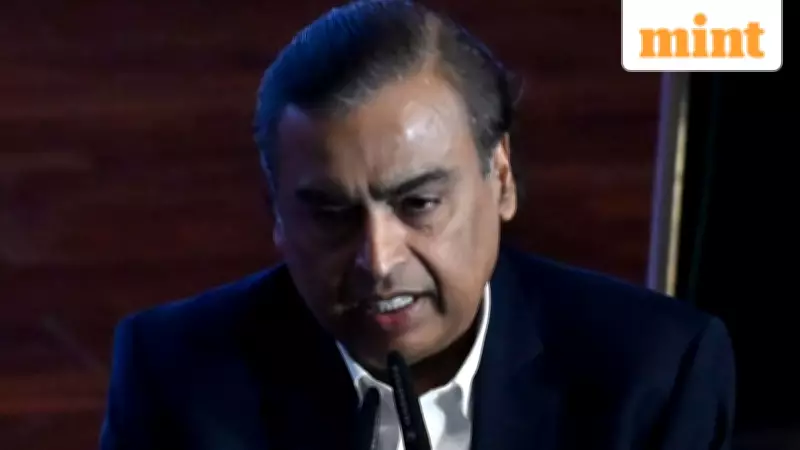
Mukesh Ambani Urges India to Embrace AI as Historic Growth Catalyst
Reliance Industries Limited chairman Mukesh Ambani sought to calm rising anxieties surrounding artificial intelligence on Wednesday, positioning the technology as a monumental opportunity for India rather than a threat. His remarks came during a global forum discussion with BlackRock chairman and CEO Larry Fink, coinciding with significant turbulence in technology markets worldwide.
AI Debut Sparks Investor Concerns as Indian Tech Index Plummets
The timing of Ambani's address was particularly noteworthy as the Nifty IT index experienced a sharp decline of nearly 6% on the same day. This market reaction was triggered by the launch of Anthropic's Claude Cowork plugins, which raised fears about AI agents potentially displacing the traditional human-driven, billable-hour business models that have long sustained India's technology giants.
Compounding these concerns, technology firm Palantir announced that its Hivemind AI platform can now autonomously migrate data from legacy systems—a service that has historically represented a core revenue stream for numerous Indian IT companies. This dual development created a climate of uncertainty among investors and industry observers.

Ambani Draws Parallel to Industrial Revolution's Transformative Impact
Despite these immediate market reactions, Ambani presented a fundamentally optimistic perspective, describing AI's emergence as "a once-in-several-centuries opportunity." He drew direct parallels to the dawn of the Industrial Revolution, which dramatically accelerated global economic growth and productivity.
"We shouldn't get scared of AI," Ambani emphasized. "It's exactly like when the Industrial Revolution came, humanity moved forward, we moved forward, productivity moved forward. We moved from 0.3% growth for many, many decades, or many centuries, to 3% growth overall."
To illustrate the transformative potential of technological advancement, Ambani offered a historical comparison: "If one were to go back 200 years and claim that people would one day travel 2,000 km in a day, it would have seemed impossible. Today, with air travel, people can cover not just 2,000 km but nearly 30,000 km in a day. And I think we are just at the beginning of that age, and we must embrace it."
Long-Term Vision: India's Path to Global Leadership Through AI
From an Indian perspective, Ambani argued that artificial intelligence presents immense advantages that could redefine the nation's global standing. He projected that if India actively embraces the technology and empowers its youth to do the same, the country could fundamentally transform itself and establish a prominent global position over the next two to three decades.
"In this new era, India and the tree of the Indian economy is bearing fruits with great visibility, with sustainability and abundance," Ambani stated, referencing an old Indian saying that "a tree only attracts attention if it bears fruit."
Particularly exciting for Ambani is India's burgeoning startup ecosystem, where he sees the aspiration and confidence of founders as the seeds that could grow into "a hundred new Reliances." This entrepreneurial energy, combined with strategic AI adoption, forms the cornerstone of his optimistic vision for India's economic future.
BlackRock's Fink Emphasizes Inclusive Economic Expansion Through AI
Echoing the need for thoughtful implementation, BlackRock's Larry Fink highlighted that the key to AI's societal success lies in ensuring it broadens economic opportunity rather than constricting it. "The real question is whether AI can not only disrupt but also expand economic growth across countries," Fink observed.

While acknowledging that the early phases of AI adoption might create uneven outcomes, Fink maintained that in the long run, artificial intelligence represents a major opportunity for businesses worldwide. He noted AI's potential to help companies better understand clients, manage operations more effectively, and improve overall efficiency—factors that could make its impact "potentially very powerful" across industries.
Together, these perspectives from two of the world's most influential business leaders frame artificial intelligence not as a disruptive threat to be feared, but as a transformative force that—if embraced strategically—could propel India toward unprecedented economic growth and global leadership in the coming decades.