Humanity has already sent five spacecraft on trajectories that will eventually carry them beyond the Solar System, demonstrating that technologically advanced civilisations can launch interstellar probes. That raises an intriguing possibility. Could another civilisation have done the same and sent robotic explorers to our cosmic neighbourhood? According to a new study by astronomer T. Joseph W. Lazio, the answer remains unknown.
Published in the Proceedings of the IAU Centenary Symposium, the research concludes that humanity currently lacks the technology and observational coverage needed to rule out the existence of extraterrestrial probes or other technological artifacts somewhere in the Solar System. In other words, if alien probes or remnants of extraterrestrial technology are hiding in our cosmic backyard, scientists simply have not looked closely enough to rule out their presence.
Why Scientists Say Aliens in Our Solar System Can't Be Ruled Out
Lazio's study examined a straightforward but falsifiable hypothesis: one or more physical extraterrestrial technosignatures are present in the Solar System today. The goal was to determine whether current technology is capable of disproving that idea. The answer, according to the study, is no. Humanity is "not even close" to being able to rule out the presence of alien artifacts, largely because only a tiny fraction of the Solar System has been surveyed in enough detail.

The idea is not as far-fetched as it may sound. Humanity itself has already launched five spacecraft on trajectories that will eventually leave the Solar System. Pioneer 10 and 11, Voyager 1 and 2, and New Horizons demonstrate that technological civilizations are capable of sending interstellar objects into space.
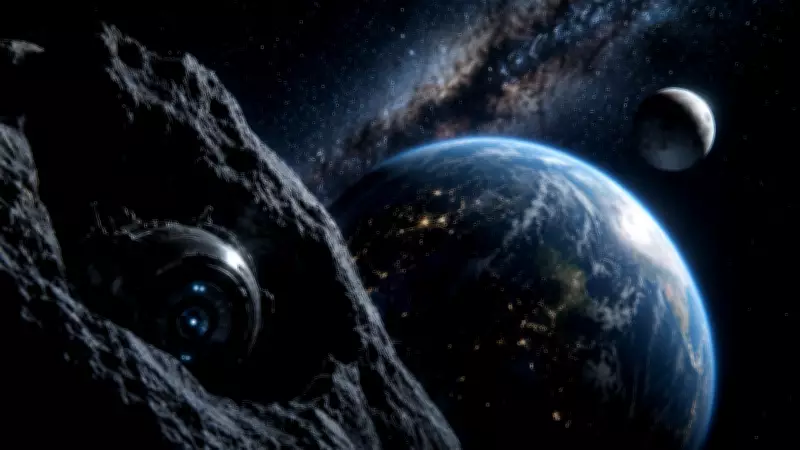
The research categorises possible technosignatures into four groups. These include passive probes drifting through space, active probes still carrying out scientific tasks, inactive objects sitting on the surfaces of planets or moons, and operational surface installations such as automated stations or mining facilities. Each category presents different challenges for detection, and some objects may simply blend in with ordinary asteroids or remain hidden on poorly explored worlds.
Why Finding Alien Probes Is So Difficult
Scientists may be able to detect unusual objects, but proving that they are artificial is another matter entirely. A striking example came in 2020 when astronomers identified an object known as 2020 SO. Initially classified as an asteroid, it was later revealed to be a Centaur rocket booster launched during NASA's Surveyor 2 mission in 1966.
The incident highlighted how difficult it can be to distinguish technological objects from natural space rocks. Interstellar visitors such as 3I/ATLAS have also sparked speculation, but no evidence has suggested they are anything other than natural objects.
A similar debate surrounded 'Oumuamua, the first known interstellar object discovered in 2017. While most researchers consider it a natural object, some scientists have argued that its unusual characteristics deserve closer examination. The controversy illustrates how challenging it can be to determine whether a mysterious object is natural or artificial.
Most of the Solar System Remains Poorly Explored
Although spacecraft and telescopes have mapped parts of the Solar System, much of it has only been observed at relatively low resolutions. Around Saturn's moons, images often cover areas measuring roughly one kilometre per pixel. Even on the Moon, only a small fraction of the surface has been imaged in sufficient detail to reveal objects smaller than half a metre.
As a result, potential artifacts could easily escape detection, especially if they are small or have degraded over millions of years.
Even Earth's Moon, one of the most thoroughly studied bodies beyond our planet, has not been photographed at its highest resolutions everywhere. According to the study, many regions across the outer Solar System have never been examined closely enough to reveal anything smaller than large geological structures.
Active Probes Might Reveal Themselves Through Heat
If alien probes are still operating, they would likely have to obey the laws of thermodynamics and release waste heat. Such objects could appear warmer than expected when viewed in infrared wavelengths.

Large surveys, including NASA's WISE mission, have already detected objects with unusual thermal properties. However, scientists lack the resources and detailed observations needed to determine whether these anomalies are natural or artificial.
Any functioning spacecraft would also likely display subtle signs of activity, such as abnormal heat signatures or unusual motions. These characteristics could help distinguish an artificial object from ordinary asteroids and comets.
New Observatories Could Improve the Search
Upcoming facilities and missions could significantly expand the search for technosignatures. The Vera C. Rubin Observatory's Legacy Survey of Space and Time, SPHEREx and NASA's Near-Earth Object Surveyor are expected to provide millions of detailed observations of asteroids and other small bodies.
These vast datasets could reveal unusual objects deserving closer investigation. However, researchers say definitive answers may ultimately require sending spacecraft to inspect suspicious targets directly.
Artificial intelligence could also become an important tool in the search. Future algorithms may help researchers sift through enormous datasets to identify subtle anomalies that human observers might otherwise miss.
The Search for Extraterrestrial Artifacts Is Gaining Attention
The concept known as SETA, or the Search for Extraterrestrial Artifacts, has traditionally received far less attention than searches for radio signals. However, the new study argues that advances in astronomical surveys may finally make the field more practical.
Unlike conventional SETI efforts, which seek electromagnetic signals from distant civilizations, SETA focuses on finding physical evidence of alien technology. Such artifacts could potentially survive for millions or even billions of years, making them easier to discover than brief transmissions.
For now, there is no evidence that alien probes are hiding in our Solar System. But according to the study, there is also no way to confidently say they are not. Until humanity explores its cosmic backyard in much greater detail, the possibility remains open.
For decades, scientists searching for extraterrestrial intelligence focused primarily on listening for radio signals from distant stars. But as telescopes become more powerful and surveys more comprehensive, researchers are increasingly considering another possibility: if evidence of alien technology exists, it may already be much closer to home. Whether such objects are eventually found or not, the question itself is now becoming scientifically testable rather than purely speculative.
This article was written by the TOI Science Desk, an inquisitive team of journalists dedicated to demystifying science and making it accessible to readers of all backgrounds.