AI-Powered Thermal Drones Revolutionize Elephant Monitoring in Chhattisgarh Forests
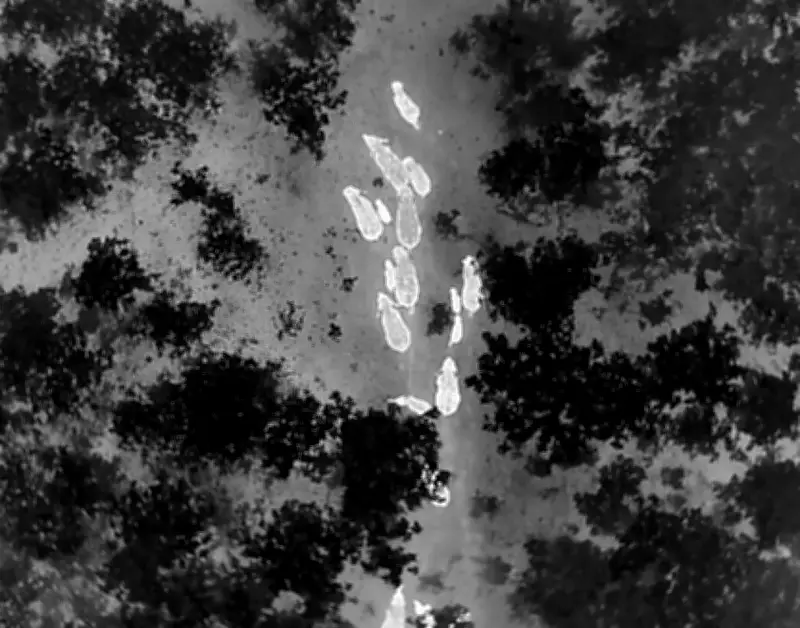
In a significant technological advancement, elephants in Chhattisgarh are now being tracked around the clock using AI-enabled thermal drones, allowing the forest department to monitor movements and profile individual animals deep within dense forest areas. This innovative system addresses the critical challenge of nighttime elephant activity, when conventional drones fail to capture clear visuals.
Night Surveillance and Individual Profiling Capabilities
Forest officials at the Udanti Sitanadi Tiger Reserve have reported that elephant movement peaks after dark, creating monitoring gaps. The new thermal drone detects heat signatures with precision, enabling staff to count elephants accurately, track herd movements, and identify solitary bulls that frequently stray near human settlements. The drone's integrated laser range finder measures elephant dimensions and surrounding terrain, facilitating detailed profiling based on distinctive features such as tusk size, tail length, ear shape, and body structure.
Deputy Director of Udanti Sitanadi Forest Reserve Varun Jain emphasized to TOI that this profiling is essential for distinguishing lone bulls from herds, as solitary elephants are often responsible for crop damage and human-wildlife conflict incidents. "Currently, three lone elephants are moving across the Udanti forest division and are difficult to identify visually. Thermal imaging helps us isolate individuals and monitor their movement and behavior with greater accuracy," explained the Indian Forest Service officer.

Advanced Technical Specifications and Broader Applications
The latest drone model represents a substantial upgrade from earlier versions with limited flight duration. It can remain airborne for 40-45 minutes and map up to 100 hectares in a single mission. Equipped with a Differential Global Positioning System module, it generates centimeter-level accurate mapping valuable for forest surveys, plantation assessments, and revenue-related geospatial data collection.
Officials highlighted the drone's high zoom capability, extending up to 500 meters, which permits monitoring from safe distances without disturbing wildlife. While real-time identification remains under development, captured imagery undergoes post-mission analysis and comparison with existing databases to track recurring individuals across different landscapes.
Although primarily introduced for elephant monitoring, the drone system has broader conservation applications. It can be trained for AI-based tracking of poaching activities, monitoring water bodies, and surveying other wildlife species. All collected data uploads to a dedicated drone portal for comprehensive analysis and long-term documentation—a system first developed by the Chhattisgarh forest department in 2021.
Conflict Reduction and Future Implementation
Forest authorities anticipate that thermal tracking will significantly enhance early warning systems for villages, enabling field staff to alert residents promptly when elephants approach human settlements. The technology is also expected to refine future elephant censuses, where laser-based measurements can provide more accurate population data than traditional methods.
"With elephant movement expanding across northern Chhattisgarh, technology like thermal drones will play a crucial role in balancing conservation efforts with community safety," stated a senior department official. The customised drone system, costing approximately Rs 9 lakh, has already seen similar deployments in forest divisions such as Dharamjaigarh and Katghora, areas known for frequent elephant movement.
The forest department plans to conduct thorough field performance evaluations before considering wider deployment across additional forest divisions, marking a progressive step toward integrating advanced technology with wildlife management strategies.