AI Impact Summit 2026: India Embraces Deployable AI in Machines and Infrastructure
The AI Impact Summit 2026, inaugurated by Prime Minister Narendra Modi from February 16 to 20 at Bharat Mandapam in New Delhi, represents a pivotal shift in India's artificial intelligence narrative. Spanning 70,000 square metres, this event moves beyond cloud-heavy and software-centric approaches to focus on physical, deployable AI embedded directly into machines, devices, and critical infrastructure.
From Promises to Practical Applications
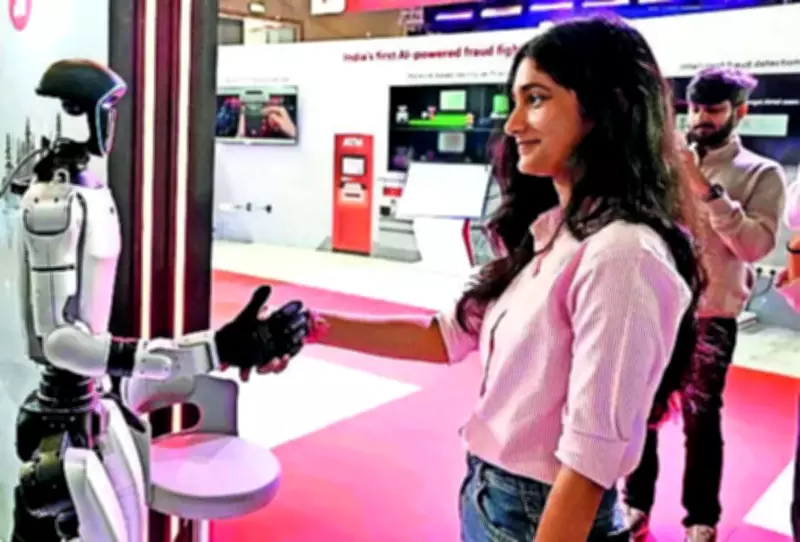
Unlike traditional tech expos that highlight future possibilities, this summit emphasizes AI already at work in real-world scenarios. The exhibition floor is bustling with live demonstrations of autonomous drones scanning crops for diseases, wearable devices assisting frontline health workers, and industrial robots performing predictive maintenance. Additionally, AI-powered tools are showcased for translating court judgments and government documents into various Indian languages, enhancing accessibility and efficiency in public services.
Global and Domestic Tech Giants Showcase Innovations
Global technology leaders have mounted extensive showcases, drawing significant crowds. Google's pavilion features applications ranging from climate modelling and extreme weather prediction to language tools and an AI cricket coach tailored for Indian users. Microsoft is presenting secure AI platforms designed for governance, public services, and enterprise adoption, while Nvidia captivates attendees with live demonstrations of GPU-powered robotics, real-time simulations, and industrial AI systems, underscoring the growing importance of high-performance computing.

Other major players like Open AI, Qualcomm, Amazon Web Services, and Schneider Electric are also present, positioning their platforms for India's large and diverse markets with a sharp focus on scale, cost efficiency, and regulatory compliance.
Equally prominent is the participation of India's own tech majors. The Tata Group's showcase spans manufacturing, mobility, and digital public infrastructure, illustrating how AI integrates into traditional industries. HCL Tech focuses on enterprise AI, secure data systems, and responsible deployment frameworks, while Reliance Industries highlights applications in telecom, retail, and cloud infrastructure.
International Collaboration and Youth Innovation
The summit's international character is reinforced by country pavilions from Japan, the United Kingdom, and Germany, hosting live demonstrations and bilateral discussions. Senior executives from global technology firms are engaging in closed-door sessions and public interactions, using this platform to explore partnerships and policy alignment in one of the world's fastest-growing AI markets.
Despite the heavy presence of big tech, the energy on the floor is driven equally by startups, students, and young innovators. Youth zones are packed with school and college teams presenting solutions for precision farming, healthcare diagnostics, climate resilience, and education, many designed to operate offline or in regional languages. "Cost is our biggest constraint," said Shashwat Ranjan, a computer science student developing an AI-based mental health tool. "Running models for college projects is expensive. Being here helps us understand how to build affordable systems that can actually scale."
Indigenous AI Models and Local Focus
Several pavilions highlight indigenous foundation models trained on Indian datasets and designed to support all 22 official languages. These initiatives are backed by domestic compute infrastructure and governed by local data protection frameworks. Officials state that the aim is to ensure AI systems reflect Indian realities and remain accessible to startups, researchers, and public institutions, fostering a self-reliant AI ecosystem.
With over 300 curated pavilions and more than 600 startups across sectors, the AI Impact Summit 2026 underscores a transformative phase in India's tech landscape, prioritizing deployment over demos and setting the stage for widespread AI integration in everyday life.