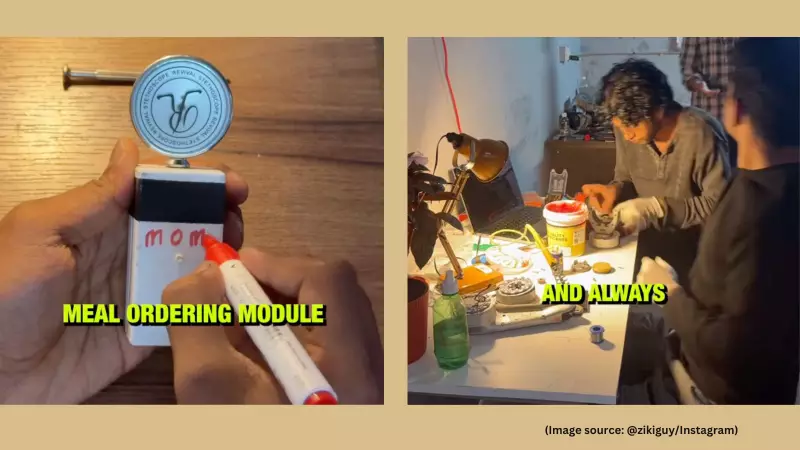
In a remarkable display of technological innovation that's both fascinating and controversial, a startup founder from Mangaluru has created an artificial intelligence-powered device that automatically orders food whenever his stomach growls. The invention, which has taken social media by storm, showcases how AI can be integrated into the most mundane aspects of daily life.
The Meal Ordering Module: How It Works
Sohan M Rai, a tech content creator and entrepreneur, recently demonstrated his unique creation in a viral video that has accumulated thousands of reactions across platforms. The device, which he has named "MOM" (Meal Ordering Module), is a small module that clips onto his belt and detects stomach growls using an unconventional setup.
To assemble the hardware for this innovative gadget, Rai employed multiple components, including a stethoscope borrowed from his sister. The device captures stomach sounds and relies on Claude AI to assess hunger levels before automatically placing food orders through the popular food delivery platform Zomato.

In the video demonstration that has captivated viewers worldwide, Rai explains: "I invented this device which understands when I'm hungry and automatically orders food on Zomato." The seamless integration of hardware and artificial intelligence represents a novel approach to solving everyday problems, though many question whether this particular problem needed solving.
Mixed Reactions from Social Media Users
The viral video has generated a flurry of reactions from viewers, with opinions sharply divided about the practical utility of such an invention. Several users expressed skepticism about the fundamental premise of the device, pointing out potential flaws in its approach to detecting hunger.
One user commented: "Should be featured in unnecessary invention," highlighting the debate around whether the device addresses a genuine need or simply demonstrates technological capability for its own sake. Another user offered a more nuanced critique: "Growl does not mean hungry. Nice work though," suggesting that the correlation between stomach sounds and hunger might not be as straightforward as the device assumes.
Health concerns also emerged in the discussion, with a third user warning: "Good invention but soon it will growl cuz of acidity. Eat homemade food." This comment reflects broader questions about the health implications of automated food ordering systems and whether they might encourage less mindful eating habits.
The Creator's Track Record of Viral Innovations
This isn't the first time Sohan M Rai has captured public attention with his technological experiments. According to his professional background, the Mangaluru native graduated from Sahyadri College of Engineering & Management and completed several internships at different tech companies before starting his own venture while simultaneously creating content on Instagram.
In 2023, Rai went viral for an equally ambitious project where he joined Zomato as a delivery partner and delivered food using a drone he built himself. Sharing that experiment on social media, he wrote: "I wanted to put my skills into use and build an autonomous drone which could deliver a pizza directly to a home, without having a pilot. Here, I have built the drone with a lot of Jugaad, and it would be a lot better when it is commercial. This is an experiment and was conducted with safety and precautions."
His consistent focus on food delivery technology suggests a particular interest in revolutionizing how people access and receive their meals, though the practical applications of such innovations remain subjects of ongoing discussion among technology enthusiasts and critics alike.
The stomach-growl-detecting device represents the latest in a series of experiments that push the boundaries of what's possible with consumer-level technology and artificial intelligence, raising important questions about the intersection of innovation, utility, and everyday life.