AI Performance Reviews: Companies Now Factor AI Adoption into Career Progression
Artificial Intelligence is becoming deeply integrated into performance appraisal systems, with companies actively encouraging employees to utilize AI tools in both internal workflows and client engagements to achieve measurable outcomes. Demonstrating practical AI adoption is rapidly emerging as a critical component for career advancement and professional growth.
AI Fluency as Core Capability
Across diverse industries, AI fluency is increasingly viewed as a fundamental capability essential for driving operational efficiency and maintaining long-term competitive advantage. Companies are recognizing that employees who effectively leverage AI tools contribute significantly to organizational success.
Amazon's Self-Directed AI Integration
Amazon India's HR Vice President Deepti Varma revealed that the company has embedded AI throughout the entire employee lifecycle, with adoption being largely self-directed rather than mandated through top-down directives. In human resources functions specifically, Amazon utilizes AI-generated nudges to prompt managers on various responsibilities including performance reviews, feedback cycles, and promotion documentation processes.

"When you remove the fear that AI is there to replace what people do, they begin using it to reduce cognitive load and improve productivity. And that's what has happened," Varma emphasized. The manager-facing AI assistant has been operational for over a year, focusing primarily on simplifying and scaling processes rather than imposing mandatory requirements.
Outcomes Over Formal Evaluation
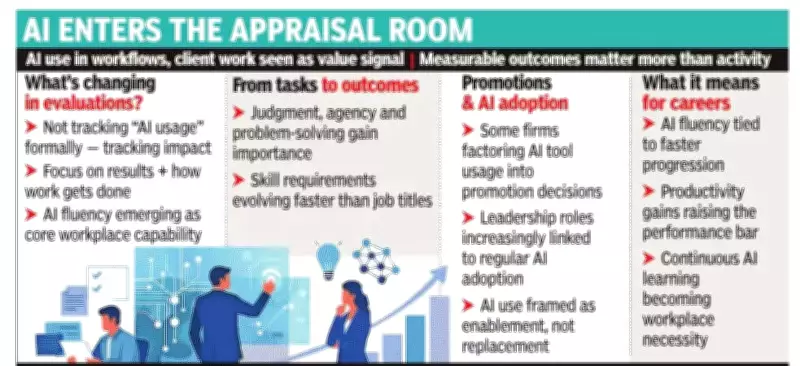
Kumaresh Pattabiraman, India Country Manager and Vice-President at LinkedIn Sales Solutions, explained that while his company doesn't formally evaluate employees specifically on AI usage, they do assess outcomes and the methods used to achieve them. The "how" component increasingly includes using AI to enhance efficiency and improve collaborative effectiveness.
Pattabiraman noted that according to LinkedIn's data, while new job titles continue to emerge, overall roles aren't necessarily shrinking. Instead, skill requirements for existing positions are evolving at an accelerated pace. AI is shifting professionals from being "doers of tasks" to "directors of outcomes," he observed, where unique human strengths such as judgment and agency become increasingly valuable, effectively raising expectations for individual contributions.
Accenture's Formal AI Tracking
A report in The Guardian revealed that Accenture has begun systematically tracking employees' utilization of AI tools and incorporating this data into promotion decisions as the firm seeks to accelerate technology adoption across its global workforce. An internal email obtained by the Financial Times indicated that the company informed senior managers and associate directors that promotion to leadership positions would require "regular adoption" of artificial intelligence technologies.
When questioned about AI becoming pivotal for career progression, Accenture responded: "Our strategy is to be the reinvention partner of choice for our clients and to be the most client-focused, AI-enabled, great place to work. That requires the adoption of the latest tools and technologies to serve our clients most effectively."
Productivity Focus at Lam Research
Rangesh Raghavan, Corporate Vice-President and General Manager at Lam Research, clarified that his company doesn't formally track or appraise employees based specifically on AI usage, even while expecting teams to adopt new tools to enhance productivity. "We don't specifically say if somebody is using AI or not using AI, they're not going to get a promotion," he stated, adding that performance is ultimately measured by outcomes and contributions to problem-solving initiatives.

The Future of AI in Workplace Development
As AI becomes more deeply embedded in everyday work activities and project assignments, industry experts anticipate this technology will transition from optional enhancement to workplace necessity. An LTM spokesperson predicted that "eventually, this will become a necessity for work and enable employees in their continuous development and growth," highlighting the inevitable integration of AI capabilities into professional advancement pathways across sectors.
The transformation represents a significant shift in how companies evaluate employee performance, with AI adoption emerging as both a practical tool for productivity enhancement and a measurable indicator of professional adaptability and forward-thinking capability in the modern workplace.