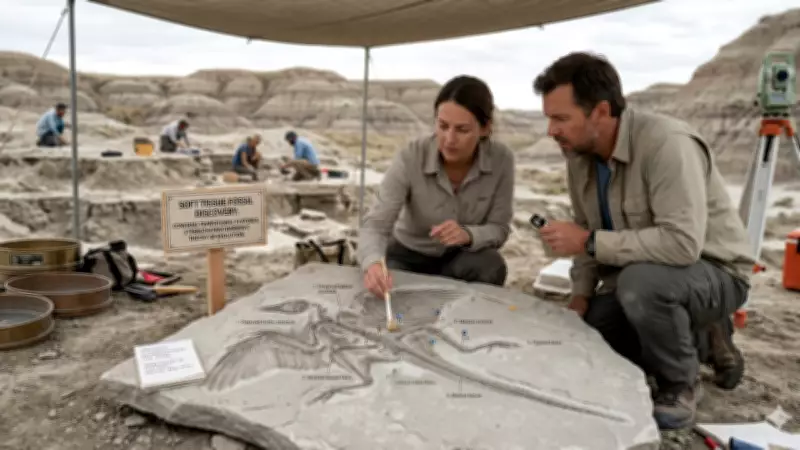
In 1859, Charles Darwin's theory of evolution was introduced in "On the Origin of Species." Darwin proposed that evolution occurred gradually, despite the lack of complete fossils at the time. Today, scientists have discovered a 150-million-year-old fossil containing soft tissue, a finding that validates Darwin's predictions and provides new insights into fossilization, prehistoric organisms, and evolutionary processes.
Darwin's Prediction and the Fossil Record Gap
In his 1859 work, Darwin acknowledged the fossil record's incompleteness as a potential weakness of his theory. He wrote, "Why, if species have descended from other species by fine gradations, do we not everywhere see innumerable transitional forms?" Darwin argued that fossilization is an imperfect and selective process, so the absence of transitional forms did not disprove evolution. Subsequent discoveries have since filled many gaps, confirming his insights.
Significance of the 150-Million-Year-Old Soft Tissue Fossil
The discovery of soft tissue in a 150-million-year-old fossil is remarkable because soft tissues typically degrade quickly after death, leaving only hard parts like bones and teeth. Research titled "Soft tissue and cellular preservation in vertebrate skeletal elements from the Cretaceous to the present" notes that such preservation offers unparalleled insight into extinct organisms' biology and evolution. Favorable conditions, such as rapid burial and low oxygen, likely slowed decay and allowed mineralization, enabling scientists to study microscopic tissues and molecular remnants.

How Soft Tissue Fossils Strengthen Evolutionary Biology
Soft-tissue fossils provide information beyond what bones can reveal, including details about appearance, behavior, and physiology. For example, they can indicate skin, muscle, and organ structures. A report from Imperial College London emphasizes that exceptional preservation can shed light on biological data otherwise absent from the fossil record. By comparing preserved specimens with living organisms, scientists trace evolutionary connections, enriching evolutionary theory.
Modern Discoveries Confirming Darwin's Theory
The preservation of soft tissues in ancient fossils confirms Darwin's prediction that additional evidence would support his theory. While Darwin could not foresee modern analytical technologies, his core premise remains valid: the fossil record becomes more detailed over time. Dr. Mary Schweitzer, a molecular paleontology expert, notes that such findings indicate biological materials may be preserved much longer than previously thought, challenging long-held beliefs about fossilization.
Evolutionary Theory Reinforced Through Fossil Evidence
Over 150 years after Darwin's proposal, fossils like this 150-million-year-old specimen provide evidence that continues to validate his theory. The once-perceived gap in the fossil record has become an exciting field of scientific exploration. This discovery expands knowledge about extinct species and demonstrates the enduring applicability of Darwin's ideas. As technology advances, the accuracy of Darwin's theory becomes increasingly evident.