

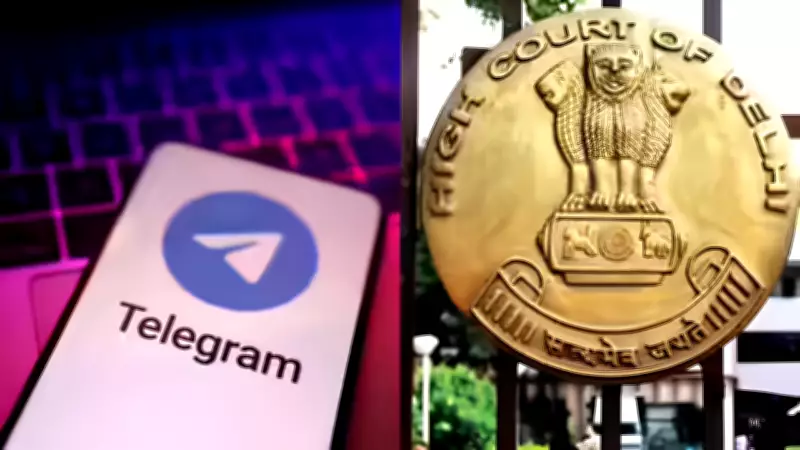
The central government on Thursday informed the Delhi High Court that the social media platform Telegram has transformed into a 'new dark web,' complicating efforts for authorities to track and attribute criminal activities.
Government's Affidavit on Telegram
In an affidavit filed in response to Telegram's plea contesting the government's move to temporarily restrict access to the app before the June 21 NEET-UG retest, the government argued that the 'scale of the said channel itself demonstrates the capability of Telegram to facilitate mass dissemination of unlawful examination-related content.'
'Telegram has become the new dark web, linking threat actors. Criminals have rapidly adopted Telegram to post links on channels that connect to dark web forums through deep web links, making it hard for authorities to track and attribute criminals,' the counter affidavit stated, as reported by Bar & Bench.

The government further asserted: 'When such information becomes repetitive and rampant, the only option is to block all information hosted by the intermediary, since technically it is not possible to segregate the unlawful content from the lawful content.'
High Court Proceedings
The High Court on Wednesday sought the Centre's stance on the ban imposed on the messaging app Telegram, even as the government claimed there is 'shocking material' which it will share with the court.
Solicitor General Tushar Mehta, representing the government, requested a day's time and noted that the government had been communicating its concerns to Telegram since May. Telegram's counsel argued that the curbs were illegal and questioned the legality of the blanket order blocking the platform.
Senior advocate Dhruv Mehta informed the High Court that over 150 million users had been affected. Solicitor General Mehta stated that the blocking order had been issued under Section 69A of the IT Act and that a post-decisional hearing had already been conducted, where Telegram's representatives participated before the nodal agency, with a fresh order expected.
'We shudder to imagine a situation where there is public unrest,' Solicitor General Tushar Mehta submitted before a bench of Justice Tejas Karia. 'There are 150 million users in the country. You block everything. Article 14 is completely violated,' Telegram's counsel Mehta countered.
'All content and channels that were requested by the government have been removed,' Telegram's counsel told the court, adding that no emergency had been recorded in the government's decision to justify the ban.
'Students obtain study material through Telegram. Educators use it. Businesses use it. You have blocked everything,' the counsel pointed out, arguing that the decision to ban failed to acknowledge actions already taken by Telegram in response to government requests.
According to Telegram, since June 1 several meetings had been held with government authorities, and whenever specific channels were identified, the platform acted upon requests for blocking them. 'If the court will hear us tomorrow, there is something shocking I can show. One channel starts, it is prohibited, and then another is started. And with a QR code, you can make a payment for questions,' Mehta argued.
Justice Karia then sought to know if 'complete' blocking of the platform is 'proportionate.'






