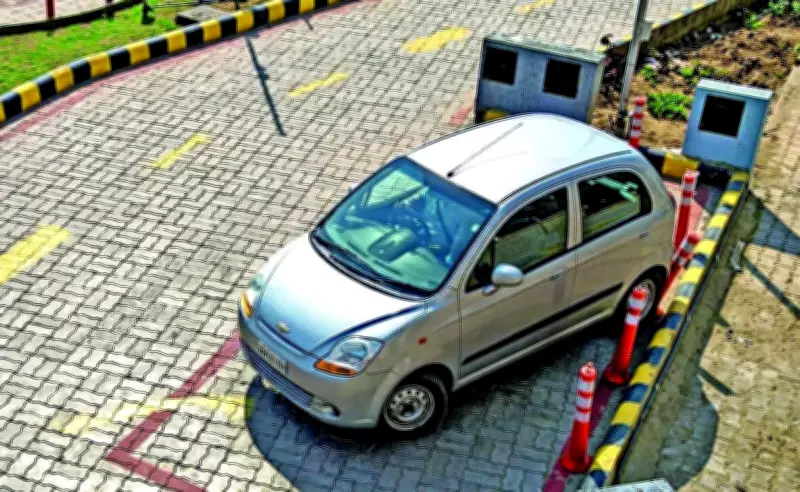
Parallel parking has emerged as the single biggest obstacle in driving licence tests across Gujarat, causing three out of every four candidates who fail to stumble at this stage, even when their vehicles are equipped with parking sensors and reverse cameras. The challenge is so significant that some applicants are now arriving with cars fitted with 360-degree cameras just to overcome it.
Failure Rates and Trends
While the overall failure rate for light motor vehicle (LMV) driving tests has declined from nearly 55% to 45% over the past two years, approximately 80% of those who fail are tripped up by the parallel parking component. This persists despite the fact that about 90% of vehicles brought for testing are equipped with parking sensors or reverse cameras.
Case of Repeated Failures
In a notable incident at a Regional Transport Office (RTO) in the Saurashtra-Kutch region, a driver failed the parallel parking test three consecutive times. On the fourth attempt, the candidate returned with a car featuring a 360-degree camera system and successfully passed. These systems use wide-angle lenses around the vehicle to create a real-time bird's-eye view, eliminating blind spots and simplifying tight reversing maneuvers.

Applicants are given 90 seconds to complete the parallel parking maneuver. Many either run out of time or touch a boundary marker, both of which result in an automatic failure.
An RTO inspector noted, 'Of the 45% who fail, about 80% fail the first step itself, which is parallel parking. And this is despite the presence of sensors and, in many vehicles, even reverse cameras.' The inspector added, 'Many applicants struggle with judging the distance from the kerb, aligning the vehicle within the marked space, and coordinating steering inputs while reversing within the time limit. Even minor contact with a marker counts as a failure.'
Improvements in Pass Rates
RTO officials attribute the overall improvement in pass rates to better familiarity with the automated testing tracks, particularly among first-time applicants aged 18 to 25, who tend to clear tests more easily than those in their 30s and above. 'The shift to automatic vehicles has also helped, since drivers no longer have to worry about the car rolling back during the gradient test,' the officer said. The reverse 'S' test, once a stumbling block, has become easier to crack due to camera-equipped vehicles.
Candidates in their mid-30s and older struggle more across multiple components. Officials note that many applicants over 60 who fail the permanent licence test simply keep renewing their learner's licence rather than taking a retest. 'Most of them never appeared for the current automated testing track earlier, and adapting to the new system becomes difficult,' an official explained.