Two Indian climbers—Arun Kumar Tiwari, a tech professional from Hyderabad, and Sandeep Are, 46—died while descending Mount Everest after reaching the summit, while a third Indian remains critical at South Col (Camp IV) at about 7,900 metres. Sherpa rescuers are working to stabilize the climber before transport to Camp II for a possible helicopter evacuation, expedition officials said on Friday.
Details of the Incidents
Nivesh Karki, executive director and co-founder of Pioneer Adventure, the expedition agency handling the deceased climbers, stated, “They fell ill while descending at high altitude. We are working out how to retrieve the bodies.”
Sandeep Are summited on Wednesday, when 274 climbers reached Everest’s top from the Nepal side in a single day—a record—after delayed route fixing and a narrow weather window compressed summit attempts. On his descent, he developed snow blindness and severe exhaustion near the Balcony area, prompting five Sherpa rescuers to carry out an overnight extraction through extreme high-altitude terrain. He was brought down to Camp II, where he died on Thursday.

Arun Kumar Tiwari reached the summit around 5:30 pm on Thursday but fell critically ill near Hillary Step, one of the most exposed sections below the summit in the “death zone.” Four Sherpa guides tried to stabilize him and help him descend, but he could not be revived, officials said.
Background of the Climbers
On LinkedIn, Tiwari had written from Everest Base Camp that he was “waiting for Mount Everest to grant me passage to the summit” and asked for “fair winds, clear sky, kind mountain gods and good luck.” He traced his mountaineering journey to a Himalayan trek soon after he joined ServiceNow in May 2015, writing that the first trek and a later Nanda Devi East Base Camp trek had “brutally tested” his limits but made him stronger.
In another LinkedIn post on an earlier Everest attempt, Tiwari said he turned back after his team raised concerns about his pace, recovery, and condition beyond Camp III. “Therefore, I chose life over being stranded in higher camps due to snow blindness or lack of oxygen cylinders,” he wrote, adding that going beyond 7,200 metres in those conditions could have increased the risk of “fatigue, snow blindness, frostbite” and loss of life. Tiwari’s profile mentions he had earlier climbed Denali, Aconcagua, Kilimanjaro, and Elbrus as part of a planned Seven Summits campaign before attempting Everest.
Sandeep Are’s hometown and detailed profile had not been officially released till late Friday, with expedition teams following standard protocol of withholding personal details until families were informed and documentation was completed.
Third Climber Critical
Pioneer Adventure also confirmed that the third Indian climber had fallen critically ill at South Col, the windswept saddle between Everest and Lhotse from which most summit bids on the Nepal side are launched. At that altitude, rescue teams usually try to move a climber to a lower camp before attempting evacuation because helicopters operate more safely at lower elevations. Ground teams and high-altitude Sherpas were trying to move the climber towards Camp II, from where an airlift could be planned if weather and medical conditions allowed. The climber’s identity was being withheld under rescue and family-notification protocols.
Record Congestion on Everest
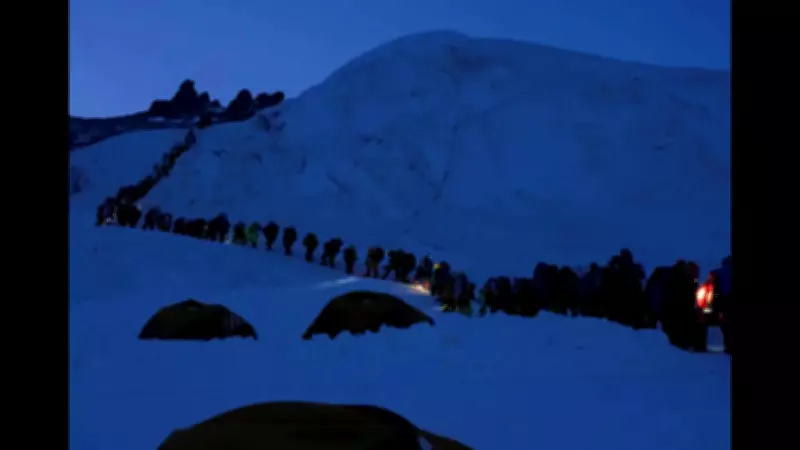
The deaths came in a season defined by congestion on the Nepal side. With the northern route through Tibet closed to regular commercial expeditions, Nepal’s southern route carried the main international summit pressure. Nepal issued 494 Everest permits this spring, each foreign climber mandatorily requiring one Sherpa’s support, which pushed the total number of people moving on the fixed-rope route close to 1,000 during the summit window. A Sherpa guide who recently returned to Kathmandu after completing Everest told TOI, “It was very crowded this year compared to last year because there were more clients.” He added, “There is a need for authorities to control this number.”

Changing Expedition Economy
The pressure has sharpened scrutiny of Everest’s changing expedition economy. Nepali firms now sell entry-level Everest climbs for $30,000 to $45,000, undercutting several Western operators that charge $50,000 to $100,000, while premium packages can cost up to $300,000. The shift has moved more business directly to Kathmandu, with clients from Mumbai, Delhi, and Beijing no longer required to book through London or New York. However, mountaineering observers said intense price competition could affect staffing, acclimatisation support, rescue capacity, and safety systems.
Ankit Babu Adhikari, a Kathmandu-based Nepali writer and co-author of ‘Sherpa’, told TOI that Everest’s changing expedition economy had brought both ownership and risk closer to Nepal. “There is competition to make climbs cheaper,” he said, adding that when agencies compete mainly on price, safety systems, staffing, and expedition standards can become the first casualties.
Mountain Maladies
At high altitudes, climbers are vulnerable to snow blindness, a painful temporary loss of vision caused by intense ultraviolet exposure reflected off snow and ice, besides severe exhaustion, frostbite, dehydration, hypothermia, high-altitude cerebral oedema, and high-altitude pulmonary oedema. In the death zone above 8,000 metres, low oxygen levels can also impair judgement, balance, and coordination.
Perilous Peaks
The danger of descent has been documented for years. A study published in BMJ, formerly British Medical Journal, on Everest deaths from 1921 to 2006 found that among 94 mountaineers who died after climbing above 8,000 metres, 53 (56%) died while descending from the summit and 16 (17%) died after turning back, while nine (10%) died during ascent. The study also found that fatigue, cognitive changes, and loss of coordination were common among those who died, a pattern often seen when climbers reached the summit after hours of effort but then faced the harder test of getting down through cold, thin air, slow fixed-rope movement, and falling oxygen reserves.