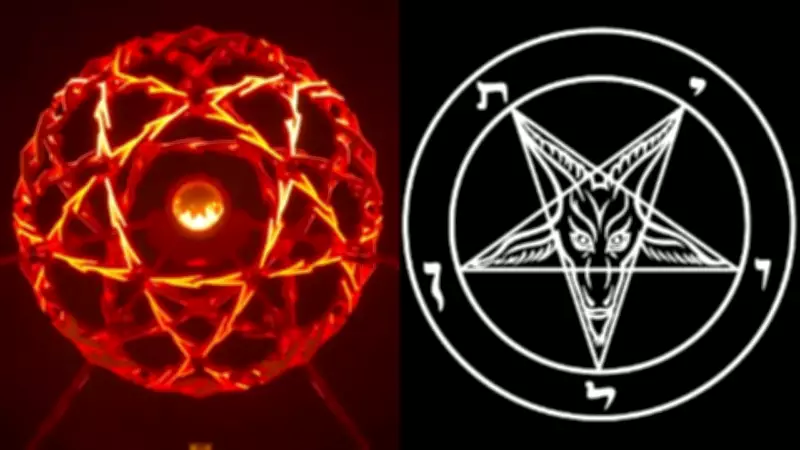
Winter Olympics Opening Ceremony Ignites Satanic Symbolism Controversy
The Milano Cortina 2026 Winter Olympics have become embroiled in a heated controversy after videos from the opening ceremony went viral on social media platforms. Netizens have expressed outrage, alleging that the design of the Olympic cauldron bears a striking resemblance to a satanic pentagram, a symbol commonly associated with demonic rituals and occult practices.
Viral Videos Fuel Conspiracy Theories
As footage from the opening ceremony circulated online, numerous users began drawing connections between the cauldron's shape and satanic imagery. This controversy has gained additional traction in light of recent events, including the release of the Epstein files and persistent rumors linking world elites to demonic identities such as 'Baal.' These elements have combined to fuel widespread conspiracy theories about occult associations among the wealthy and powerful.
The opening ceremony took place on Friday, February 6, 2026, across multiple locations in Italy. The primary events were held at Milan's iconic San Siro stadium, with smaller ceremonies occurring at Cortina d'Ampezzo. Reflecting the dual host cities, two Olympic cauldrons were lit simultaneously at the conclusion of the ceremonies: one at Arco della Pace (Arch of Peace) in Milan and another at Cortina d'Ampezzo's main square.

Italian Olympic champion Sofia Goggia served as the final torchbearer, lighting the cauldron in a moment broadcast to a global audience. However, as videos spread across social media, many viewers focused not on the athletic achievement but on the cauldron's design.
Social Media Reactions and Allegations
Social media platforms, particularly X (formerly Twitter), became hotbeds of discussion and accusation. One user wrote, "Satanic symbolism at the Olympics. When will we overthrow the rule of pedophiles and Satanists?" Another added, "Not even disguised. Just pentagrams of flame, prison planets, Lord of the Rings, Saturn worship and inversion all over. No biggie."
A particularly viral post declared, "It really doesn't get any more IN YOUR FACE than this... A clearly visible upside-down pentagram at the Opening Ceremony of the Olympics. Revelation of the method. As if you needed more PROOF that this world is run by satan and his minions."
These reactions highlight how viewers interpreted the cauldron's kinetic structure, which expands and contracts during the ceremony, creating lines that many perceived as forming pentagrams. Some users even questioned other elements, such as the spiral pattern on stage during performances and the simultaneous lighting of two cauldrons.
Historical and Symbolic Context of the Pentagram
The allegations specifically focus on the upside-down pentagram, also known as a satanic pentagram or demonic eye. This symbol is linked to the Church of Satan and the Sigil of Baphomet, with associations dating back to the mid-19th and 20th centuries. However, it's important to note that the five-pointed star has also been used as a positive symbol in Christian, Islamic, and pagan traditions throughout history.
Some conspiracy theorists extended their analysis beyond the cauldron itself. One X user compared the "large spiral/vortex stage design" to a demonic portal, particularly noting the use of smoke, flashes, and color shifts to orange and red. The same user referenced the lighting of two cauldrons as invoking the twin pillars of Boaz and Jachin from Solomon's Temple in Jerusalem, symbols that, while biblical, are also deeply embedded in occult practices as representations of duality.
Official Explanation and Design Intent
For most observers, the Olympic cauldron traditionally symbolizes unity, continuity, and the commencement of the eagerly anticipated games. The 2026 cauldron was designed by Italian creative director Marco Balich in collaboration with Fincantieri. The structure draws inspiration from Renaissance geometry and the interlaced "knots" found in Leonardo da Vinci's notebooks.

Constructed from lightweight aeronautical aluminium, the cauldron consists of 1,440 components and 244 pivot points. Its diameter expands from approximately 3.1 meters when closed to 4.5 meters when fully open. The kinetic motion was intentionally designed to reflect themes of movement, unity, and transformation rather than any ritual or ideological symbolism.
The cauldrons were engineered to protect the Olympic flame, which is enclosed in a glass and metal container. Designers also prioritized sustainability, ensuring no material fallout, low acoustic impact, minimal smoke emissions, and enhanced public safety. The use of red and orange lighting was intended to evoke imagery of fire and struggle, drawing on literary references to Dante's Inferno as a homage to Italian culture.
Olympic officials have confirmed that the simultaneous lighting of two cauldrons was both a logistical and artistic choice, marking a historic first for the Winter Games. This decision was meant to visually represent the unity between Milan and Cortina d'Ampezzo as co-host cities.
Broader Implications and Interpretations
Given the presence of numerous world leaders at the ceremony, some analysts suggest that the imagery and its link to occult practices may have been interpreted as a subtle commentary on their attendance and influence, rather than a confirmation of actual occult associations. The controversy highlights how symbolic interpretation can vary dramatically between official intent and public perception, particularly in the age of viral social media content.
As the Milano Cortina 2026 Winter Olympics continue, this controversy serves as a reminder of how global events can become flashpoints for broader cultural and conspiratorial discussions, often overshadowing the athletic achievements at their core.