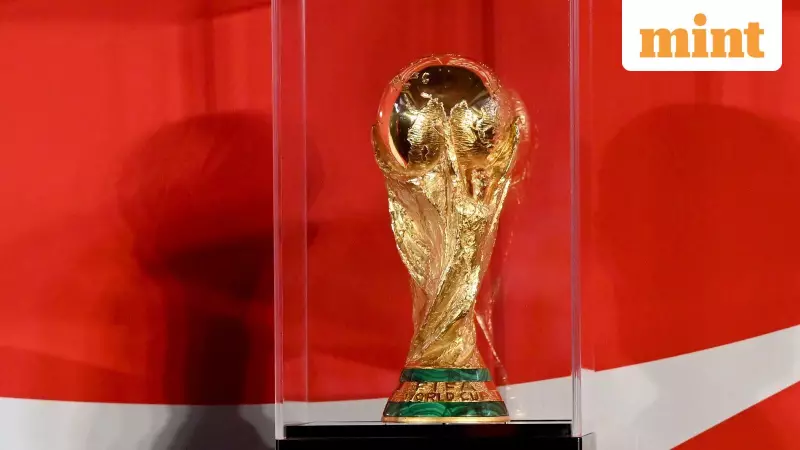
The iconic original FIFA World Cup Trophy made a grand return to Indian soil on Saturday, unveiling in the national capital after a gap of twelve years. This ceremonial stop on its global tour was viewed by stakeholders as a significant moment for Indian sports, coinciding with a major corporate commitment to boost the women's game.
A Trophy's Return and a Landmark Partnership
Sanket Ray, President of Coca-Cola India and South-West Asia, highlighted the visit's broader context. "Sport in India is entering a defining phase, marked by wider participation, stronger infrastructure and growing global engagement," he stated. The soft drinks giant, a FIFA partner since 1978, used the occasion to announce a crucial new three-year sponsorship deal for the Indian Women's National Football Team, unveiled in collaboration with the All India Football Federation (AIFF).
This partnership arrives on the crest of a historic achievement. The senior women's national team recently qualified for the AFC Women's Asian Cup 2026 in Australia, ending a wait of over two decades. The team dominated its qualification group, securing four wins, scoring 27 goals, and conceding only one, which included a standout victory against higher-ranked Thailand.

The Tour and the Trophy's Storied Legacy
Ahead of the FIFA World Cup 2026, the original trophy is embarking on an extensive global journey, visiting 30 member associations across 75 stops over more than 150 days. India's three-day leg features two days in New Delhi before the trophy travels to Guwahati in Assam.
The trophy itself is a masterpiece of football heritage. Weighing 6.175kg and crafted from 18-carat gold, the current design was introduced in 1974 and depicts two human figures holding up the Earth. Access to the original trophy is highly restricted, typically reserved for World Cup winners, a select group of officials, and certain heads of state.
India's Football Journey: Deep Roots and Unfulfilled Dreams
The trophy's visit inevitably revisits India's complex and passionate, yet unfinished, relationship with the world's biggest football tournament. Sports historian Boria Majumdar clarified a long-held myth, noting that India qualified for the 1950 World Cup in Brazil but withdrew primarily due to travel costs and logistics. The popular belief of a ban for playing barefoot is incorrect, as FIFA only outlawed barefoot play in 1953. India has not qualified for the tournament since.
Despite this, football's roots in the country run deep. Post-independence, the national team celebrated successes like gold medals at the 1951 and 1962 Asian Games and a semi-final berth at the 1956 Melbourne Olympics. At the club level, Mohun Bagan's iconic 1911 IFA Shield victory over the East Yorkshire Regiment by an all-Indian team remains a seminal moment of national pride under colonial rule.
However, the current reality shows a gap between this rich history and present standing. The men's national team is currently ranked 142nd globally, indicating a period of stagnation despite enduring passion in traditional hubs like Kolkata, Goa, Kerala, and the North-East.
Building a New Future from the Grassroots
Addressing this gap is now a policy focus. Speaking at the unveiling, Union Minister for Parliamentary Affairs Kiren Rijiju emphasized, "We want to build the sport from the grassroots—push for practice matches wherever there is space and get more boys and girls to play. Corporate sponsorship is vital."
The trophy tour aims to inspire the next generation. FIFA legend and former Brazil international Gilberto D'Silva expressed hope that the visit would encourage young Indians to look at football with the same passion as cricket. "This trophy is to inspire so many young kids—the next generation of players, women and boys—to become successful here in football," he said.

Echoing this sentiment, Union Minister for Youth Affairs and Sports Mansukh Mandaviya positioned sports as central to national development. "Sports is a powerful instrument for nurturing discipline, confidence and character, particularly among our youth," he said. "The FIFA World Cup Trophy Tour resonates strongly with our aspiration to position India among the world’s top five sporting nations by 2047." He affirmed that sport would remain a vital pillar for nation-building and youth empowerment in India's growth story.